



A solar net meter is a two-way electricity meter used with a grid-connected rooftop solar system. It records the electricity your home or business takes from the power grid and the extra solar electricity sent back to the grid. When your solar panels produce more electricity than you use, the unused power can be exported to the grid through the net metering system. When your solar panels are not producing enough power, such as at night, electricity is taken from the grid as usual.
Solar net metering helps connect your rooftop solar system with the electricity grid and can reduce your electricity bill by allowing proper accounting of the power you use and export. The exact rules, eligibility, charges and process can vary by location and electricity distribution company. In Telangana, rooftop solar and net metering are covered by the Telangana Electricity Regulatory Commission’s current regulations.
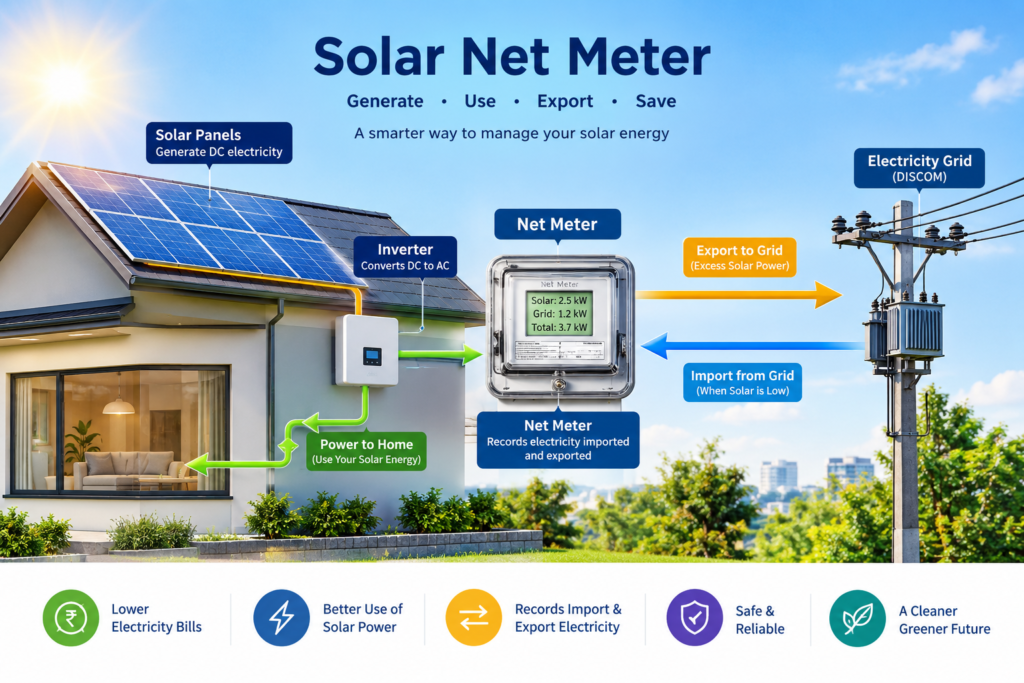
Table of Contents
A solar net meter is a special electricity meter used with a grid-connected rooftop solar system. Unlike a normal electricity meter that mainly records the electricity you use, a solar net meter can record electricity flowing in both directions—from the grid to your home and from your solar system back to the grid.
In simple words, it keeps track of:
- Electricity you take from the grid
- Extra solar electricity you send to the grid
This is why a solar net meter is also commonly called a two-way meter or bidirectional meter.
How does a solar net meter work?
During the day, your solar panels generate electricity. Your home or business uses this electricity first. If your solar panels produce more electricity than you need at that time, the extra electricity can be sent to the grid, subject to the applicable rules.
When your solar panels are not producing enough electricity, such as at night, your property can take electricity from the grid.
The solar net meter records these electricity flows so they can be accounted for in the applicable billing arrangement.
Why is a solar net meter important?
A net meter makes it possible to properly account for the electricity your rooftop solar system sends to and receives from the grid. This can help reduce your electricity costs when your system is eligible for net metering.
The exact eligibility, approval process and metering rules depend on the applicable electricity regulations and distribution company. In Telangana, rooftop solar systems are currently governed by the Telangana Electricity Regulatory Commission’s Rooftop Solar PV Grid Interactive Systems Regulation, 2025.
How Does Solar Net Metering Work?
Solar net metering works by measuring the electricity your home or business receives from the grid and the extra electricity your solar panels send to the grid. A solar net meter records these two-way electricity flows, helping the electricity distribution company account for your solar generation and grid usage according to the applicable rules.
Here is a simple example of how solar net metering works:
1. Solar panels generate electricity
During the daytime, your rooftop solar panels use sunlight to generate electricity. Your home or business uses this solar power for appliances, lights, fans, computers and other electrical equipment.
2. Your property uses the solar power first
If your solar panels are producing enough electricity, the power generated by the system can be used directly by your property. This helps reduce the amount of electricity you need to take from the grid.
3. Extra solar power goes to the grid
Sometimes, your solar panels produce more electricity than your property is using. The extra electricity can flow back to the electricity grid through the approved grid-connected solar system.
The solar net meter records this exported electricity.
4. Electricity is taken from the grid when needed
Solar panels do not produce the same amount of electricity all the time. At night, for example, your solar panels do not generate power. When your property needs more electricity than the solar system is producing, electricity is taken from the grid.
The net meter records this imported electricity as well.
5. The meter records both directions
Think of the solar net meter like a two-way counter:
Grid → Home = Electricity imported
Solar/Home → Grid = Electricity exported
This is why a solar net meter is also commonly described as a bidirectional or two-way electricity meter.
Simple Solar Net Metering Example
Suppose your solar system generates 20 units of electricity during a particular period.
- Your home uses 15 units.
- 5 units are left over.
- The extra 5 units can be exported to the grid.
- The net meter records the electricity flowing in both directions.
Later, when your solar system is not producing enough electricity, your home can take power from the grid and the meter records that import as well.
The final electricity bill and settlement depend on the applicable net-metering rules, tariff and electricity distribution company. Telangana’s current rooftop-solar regulations provide for net metering along with other arrangements such as group net metering, gross metering and virtual net metering.
How Does a Net Meter Reduce Your Electricity Bill?
A solar net meter can help reduce your electricity bill by keeping track of the electricity your solar system sends to the grid and the electricity you take from the grid. The actual bill depends on your solar generation, electricity use, applicable tariff, metering arrangement and the rules of your electricity distribution company.
How does it reduce the bill?
The basic idea is simple:
Solar power generated → Your home uses it → Extra power goes to the grid → Net meter records the flow → Electricity is accounted for in your bill
For example, suppose your rooftop solar system generates 500 units of electricity during a billing period.
- Your home uses some of the solar electricity directly.
- If there is extra solar power, it may be exported to the grid under the applicable net-metering arrangement.
- When your home needs more electricity than the solar system is producing, you can draw electricity from the grid.
- The solar net meter records the electricity imported from and exported to the grid.
The final bill is then prepared according to the applicable billing and net-metering rules.
Does net metering mean a zero electricity bill?
Not always. Installing solar and a net meter does not automatically mean that your electricity bill will become zero. Your final bill can still depend on applicable fixed charges, tariffs, taxes or other charges and the rules that apply to your connection.
This is important because solar savings are different for every home and business.
Why is net metering useful for solar?
Without a suitable grid-metering arrangement, the extra electricity produced by an on-grid solar system may not be accounted for in the same way. Net metering provides a way to measure two-way electricity flow between the property and the grid.
In Telangana, the current TSERC Rooftop Solar PV Grid Interactive Systems Regulation, 2025 provides the regulatory framework for rooftop solar and includes net metering among its permitted metering arrangements.
Solar Net Meter Example: How Is Electricity Calculated?
A simple example makes solar net metering much easier to understand. The amount of electricity your solar panels generate will change from day to day, so the actual import, export and final bill will depend on your system, electricity use and applicable rules.
Example of solar net metering
Suppose you have a 5 kW rooftop solar system and, during a billing period:
- Your solar panels generate 600 units
- Your home uses 500 units
- Some of the solar electricity is used directly by your home
- The remaining electricity can be exported to the grid when generation is higher than your home’s demand
The solar net meter records electricity moving between your property and the grid.
For example:
Solar electricity generated → Home uses electricity → Extra electricity → Grid
And when solar power is not enough:
Grid → Home
What does the net meter record?
A solar net meter keeps track of two main electricity flows:
| Electricity flow | Meaning |
|---|---|
| Import | Electricity taken from the grid |
| Export | Excess electricity sent to the grid |
This information is used for electricity accounting under the applicable metering arrangement.
Does 600 units of solar generation mean a 100-unit bill?
No. You cannot simply subtract total solar generation from total household consumption because some solar electricity may be used directly at the time it is generated, while other electricity may be imported or exported at different times.
The actual billing calculation depends on the applicable net-metering rules, tariff, billing period and consumer category. Telangana’s 2025 rooftop-solar regulations specify how net electricity consumption and other applicable charges are handled.
Solar Net Meter vs Normal Electricity Meter
A solar net meter and a normal electricity meter both measure electricity, but they are used differently. The main difference is that a solar net meter can record electricity flowing in both directions—electricity coming from the grid and excess solar electricity going back to the grid. Official rooftop-solar guidance describes a bidirectional/net meter as a meter that records both consumed power and power fed into the grid.
Simple comparison
| Feature | Normal Electricity Meter | Solar Net Meter |
|---|---|---|
| Records electricity used from the grid | Yes | Yes |
| Records electricity sent to the grid | Generally no | Yes |
| Measures two-way electricity flow | No | Yes |
| Used with grid-connected rooftop solar | Not designed for this purpose | Yes |
| Records import and export separately | No | Yes |
| Helps with solar net-metering billing | No | Yes |
How does a normal electricity meter work?
A normal electricity meter mainly records the electricity your home or business takes from the electricity grid.
For example, if your home uses 300 units from the grid during a billing period, the meter records that consumption for billing.
How does a solar net meter work?
A solar net meter can record both:
Grid → Home = Imported electricity
Home/Solar → Grid = Exported electricity
This is important for an on-grid solar system because your solar panels may produce more electricity than your home needs at certain times. The extra electricity can flow to the grid, and the meter records that export according to the applicable rules.
Why do you need a net meter for rooftop solar?
When you install a grid-connected solar system, electricity can move between your property and the grid. A suitable bidirectional meter allows these flows to be measured and accounted for.
However, the exact meter type, installation process and billing arrangement depend on the applicable DISCOM and state regulations. Therefore, homeowners should check the current requirements before installing or changing a meter.
What Is a Bidirectional Meter for Solar?
A bidirectional meter is an electricity meter that can measure power flowing in two directions. In a rooftop solar system, it records the electricity your home or business takes from the grid and the extra electricity your solar system sends to the grid. Telangana’s rooftop-solar regulations define a net meter as a meter capable of recording both import and export of electricity.
How does a bidirectional solar meter work?
Think of it as a two-way counter:
Grid → Your Home
When your solar system is not producing enough electricity, you take power from the grid. This is called import.
Your Solar System → Grid
When your solar panels produce more electricity than your property needs, the extra power can flow to the grid under the applicable rules. This is called export.
The meter records both flows so the electricity distribution company can account for them under the applicable billing arrangement.
Is a bidirectional meter the same as a solar net meter?
In many rooftop solar applications, yes, the terms are closely related. A solar net meter is designed to measure electricity imported from and exported to the grid. However, the exact metering arrangement can vary depending on the system and applicable regulations.
For example, official solar-system guidance describes a bi-directional grid interface meter as recording important values such as imported energy and exported energy.
Why is it important for rooftop solar?
A bidirectional meter is important because a grid-connected solar system can both consume electricity from the grid and send surplus electricity to the grid.
How to Read a Solar Net Meter
A solar net meter reading helps you understand how much electricity your home has taken from the grid and how much excess solar electricity has been sent back to the grid. A typical bidirectional meter records import and export energy, usually in kWh (units).
1. Import Reading
Import means the electricity your home or business has taken from the grid.
For example, at night, your solar panels are not producing electricity. Your appliances may then use electricity from the grid. The net meter records this electricity as import.
You may see labels such as:
- IMP
- Import
- kWh Import
2. Export Reading
Export means the extra electricity from your solar system that flows back to the grid.
For example, if your solar panels are producing more electricity than your home is using during the day, the extra power can be exported to the grid under the applicable rules.
You may see labels such as:
- EXP
- Export
- kWh Export
3. Check the Meter Display
Most digital solar net meters automatically show different readings on the display. Some meters may also have a button that lets you move between readings. The exact display codes can differ by meter manufacturer.
Simple Example
Suppose your meter shows:
Import: 150 kWh
Export: 100 kWh
This means your property has taken 150 units from the grid and sent 100 units to the grid during the relevant period.
However, don’t assume that your final electricity bill will always be calculated simply as 150 − 100 = 50 units. The actual billing and credit treatment depends on the applicable state and DISCOM rules.
For example, the Andhra Pradesh Eastern Power Distribution Company Limited explains that its net meter records only the electricity exchanged with the grid, while the solar inverter records total solar generation. This is an important difference when checking your solar readings.
How to Apply for a Solar Net Meter?
To apply for a solar net meter, you generally need to submit a rooftop solar or net-metering application to the concerned electricity distribution company (DISCOM), provide the required consumer and solar-system details, complete the approval and inspection process, and then get the approved meter arrangement installed. The exact process can vary depending on your state, DISCOM, consumer category and solar-system capacity.
For consumers in Telangana, the current rooftop-solar regulations include a specific application for net metering connection. The application asks for details such as the consumer’s service connection number, tariff category, sanctioned load, average monthly electricity consumption, proposed solar-system capacity and other system-related information.
Step-by-step solar net meter application process
1. Check your electricity connection
First, check your existing electricity connection, including your service connection number, tariff category and sanctioned load. These details are normally available on your electricity bill.
2. Decide the solar system capacity
Choose the suitable rooftop solar system capacity based on your electricity consumption, available roof space and applicable rules.
The proposed solar capacity is one of the details included in Telangana’s net-metering application.
3. Submit the net-metering application
Apply through the applicable DISCOM process and provide the required information and documents.
For Telangana, the prescribed application includes consumer details, site details, electricity connection information, bank details, solar-system capacity and technical information.
4. Get the application reviewed
The electricity distribution company checks the application and the proposed rooftop solar connection against the applicable technical and regulatory requirements.
5. Install the approved solar system
After the required approval/process, the rooftop solar system can be installed according to the applicable technical requirements.
6. Complete inspection and commissioning
The required inspection, testing and commissioning steps need to be completed before the system starts operating under the approved grid-connected arrangement.
7. Install or replace the meter
Once the required process is completed, the applicable solar net meter/bidirectional meter arrangement is installed or updated.
What documents may be required?
Requirements can vary, but the Telangana net-metering application includes information such as:
- Applicant details
- Address of the installation site
- Electricity service connection number
- Electricity tariff category
- Sanctioned load or contract demand
- Average monthly electricity consumption
- Proposed solar-system capacity
- System-integrator details, where applicable
- Technical and test-certificate details
Important: Do not assume that the same documents, charges or procedure apply to every consumer. Always check the latest requirements of the concerned DISCOM before applying.
How Natural Power can help
If you are planning rooftop solar in, a professional solar installer can help you understand the suitable system size, application requirements, installation process and net-metering procedure.
Solar Net Meter Requirements
The solar net meter requirements depend on your electricity connection, solar system capacity, location and the rules of your electricity distribution company. In simple terms, you need an eligible electricity connection, an approved grid-connected rooftop solar system and the required approvals before the net-metering arrangement can be activated.
For Telangana, the current rooftop-solar regulations allow eligible consumers, except temporary-supply consumers, to use net metering for rooftop solar systems up to 500 kWp, subject to the applicable conditions. The regulations also require the solar system to meet the relevant technical and safety standards.
Basic requirements for solar net metering
Before applying for a solar net meter, you generally need:
- A valid electricity connection
- An eligible consumer category
- A suitable rooftop solar system
- Required sanctioned load/capacity as applicable
- A grid-connected solar inverter and other approved equipment
- A net-metering application
- Required consumer and system documents
- Technical approval from the concerned DISCOM
- Inspection and testing, where required
- Compliance with applicable electrical safety and grid-connection standards
Solar system capacity matters
The size of your solar system is an important part of the net-metering process. In Telangana, the current regulations specify a minimum rooftop solar size of 1 kWp for net metering, while the general net-metering limit for eligible consumers is up to 500 kWp, subject to the regulation’s conditions.
This does not mean every home can automatically install a 500 kWp system. The suitable capacity depends on factors such as your electricity connection, consumption, sanctioned load, available roof space and applicable technical requirements.
Technical and safety requirements
A grid-connected solar system must also follow the applicable electricity and safety standards. Telangana’s regulations refer to Central Electricity Authority requirements for grid connectivity and electrical safety.
This is important because a solar net meter is not simply a replacement for your existing electricity meter. The solar system, inverter, wiring, protection equipment and grid connection must all be suitable for safe operation.
Are the requirements the same for everyone?
No. Requirements can vary based on:
- Residential or commercial connection
- Electricity tariff category
- Solar system capacity
- Existing sanctioned load
- DISCOM
- Type of metering arrangement
- Current regulations
Therefore, it is better to check the latest DISCOM requirements before applying.
Solar Net Meter Cost
The solar net meter cost is not the same for every consumer. The total amount can depend on the electricity distribution company, consumer category, solar system size, meter arrangement, application charges, installation requirements and other applicable charges.
For this reason, it is better not to quote one fixed net meter price unless the current charges published by the concerned DISCOM are confirmed.
What can be included in solar net meter charges?
Depending on the applicable process, you may have costs related to:
- Net-metering application
- Meter charges
- Installation or replacement of the meter
- Testing or inspection
- Applicable taxes
- CT/PT equipment, where required
- Other DISCOM-approved charges
The Telangana Southern Power Distribution Company Limited (TGSPDCL), for example, states that the existing energy meter is replaced with a bi-directional meter for net metering. It also provides separate information about solar net-metering applications and requirements.
Does the customer pay for the net meter?
The answer can depend on the applicable rules and the type of connection. Some costs may be paid by the consumer, while the DISCOM may provide or install the meter under its approved procedure.
Older Telangana net-metering guidelines included specific provisions regarding meter installation and associated equipment, but consumers should always check the latest DISCOM charges and procedure rather than relying on an old price list.
How can you find the current solar net meter cost?
If you are installing rooftop solar in Telangana, check the latest information from your concerned DISCOM before making payment. TGREDCO currently provides links for solar net-meter registration and related rooftop-solar services, while TGNPDCL also publishes its current solar net-metering application resources.
Does the net meter cost include the solar system?
No. The cost of a solar net meter or its related charges should not be confused with the total rooftop solar installation cost.
Your complete solar project may include:
Solar panels + inverter + mounting structure + cables + protection equipment + installation + approvals/metering + other applicable charges
The final cost depends on the size and type of solar system you choose.
Solar Net Meter Rules in Telangana
The solar net meter rules in Telangana are set by the state’s electricity regulations and the concerned electricity distribution company (DISCOM). These rules explain who can use net metering, what solar system capacity is allowed, how the application and approval process works, and how electricity exported to the grid is accounted for.
Under Telangana’s Rooftop Solar PV Grid Interactive Systems Regulation, 2025, eligible consumers other than temporary-supply consumers can use net metering for rooftop solar systems up to 500 kWp, subject to the conditions in the regulation. The regulation also covers other arrangements such as gross metering, group net metering and virtual net metering.
Who can use solar net metering in Telangana?
Net metering is available to eligible electricity consumers who meet the requirements under the applicable regulations.
The consumer must have an eligible electricity connection and install a rooftop solar system that meets the required technical and safety standards.
The exact eligibility can depend on factors such as:
- Consumer category
- Electricity connection
- Sanctioned load
- Solar system capacity
- DISCOM requirements
- Technical feasibility
- Applicable regulations
What is the net-metering capacity limit?
Under the current Telangana rooftop-solar regulation, the general net-metering limit for eligible consumers is up to 500 kWp, subject to the conditions specified in the regulation. The regulation also specifies a minimum rooftop solar capacity of 1 kWp for net-metering systems.
This does not mean every consumer can automatically install any capacity up to 500 kWp. The approved capacity can depend on the consumer’s connection, sanctioned load, technical requirements and other applicable conditions.
What happens after applying?
After submitting the application, the concerned DISCOM reviews the proposed rooftop solar system and checks whether it meets the applicable requirements.
Depending on the case, the process may include:
Application → Technical review → Approval → Solar installation → Inspection/testing → Metering arrangement → Commissioning
The exact steps and timelines can vary, so consumers should check the latest process with their concerned DISCOM.
Which DISCOM applies to you?
The applicable process depends on the area where your electricity connection is located. Telangana has different electricity distribution companies serving different areas.
For example, consumers in areas served by TGSPDCL and TGNPDCL may need to follow the process prescribed by their respective DISCOM.
Can the rules change?
Yes. Solar net-metering rules, charges, procedures and technical requirements can change because they are governed by regulations and DISCOM procedures.
Therefore, if you are planning to install rooftop solar, avoid depending on an old blog post or outdated price list. Always check the latest official information before submitting an application or making a payment.
Net Metering vs Gross Metering
Net metering and gross metering are two different ways of accounting for electricity generated by a rooftop solar system. Under net metering, the electricity you use and the electricity your solar system sends to the grid are accounted for through the applicable net-metering arrangement. Under gross metering, the solar generation is measured separately for the applicable export or purchase arrangement. Telangana’s current rooftop-solar regulation provides for both net metering and gross metering, along with group and virtual net-metering arrangements.
What is the difference between net metering and gross metering?
| Feature | Net Metering | Gross Metering |
|---|---|---|
| Solar electricity used by your property | Can be used by the property | Accounted for under the applicable arrangement |
| Excess solar electricity | Exported to the grid | Exported to the grid |
| Main focus | Accounting of electricity imported and exported | Accounting of solar electricity generated/exported |
| Electricity from the grid | Accounted separately | Accounted according to the applicable billing arrangement |
| Best understood as | Two-way electricity accounting | Solar generation/export accounting |
How does net metering work?
With solar net metering, your rooftop solar system can supply electricity to your home or business. When your solar generation is higher than your immediate requirement, the extra electricity can flow to the grid.
When your property needs more electricity than the solar system is producing, electricity can come from the grid.
The net meter records the electricity moving in both directions.
Solar → Home → Grid when there is excess
Grid → Home when solar power is not enough
The final billing treatment depends on the applicable regulations and tariff.
How does gross metering work?
With a gross metering arrangement, the electricity generated by the solar system is measured for the applicable export or purchase arrangement. The treatment of the electricity generated and the electricity consumed from the grid is different from a standard net-metering arrangement.
The exact payment, tariff and settlement rules depend on the applicable state regulations and DISCOM arrangement.
Which is better: net metering or gross metering?
There is no single option that is best for everyone. The suitable arrangement depends on your electricity consumption, solar generation, consumer category, system size and the current rules available for your connection.
For a homeowner mainly looking to use rooftop solar to reduce grid electricity consumption, net metering may be particularly relevant where the consumer is eligible. But the actual financial benefit should be checked using the current tariff and applicable regulations.
What applies in Telangana?
Telangana’s Rooftop Solar PV Grid Interactive Systems Regulation, 2025 recognizes net metering, gross metering, group net metering and virtual net metering arrangements. The eligibility and conditions differ by arrangement, so consumers should check the current regulation and their DISCOM’s process before choosing an arrangement.
Is Net Metering Available for Residential Solar in Telangana?
Yes. Eligible residential consumers in Telangana can use net metering for a grid-connected rooftop solar system, subject to the current Telangana regulations and the requirements of the concerned DISCOM. The Telangana Electricity Regulatory Commission’s 2025 rooftop-solar regulation provides for net metering for eligible consumers and sets capacity and other conditions for rooftop solar systems.
How does residential solar net metering work?
For a home with an approved on-grid solar system, the process is simple:
Solar panels generate electricity → Your home uses the solar power → Extra electricity can go to the grid → Net meter records the electricity flow
When your solar system is not producing enough electricity, your home can take electricity from the grid.
The solar net meter records both import and export, allowing the applicable billing system to account for the electricity exchanged with the grid.
Who can get net metering for a home?
Residential consumers need to meet the applicable eligibility and technical requirements. These can include:
- An eligible residential electricity connection
- An approved rooftop solar system
- Required sanctioned load
- Applicable technical and safety standards
- No disqualifying pending arrears under the current regulations
- Approval from the concerned electricity distribution company
The current Telangana regulation states that eligible consumers with pending arrears with the distribution licensee are not entitled to net metering and certain other rooftop-solar metering arrangements.
How much solar can a residential consumer install?
For residential consumers, Telangana’s current regulation allows rooftop solar capacity for net metering up to 100% of the consumer’s sanctioned load, subject to the applicable conditions.
For example, this does not mean that every house can install any solar capacity it wants. Your sanctioned load, electricity connection, roof space, solar system design and technical approval all matter.
Can a home get a lower electricity bill with net metering?
It can help reduce electricity costs by allowing the electricity generated by your rooftop solar system to be used by your home and, where permitted, excess electricity to be exported to the grid.
However, net metering does not guarantee a zero electricity bill. Your final bill can depend on your electricity consumption, solar generation, tariff, fixed charges and other applicable charges.
What should homeowners check before installing solar?
Before installing a rooftop solar system, check:
- Your monthly electricity consumption.
- Your sanctioned load.
- Available rooftop space.
- Suitable solar system capacity.
- Current net-metering eligibility.
- Applicable DISCOM procedure and charges.
- Current Telangana solar regulations.
Because electricity rules can change, homeowners should use the latest official information rather than relying on an old net-metering article.
Is Net Metering Available for Commercial Solar?
Yes. Eligible commercial consumers in Telangana can use net metering for grid-connected rooftop solar, subject to the current Telangana regulations and the requirements of the concerned DISCOM. The 2025 Telangana rooftop-solar regulation allows eligible consumers of different categories, except temporary-supply consumers, to install rooftop solar under the net-metering arrangement up to 500 kWp, subject to the applicable conditions.
How does commercial solar net metering work?
The basic process is similar to residential solar.
During the day, the commercial solar system generates electricity. The business can use the solar power for its own needs. If the solar system produces more electricity than the business is using at that time, the excess power can be exported to the grid under the approved metering arrangement.
When solar generation is not enough, the business can take electricity from the grid.
The solar net meter records electricity imported from and exported to the grid, allowing the applicable billing system to account for the electricity exchanged.
Which businesses can consider net metering?
Depending on eligibility and the applicable DISCOM rules, rooftop solar with net metering can be considered for businesses such as:
- Offices
- Shops and showrooms
- Schools and institutions
- Hospitals and other eligible facilities
- Warehouses
- Commercial buildings
- Small and medium businesses
- Other eligible electricity consumers
However, eligibility should be checked based on the actual electricity connection and current regulations rather than assuming that every commercial connection qualifies.
Why is net metering useful for businesses?
Commercial buildings often use a significant amount of electricity during the daytime, when solar panels are producing power. Using solar electricity directly can reduce the amount of electricity the business needs to take from the grid.
If there is surplus solar generation, the applicable net-metering arrangement can allow the excess electricity to be exported to the grid and recorded by the meter.
This can make rooftop solar and solar net metering useful for businesses looking to manage their long-term electricity costs.
Is there a capacity limit?
Under Telangana’s current 2025 regulation, eligible consumers of all categories except temporary-supply consumers can install rooftop solar under net metering up to 500 kWp, subject to the regulation’s conditions. The minimum rooftop solar size under the net-metering arrangement is 1 kWp.
The actual system size suitable for a business depends on factors such as:
- Electricity consumption
- Sanctioned load
- Available roof space
- Solar generation potential
- Technical feasibility
- Applicable DISCOM requirements
Net metering for commercial solar: an important point
Businesses should not choose a solar capacity only because a particular capacity is allowed by regulation. The right system should be planned around the business’s actual electricity consumption and load pattern.
For example, a business that uses most of its electricity during the daytime may be able to use a large portion of its solar generation directly. A business with different operating hours may have a different solar and metering requirement.
Can Solar Work Without a Net Meter?
Yes, a solar system can work without a net meter, but how it works depends on the type of solar system you install. An on-grid solar system normally needs an approved metering arrangement when it is connected to the electricity grid and you want to export surplus solar power. An off-grid solar system can work without a net meter because it uses batteries instead of sending excess electricity to the grid.
On-Grid Solar Without a Net Meter
An on-grid solar system is connected to the electricity grid. During the day, your solar panels produce electricity and your home or business uses that power first.
If the system produces more electricity than you are using, the extra power may be exported to the grid under the approved metering arrangement.
Without the required meter and DISCOM approval, you should not simply connect a rooftop solar system to the grid and start exporting electricity. The connection must follow the applicable technical and regulatory requirements.
In Telangana, the current 2025 rooftop solar regulation provides rules for net metering, gross metering, group net metering and virtual net metering.
Off-Grid Solar Without a Net Meter
An off-grid solar system can operate without a net meter because it is not designed to export electricity to the grid.
A typical off-grid system includes:
- Solar panels
- Solar inverter
- Battery storage
- Required protection and electrical equipment
The solar panels generate electricity, and the battery stores unused solar power for later use. This type of system can be useful where grid electricity is unavailable or where battery backup is a major requirement.
What About a Hybrid Solar System?
A hybrid solar system can also operate without exporting solar electricity to the grid, depending on how it is designed and connected.
It can use solar power, battery storage and grid electricity together. The exact setup depends on the inverter, battery system and electrical connection.
Should You Install Solar Without a Net Meter?
If you are planning an on-grid rooftop solar system and want to send surplus electricity to the grid, do not treat the net meter as optional. The required approval, metering arrangement and connection process should be completed through the concerned electricity distribution company.
If your goal is to use solar power independently with battery storage, an off-grid or suitable hybrid system may work without net metering.
What Are the Advantages of Solar Net Metering?
Solar net metering helps eligible rooftop solar users make better use of the electricity their solar panels generate. You can use solar power in your home or business, and when your system produces more electricity than you are using, the approved metering arrangement can record electricity exported to the grid. This can help reduce the amount of electricity you need to purchase from the grid.
1. Helps Reduce Electricity Bills
One of the main reasons people choose solar net metering is to reduce their electricity costs.
Your solar panels generate electricity during the day. You can use that electricity directly instead of taking the same amount from the grid. Depending on your consumption, solar system size, tariff and applicable billing rules, this can reduce your electricity bill.
2. Allows Surplus Solar Power to Be Exported
Sometimes your solar panels may generate more electricity than your home or business is using.
With an approved grid-connected solar system, surplus electricity can be exported to the electricity grid and recorded through the applicable meter.
This means the solar energy you do not use immediately does not simply go unused.
3. Makes Rooftop Solar More Useful
Without an appropriate grid-metering arrangement, the benefit of surplus solar generation can be limited for an on-grid system.
Solar net metering connects your rooftop solar system with the electricity billing system, allowing electricity imported from and exported to the grid to be measured according to the applicable rules.
4. Useful for Homes and Businesses
Net metering can be useful for both residential and eligible commercial consumers.
For a home, solar generation can help reduce electricity purchased from the grid.
For a business, daytime solar generation can be especially useful because many offices, shops and commercial buildings consume electricity while solar panels are producing power.
5. Reduces Dependence on Grid Electricity
Generating some of your electricity through rooftop solar can reduce your dependence on electricity purchased from the grid.
The actual reduction depends on factors such as your electricity consumption, solar system capacity, roof conditions, weather, tariff and the applicable net-metering rules.
6. Helps Use Solar Energy More Efficiently
A properly designed rooftop solar system can generate electricity when sunlight is available. Net metering provides a way to account for electricity flowing between the solar consumer and the grid.
However, net metering does not guarantee a zero electricity bill. Fixed charges, applicable taxes, demand charges and other billing components may still apply depending on the consumer category and current tariff rules.
7. Telangana Has a Defined Rooftop Solar Framework
Telangana currently has the Telangana Electricity Regulatory Commission (Rooftop Solar PV Grid Interactive Systems) Regulation, 2025, which covers arrangements including net metering, group net metering, gross metering and virtual net metering. The regulation applies across Telangana and sets conditions for connecting eligible rooftop solar systems to the distribution network.
What Are the Limitations of Solar Net Metering?
Solar net metering can help reduce electricity costs, but it does not mean that every solar user will have a zero electricity bill. Your actual savings depend on your solar system size, electricity consumption, sanctioned load, tariff, exported electricity and the rules applicable to your connection.
1. Approval Is Required
An on-grid solar system cannot simply be connected to the electricity grid without following the required process.
The concerned distribution licensee must approve the connection and the applicable metering arrangement. Telangana’s current rooftop solar regulation also requires the system to meet applicable technical and safety requirements.
2. Solar System Size Has Limits
You cannot always install a solar system of any size you want.
Under Telangana’s 2025 rooftop solar regulation, the maximum rooftop solar capacity for industrial, commercial and other consumers under net metering is up to 80% of the sanctioned load or contracted demand, subject to the other conditions in the regulation.
This means your electricity connection and load should be checked before deciding the solar capacity.
3. Pending Electricity Arrears Can Affect Eligibility
Consumers with pending arrears with the distribution licensee are not entitled to net metering, group net metering, gross metering or virtual net metering under the current Telangana regulation.
Therefore, it is important to check your electricity account before starting the solar net-meter application process.
4. A Net Meter Does Not Guarantee a Zero Bill
This is one of the most important points to understand.
Even after installing solar panels and a net meter, you should not assume that your electricity bill will always become zero.
The final bill can depend on the applicable tariff, fixed charges, demand-related charges, taxes and other billing components. The treatment of imported and exported electricity also follows the applicable regulatory framework.
5. Solar Generation Changes With Weather
Solar panels produce electricity mainly when sunlight is available.
Generation can change because of:
- Clouds and rain
- Shade
- Dust on panels
- Panel orientation
- Roof conditions
- Seasonal changes
- System performance
So, the amount of electricity exported to the grid will not be exactly the same every month.
6. The Metering Process Takes Time
Installing rooftop solar involves more than putting panels on the roof.
Depending on the project, the process can include application, technical evaluation, approval, installation, testing, meter-related work and completion of the required connection formalities.
The current TGNPDCL portal provides separate resources for the net-metering application, application fee details, connection agreement and the final 2025 rooftop solar regulation.
7. Rules and Charges Can Change
Solar net-metering rules, tariffs, application procedures and charges can be updated by the relevant authorities.
For this reason, readers should check the latest information from the concerned DISCOM and Telangana Electricity Regulatory Commission before making a final decision.
Is Solar Net Metering Still Worth It?
For many eligible rooftop solar users, net metering can be useful because it allows electricity exchanged with the grid to be measured under the applicable rules.
But the right solar system should be designed based on actual electricity usage, sanctioned load, roof space and the current regulatory requirements rather than choosing a system only because a particular capacity is permitted.
READY TO GO SOLAR?
Frequently Asked Questions About Solar Net Meter
What is a solar net meter?
How does a solar net meter work?
Is a net meter necessary for rooftop solar?
Can a solar net meter reduce my electricity bill?
What is a bidirectional meter?
Can residential consumers get solar net metering in Telangana?
Can commercial consumers get solar net metering in Telangana?
How do I apply for a solar net meter?
What documents are required for a solar net meter?
How much does a solar net meter cost?
For an accurate current amount, check the latest fee information issued by the concerned DISCOM rather than relying on an old online figure.
How long does solar net meter installation take?
Can I install solar without a net meter?
Is net metering the same as gross metering?
Telangana's current rooftop solar regulation separately defines net metering, gross metering, group net metering and virtual net metering arrangements.
Can net metering make my electricity bill zero?
Is solar net metering available everywhere in India?
Therefore, always check the latest rules applicable to your state and electricity connection before installing a solar system.
What is the main benefit of a solar net meter?
What Is a Solar Inverter? How It Works, Types, Benefits & How to Choose
- August 31, 2026