
Off Grid Solar System for Home
An off grid solar system is a solar power system that can generate and store electricity without depending on the main electricity grid. It uses solar panels to produce electricity during the day and batteries to store extra energy for use when sunlight is not available. A typical off-grid solar system includes solar panels, a solar battery, an off-grid inverter, a charge controller, mounting structures, cables, and safety equipment.
Off grid solar systems are useful for homes, farmhouses, rural properties, agricultural sites, and other locations where grid power is unavailable or unreliable. They can also provide power during grid outages because the system has its own battery storage.
The right system size depends on your daily electricity use, the appliances you need to run, backup requirements, available sunlight, and battery capacity. In this guide, you will learn how an off-grid solar system works, its main components, cost, sizing, battery options, benefits, limitations, and installation process.
- MNRE approved
- Quality products and warranty
- Expert installation team
- After sales support
What Is an Off-Grid Solar System?
An off-grid solar system is a standalone solar power system that produces and stores electricity without relying on the main electricity grid. It is designed to supply power to a home, farm, business, or other location using solar energy and battery storage.
Unlike an on-grid solar system, an off-grid system is not connected to the electricity grid for its normal power supply. Solar panels generate electricity during the day, while the battery stores energy for use at night or when sunlight is low.
An off-grid solar system is especially useful in places where grid electricity is not available, is unreliable, or where independent power is required.
How Is an Off-Grid Solar System Different?
The main difference is energy storage. An on-grid solar system can use electricity from the grid when solar generation is not enough. An off-grid system cannot depend on the grid, so it needs enough battery storage and solar capacity to meet the required electricity demand.
The system must therefore be properly sized based on:
- Daily electricity consumption
- Appliances and equipment being used
- Peak power requirement
- Required backup time
- Available sunlight
- Solar panel capacity
- Battery capacity
This makes proper system design important when choosing an off grid solar system for home or other applications. A system that is too small may not provide enough power, while an unnecessarily large system can increase the initial cost.
How Does an Off-Grid Solar System Work?
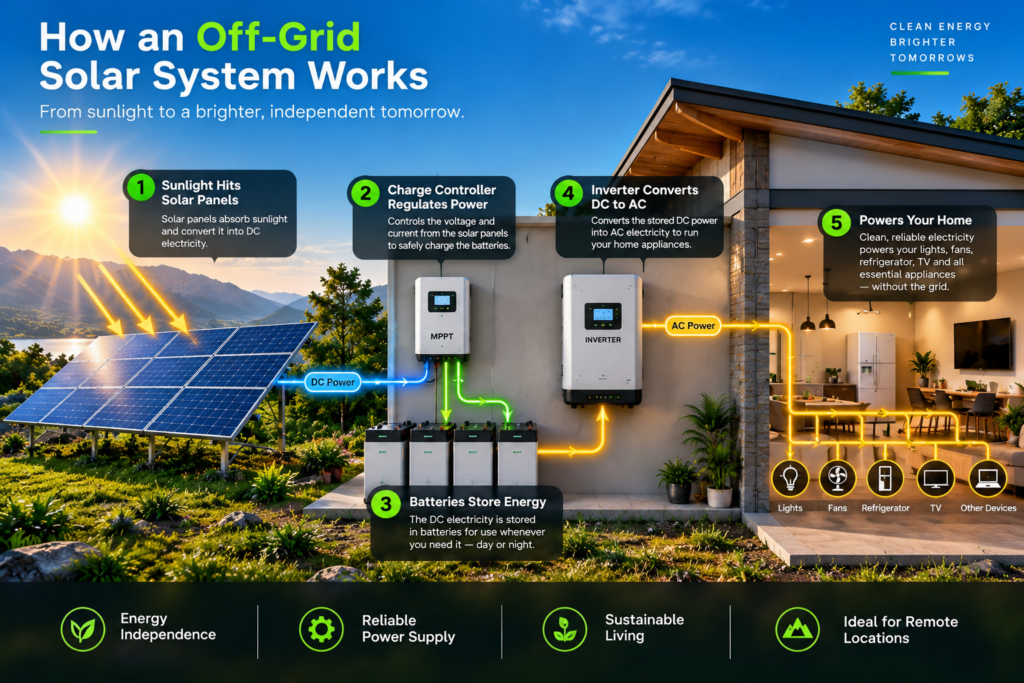
An off grid solar system works by converting sunlight into electricity, storing the energy in batteries, and supplying power to your appliances when you need it. Because the system does not depend on the main electricity grid, its solar panels and battery must be properly sized for the required electricity use.
The basic working process is:
Sunlight → Solar Panels → Charge Controller → Battery → Inverter → Appliances
During the Day
Solar panels receive sunlight and generate DC electricity. The charge controller manages this electricity and safely sends it to the battery for charging. At the same time, the system can supply electricity to appliances through the inverter.
When the Battery Is Charging
If the solar panels produce more electricity than the appliances are using, the extra energy can be stored in the battery. This stored power can later be used when solar generation is low or unavailable.
At Night
Solar panels cannot generate electricity without sunlight. The battery supplies the stored energy to the inverter. The inverter converts the battery’s DC electricity into AC electricity that can be used by normal household appliances.
During a Power Outage
Since an off-grid solar system does not rely on the main electricity grid, it can continue supplying power from its solar panels and battery, provided sufficient stored energy and solar generation are available.
What Happens on Cloudy or Rainy Days?
Solar panels can still generate electricity during daylight when the weather is cloudy, but generation may be lower than on a bright sunny day. The battery helps provide power when solar generation is not enough.
This is why solar panel capacity, battery capacity, inverter size, and daily electricity consumption should all be considered together when designing an off-grid solar power system.
Components of an Off-Grid Solar System
An off grid solar system has several important components. Each part has a specific job, from generating solar electricity to storing energy and supplying safe power to your appliances. Choosing the right components is important for reliable performance and long-term use.
Component | What it does |
Solar panels | Solar panels are the main source of energy. They capture sunlight and convert it into DC electricity. The number and capacity of panels required depend on your daily electricity use, available sunlight, and the amount of energy the system needs to generate. |
Solar Charge Controller | The charge controller manages the electricity flowing from the solar panels to the battery. It helps charge the battery safely and protects it from overcharging. MPPT and PWM are two common types of solar charge controllers. MPPT controllers can make better use of the available solar power in many system designs. |
Solar Battery | The battery stores electricity generated by the solar panels. This stored energy can be used at night, during cloudy weather, or when solar generation is not enough to meet the load. Battery capacity is an important part of an off grid solar system with battery because it affects how long your appliances can run without solar generation. |
Off-Grid Solar Inverter | The solar panels and batteries produce DC electricity, while most household appliances use AC electricity. The off-grid solar inverter converts DC electricity into AC electricity so that appliances can use it. The inverter should be selected according to the home’s power demand, including appliances that may require extra power when they start. |
Mounting Structure | The mounting structure securely holds the solar panels in place. It should be suitable for the roof or ground where the panels are installed and positioned to receive good sunlight. |
Cables and Electrical Protection | Solar cables carry electricity between the different parts of the system. Protection equipment such as DCDB, ACDB, fuses, isolators, and surge protection devices can help protect the system from electrical faults and surges. |
Earthing and Lightning Protection | Proper earthing is an important safety measure. Depending on the system and site requirements, suitable lightning protection may also be installed to help protect people and equipment. |
Monitoring System | A monitoring system can help you check important information such as solar generation, battery status, power consumption, and system performance. This makes it easier to identify unusual performance or potential problems. |
How to Size an Off-Grid Solar System
Choosing the right size is one of the most important steps when installing an off grid solar system. The system should generate enough electricity for your daily needs and store enough energy to provide the required backup. Simply choosing a larger number of solar panels does not always mean the system will meet your needs.
The system size is mainly based on electricity consumption, peak load, sunlight, battery capacity, and required backup time.
Step 1: Calculate Your Daily Electricity Consumption
First, make a list of the appliances you want to run and how many hours you use them each day.
For example:
| Appliance | Power | Daily Use |
|---|---|---|
| LED lights | 10W each | 5 hours |
| Ceiling fan | 70W | 8 hours |
| TV | 100W | 4 hours |
| Refrigerator | 200W | 8 hours* |
*Actual refrigerator energy use varies because its compressor does not run continuously.
A simple calculation is:
Power (W) × Usage (hours) ÷ 1,000 = Energy used (kWh)
Adding the energy used by your appliances gives an estimate of your daily electricity requirement.
Step 2: Calculate the Peak Load
Daily energy use tells you how much electricity you consume, but you also need to know how much power your appliances may use at the same time.
For example, an air conditioner, refrigerator, water pump, or other motor-based appliance may need extra power when starting.
The inverter should have enough capacity to handle the expected running load and the required starting or surge power.
Step 3: Determine the Battery Capacity
The battery needs to store enough energy for the period when your solar panels cannot produce enough electricity.
Battery sizing depends on:
- Daily energy requirement
- Required backup hours
- Battery type
- Usable battery capacity
- Depth of discharge
- Battery efficiency
For example, a home that needs several hours of backup will generally require more battery storage than a home that only needs a few hours.
Step 4: Calculate the Solar Panel Capacity
The solar panels must generate enough electricity to meet the daily load and recharge the battery.
The calculation depends on:
- Daily energy requirement
- Available sunlight
- Solar panel capacity
- System losses
- Battery charging needs
Actual solar generation can change with weather, shading, panel orientation, temperature, and other site conditions.
Step 5: Select the Right Inverter
The inverter should be selected based on the appliances you plan to operate. It needs to handle the normal power demand and, where required, the higher starting power of certain appliances.
Why Professional Sizing Matters
An off grid solar system for home should be designed around your actual electricity usage rather than choosing a system size based only on the number of rooms or the size of the house.
A properly designed system balances solar panels, battery storage, and inverter capacity so that you get reliable power without paying for unnecessary capacity.
Off-Grid Solar System Price in India
The off grid solar system price in India depends on the size of the solar system, battery capacity, inverter, type of solar panels, installation requirements, and the amount of backup you need. Unlike an on-grid system, an off-grid system requires battery storage, which can make the overall investment higher.
There is no single price that applies to every home or property. The correct cost should be calculated after understanding your electricity consumption and backup requirements.
What Determines the Cost of an Off-Grid Solar System?
The main factors include:
- Solar panel capacity: More solar generation usually requires more panels.
- Battery capacity: A larger battery provides more stored energy and can increase the system cost.
- Inverter capacity: The inverter must be suitable for your appliances and power demand.
- Battery type: Lithium and lead-acid batteries have different prices, performance, and expected service life.
- Mounting structure: Roof type, ground installation, and site conditions can affect the structure cost.
- Electrical protection: Cables, ACDB, DCDB, earthing, isolators, and other safety equipment are part of a properly designed system.
- Installation: Labour, transportation, site conditions, and installation complexity can affect the final price.
- Backup requirement: A system designed to provide longer backup generally needs greater battery storage.
1kW, 2kW, 3kW and 5kW Off-Grid Systems
Different system sizes are suitable for different electricity requirements. A smaller system may be suitable for basic loads such as lights, fans, a TV, and selected appliances, while a larger system may be required for a home with higher consumption.
For example, a 5kW off-grid solar system may require substantially more battery storage than a 5kW system designed only for short backup periods. Therefore, comparing systems only by their solar panel capacity can give a misleading idea of the actual cost.
What Should Be Included in an Off-Grid Solar Quotation?
Before choosing an installer, check whether the quotation clearly covers:
- Solar panels
- Off-grid inverter
- Solar battery
- Charge controller, if required separately
- Mounting structure
- Solar cables
- AC and DC protection
- Earthing and safety equipment
- Installation
- Testing and commissioning
- Warranty details
- After-sales support
A low initial price does not always mean better value. Compare the equipment specifications, battery capacity, warranties, installation quality, safety equipment, and expected system performance before making a decision.
For a home off-grid solar system, the best approach is to calculate your actual electricity requirement first and then select the solar panels, inverter, and battery capacity accordingly.
Off-Grid Solar System With Battery
An off grid solar system with battery stores solar electricity so it can be used when the solar panels are not producing enough power. This is what allows an off-grid system to provide electricity at night and during periods of low sunlight without depending on the main electricity grid.
During the day, solar panels generate electricity. Some of this electricity can power appliances directly, while the remaining available energy can be used to charge the battery. When solar generation is low or unavailable, the battery supplies stored energy through the inverter.
Why Does an Off-Grid Solar System Need a Battery?
An off-grid system cannot depend on the electricity grid when solar generation is unavailable. Therefore, battery storage is normally an essential part of the system.
The battery can provide stored energy:
- At night
- During cloudy periods
- During early morning and evening
- When electricity consumption is higher than solar generation
- During periods when the solar panels cannot meet the required load
How Much Battery Storage Do You Need?
The required battery capacity depends on how much electricity you use and how much backup you want.
For example, a home that needs only essential loads for a few hours will have a different battery requirement from a home that wants to operate several appliances throughout the night.
Battery sizing should consider:
- Daily electricity consumption
- Required backup duration
- Battery type
- Usable battery capacity
- Depth of discharge
- Battery efficiency
- Expected future electricity use
Common Battery Types for Off-Grid Solar
The two broad battery choices commonly considered for solar systems are:
Lithium batteries: These generally offer higher usable capacity, longer cycle life, and lower maintenance, but usually have a higher upfront cost.
Lead-acid batteries: These generally have a lower initial cost and are available in several types, but their usable capacity, cycle life, maintenance needs, and overall performance differ from lithium batteries.
The right battery should be selected based on the system’s load, backup requirement, budget, available space, and expected usage rather than choosing a battery only because it has a lower purchase price.
Battery Backup Is Not Unlimited
A battery can provide power only for the amount of energy stored in it. If electricity consumption is high or there are several days of low solar generation, the stored energy can be used faster than it is replaced.
That is why a good off grid solar system design considers both solar generation and battery storage. The goal is to create a system that can meet your expected electricity needs while keeping the system practical and cost-effective.
Off-Grid Solar System vs On-Grid vs Hybrid Solar System
Choosing between an off grid solar system, on-grid solar system, and hybrid solar system depends on your electricity needs, grid availability, and whether you need battery backup. Although all three use solar panels to generate electricity, they work in different ways.
Advantages & Disadvantages of an Off-Grid Solar System
An off grid solar system can provide independent electricity without depending on the main power grid. This makes it useful for homes and properties where grid electricity is unavailable, unreliable, or where backup power is important.
1. Independent Power Supply
An off-grid solar system generates and stores its own electricity. You can use the stored energy when solar panels are not producing enough power, such as at night.
2. Power During Grid Outages
Because the system does not rely on the electricity grid, it can continue supplying power during a grid outage, as long as sufficient battery energy is available.
3. Useful in Remote Locations
Off-grid solar is a practical option for places where extending a grid connection may be difficult or costly. It can be used for farmhouses, rural homes, remote properties, agricultural sites, and other locations with limited grid access.
4. Uses Clean Solar Energy
Solar panels generate electricity from sunlight without burning fuel during operation. This allows an off-grid system to use renewable energy for everyday electricity needs.
5. Reduces Dependence on Generators
Where diesel generators are commonly used for backup, an off-grid solar system can reduce the need to run a generator for suitable electrical loads. This can also reduce fuel use and the work involved in regular generator operation.
6. Can Be Designed for Specific Loads
An off-grid system does not always have to power every appliance in a property. It can be designed around essential loads such as lights, fans, refrigerators, communication equipment, pumps, or other selected appliances.
7. Greater Energy Independence
With properly sized solar panels, batteries, and an inverter, an off-grid solar power system can provide a greater level of energy independence. However, the available power still depends on system capacity, battery storage, sunlight, and electricity consumption.
Although an off grid solar system can provide independent power, it also has some limitations. Understanding these points before installation can help you choose the right solar system for your needs.
1. Higher Initial Cost
An off-grid system usually costs more than a standard on-grid system of similar solar capacity because it needs battery storage in addition to solar panels and an inverter. The final cost depends largely on the required battery capacity and backup time.
2. Battery Replacement Cost
Solar batteries do not last forever. Their service life depends on the battery type, usage, temperature, charging and discharging patterns, and maintenance. At some point, the battery may need to be replaced, which adds to the long-term cost of the system.
3. Limited Energy During Long Periods of Low Sunlight
Solar generation can be lower during extended cloudy or rainy periods. If the battery is also running low, the system may not be able to supply all the required loads.
For this reason, an off-grid system should be designed with the local weather conditions and expected electricity consumption in mind.
4. Requires Proper System Sizing
An off-grid system needs careful sizing of the solar panels, battery, and inverter. If the battery is too small, backup time may be limited. If the solar array is too small, there may not be enough energy to recharge the battery and meet daily consumption.
5. Higher Dependence on Energy Management
Because there is no electricity grid available as a backup source, users may need to manage their electricity consumption when solar generation is low or battery energy is limited.
Using high-power appliances at the same time can quickly increase energy consumption.
6. Requires Space for Equipment
An off-grid solar system needs space for solar panels and other equipment. Battery storage also requires a suitable installation location with conditions appropriate for the selected battery technology.
7. Not Always the Best Choice for Every Home
If a property already has a reliable grid connection and the main goal is simply to reduce electricity bills, an on-grid solar system may be more suitable and economical.
An off-grid system makes more sense when energy independence, unreliable grid supply, or the need for backup power is a major priority.
Where Are Off-Grid Solar Systems Used?
An off grid solar system is useful in places where electricity from the main grid is not available, is unreliable, or where an independent power supply is needed. Because the system generates and stores its own electricity, it can be designed for different types of properties and applications.
Homes
Farmhouses
Rural and Remote Properties
Agriculture
Water Pumping
Remote Commercial Locations
Telecom and Remote Equipment
Schools and Community Facilities
Which Applications Are Best for Off-Grid Solar?
Off-grid solar is generally most useful when grid electricity is unavailable or unreliable, or when a property requires independent power. Before installation, the expected electricity consumption, peak load, required backup, available sunlight, and space for solar panels and batteries should be assessed.
The right system is not determined only by the property type. Proper system sizing based on actual electricity needs is the key to getting reliable performance.
Is an Off-Grid Solar System Right for Your Home?
An off grid solar system for home can be a good choice when you want independent power and cannot depend on the main electricity grid. However, it is not the right solution for every home. Your electricity usage, grid availability, backup needs, roof space, and budget should be considered before choosing the system.
An Off-Grid System May Be Suitable If:
- Your property does not have a reliable grid connection.
- You live in a remote or rural location.
- Your home experiences frequent or long power outages.
- You need independent electricity for essential appliances.
- You have enough space for solar panels and battery equipment.
- You are prepared to invest in battery storage.
An On-Grid System May Be Better If:
If your home already has a reliable electricity connection and your main goal is to reduce your electricity bill, an on-grid solar system may be a more suitable option.
An on-grid system normally costs less than an off-grid system because it does not require the same level of battery storage. It can also use the electricity grid when solar generation is not enough.
A Hybrid System May Be Better If:
A hybrid solar system may be worth considering if you have a grid connection but also want solar energy, battery storage, and backup power.
It can provide a balance between reducing grid electricity use and having stored energy available when required, depending on the system design.
Ask These Questions Before Choosing
Before purchasing an off-grid solar power system, consider:
- How much electricity does my home use every day?
- Which appliances need to work during a power outage?
- How many hours of battery backup do I need?
- Is my electricity grid connection reliable?
- How much roof or ground space is available for solar panels?
- Can the location provide enough sunlight for the required solar generation?
- What battery capacity will I need?
- What is my available budget for the complete system?
The best off grid solar system is not necessarily the largest one. It is the system that is properly designed around your actual electricity needs and backup requirements.
If your main goal is energy independence and reliable backup without depending on the grid, an off-grid system can be a strong option. If your main goal is reducing electricity bills and you already have a reliable grid connection, an on-grid or hybrid system may be more appropriate.
Off-Grid Solar System Installation Process
Installing an off grid solar system involves more than simply placing solar panels on a roof. The panels, battery, inverter, wiring, and safety equipment must work together correctly. A proper installation starts with understanding your electricity needs and ends with testing the complete system.
1. Site Assessment
The first step is to check the location where the system will be installed. The installer evaluates the available roof or ground area, sunlight, shading, orientation, equipment space, and other site conditions.
2. Electricity Load Assessment
Next, the installer identifies the appliances and equipment you want to operate. Their power ratings and expected usage are used to estimate daily energy consumption and peak load.
This information helps determine the required solar panel capacity, battery capacity, and inverter size.
3. System Design and Sizing
The system is then designed according to your electricity requirements. The design considers:
- Solar panel capacity
- Battery capacity
- Inverter capacity
- Required backup time
- Available sunlight
- Expected energy consumption
- Safety and protection requirements
4. Equipment Selection
The appropriate solar panels, battery, inverter, mounting structure, cables, and electrical protection equipment are selected according to the system design.
The equipment should be compatible with each other and suitable for the expected operating conditions.
5. Solar Panel Installation
The mounting structure is installed securely, and the solar panels are positioned to receive suitable sunlight. Proper cable routing and connections are also important at this stage.
6. Battery and Inverter Installation
The battery and inverter are installed in a suitable location according to the manufacturer’s requirements. The equipment should have adequate ventilation and protection from unsuitable environmental conditions.
7. Electrical Connections and Safety
The solar panels, charge controller, battery, inverter, and appliances are connected using suitable electrical cables and protection devices.
Earthing and other required safety measures should also be completed correctly.
8. Testing and Commissioning
After installation, the complete system is tested. The installer checks the solar generation, battery charging, inverter operation, electrical connections, protection equipment, and connected loads.
Once the system passes the required checks, it can be commissioned for use.
Why Professional Installation Matters
An off-grid system operates independently from the electricity grid, so correct system sizing, wiring, battery installation, inverter configuration, and electrical protection are important for safe and reliable operation.
A professional installer can assess the property’s actual requirements and design an off grid solar system for home, farmhouse, agricultural site, or commercial property according to its specific electricity needs.
How Much Maintenance Does an Off-Grid Solar System Need?
An off grid solar system generally needs regular but manageable maintenance. Since the system includes solar panels, batteries, an inverter, cables, and electrical protection equipment, each component should be checked periodically to maintain safe and reliable operation.
1. Clean the Solar Panels
Dust, dirt, bird droppings, and other debris can reduce the amount of sunlight reaching the panels. Cleaning frequency depends on the local environment, weather, dust levels, and site conditions.
Use suitable cleaning methods recommended by the solar panel manufacturer.
2. Check Battery Performance
Battery maintenance depends on the battery technology.
Lithium batteries generally require less routine maintenance, while some lead-acid batteries may require additional checks depending on their design.
Battery condition, charging behavior, temperature, connections, and available capacity should be monitored.
3. Inspect the Solar Inverter
The inverter should be checked for warning messages, unusual sounds, overheating, or other signs of abnormal operation. Keeping the inverter’s installation area clean and properly ventilated can also help.
4. Check Electrical Connections
Cables, terminals, connectors, fuses, isolators, and other electrical protection equipment should be inspected periodically for signs of damage, loose connections, corrosion, or overheating.
Electrical inspection should be carried out by a qualified professional where required.
5. Check Mounting Structures
The mounting structure should be inspected for loose fasteners, corrosion, physical damage, or other issues that could affect the stability of the solar panels.
6. Monitor System Performance
Regularly checking solar generation, battery charge level, energy consumption, and inverter status can help identify performance changes early.
A monitoring system can make this easier by providing system information through a display or monitoring platform.
How Often Should an Off-Grid Solar System Be Serviced?
There is no single maintenance schedule for every system. The required frequency depends on the type of equipment, battery technology, location, weather, dust levels, usage, and manufacturer’s recommendations.
A good maintenance routine includes:
- Keeping solar panels reasonably clean
- Monitoring battery performance
- Checking inverter status
- Inspecting electrical connections
- Checking mounting structures
- Reviewing system performance
- Following manufacturer service recommendations
Proper maintenance can help identify problems early and support the safe, efficient operation of your off-grid solar system.
How Long Does an Off-Grid Solar System Last?
The lifespan of an off grid solar system depends on the individual components, how the system is used, installation quality, environmental conditions, and regular maintenance. Solar panels, batteries, inverters, and other equipment do not all have the same service life.
Solar Panels
Solar panels are designed for long-term operation and can continue producing electricity for many years. However, their power output gradually decreases over time. The actual performance depends on the panel quality, installation conditions, temperature, weather exposure, and manufacturer specifications.
Solar Batteries
The battery is usually the component that needs replacement sooner than the solar panels. Its lifespan depends on:
- Battery technology
- Number of charge and discharge cycles
- Depth of discharge
- Operating temperature
- Charging and discharging conditions
- Maintenance, where applicable
Lithium batteries generally offer longer cycle life and lower maintenance than many traditional lead-acid batteries, but the actual lifespan varies by product and usage.
Solar Inverter
The inverter also has a finite service life. Its operating environment, temperature, workload, maintenance, and product quality can affect how long it performs reliably.
Mounting Structure and Electrical Equipment
A properly installed mounting structure can remain in service for many years, provided it is protected against corrosion and other environmental conditions. Cables, connectors, protection devices, and other electrical components should be inspected regularly and replaced if they become damaged or unsafe.
What Affects the Overall Lifespan?
The long-term performance of an off-grid system depends on the complete system, not just the solar panels. Important factors include:
- Quality of equipment
- Correct system sizing
- Professional installation
- Battery usage and operating conditions
- Local weather and environmental conditions
- Regular inspection and maintenance
- Following manufacturer recommendations
Common Off-Grid Solar System Mistakes
Choosing an off grid solar system requires careful planning. Many performance and reliability problems happen because the system is selected based only on solar panel capacity or initial price. Understanding common mistakes can help you choose a system that matches your actual electricity needs.
1. Choosing the System Only by kW
A 5kW solar system does not automatically provide the same backup in every installation. Battery capacity, daily electricity consumption, inverter capacity, and required backup time also matter.
The complete system should be designed based on your actual energy requirements.
2. Installing an Undersized Battery
A battery that is too small may not provide enough energy during the night or during periods of low solar generation.
Battery sizing should consider daily consumption, required backup duration, usable battery capacity, depth of discharge, and battery efficiency.
3. Ignoring Peak and Starting Loads
Some appliances, particularly motors and compressors, can require higher power when starting. Examples include:
- Water pumps
- Refrigerators
- Air conditioners
- Motors
- Other equipment with starting surges
The inverter should be selected to handle the expected running and starting requirements.
4. Installing Too Many or Too Few Solar Panels
The solar array should be sized to meet the required electricity demand and recharge the battery under expected site conditions.
Simply adding more panels without considering the inverter, charge controller, battery, and actual energy requirement may not be the most suitable solution.
5. Choosing Equipment Only by Price
The cheapest quotation may not provide the best long-term value. Compare:
- Solar panel specifications
- Inverter capacity and features
- Battery technology and capacity
- Warranties
- Protection equipment
- Installation quality
- After-sales support
6. Ignoring Shading and Site Conditions
Even partial shading can affect solar generation. Roof orientation, nearby buildings, trees, dust, temperature, and available installation area should be considered during the site assessment.
7. Not Planning for Future Loads
If you expect to add appliances such as an air conditioner, water pump, refrigerator, or other equipment later, this should be discussed during system design.
Adding significant loads later may require changes to the inverter, battery, or solar array.
8. Poor Electrical Protection
Proper cables, fuses, isolators, surge protection, earthing, and other required safety equipment are important parts of an off-grid installation.
These should not be removed simply to reduce the initial installation cost.
9. Expecting Unlimited Backup
An off-grid solar system cannot provide unlimited electricity. Available energy depends on solar generation, battery capacity, weather conditions, and electricity consumption.
During extended periods of low sunlight, reducing non-essential loads may be necessary.
10. Not Monitoring System Performance
Ignoring battery levels, solar generation, inverter warnings, or unusual changes in performance can allow small problems to become larger ones.
Regular monitoring and timely maintenance can help identify issues early.
Key Takeaway
The biggest mistake is treating an off grid solar system as simply a collection of solar panels and batteries. A reliable system requires the right combination of solar capacity, battery storage, inverter capacity, electrical protection, installation quality, and energy management.
Proper planning before installation can help avoid unnecessary costs and improve the system’s long-term performance.