


Blog- Natural Power
Believing that businesses should be a force for good, our employee-owned company subscribes to a triple-bottom-line philosophy.
If you are planning to install solar panels at home, choosing the right solar inverter is just as important as choosing the panels. A solar inverter for home converts the electricity produced by solar panels from DC power into AC power that your household appliances can use. The right inverter depends on your solar system size, electricity usage, need for battery backup, and connection to the electricity grid. Homeowners can choose from on-grid, off-grid, and hybrid solar inverters, depending on how they want to use and store solar power. In this guide, you will learn how a home solar inverter works, which type may suit different needs, how to choose the right size, what affects solar inverter price in India, and what features to check before buying. The goal is simple: help you understand your options so you can make an informed choice for your home solar system.
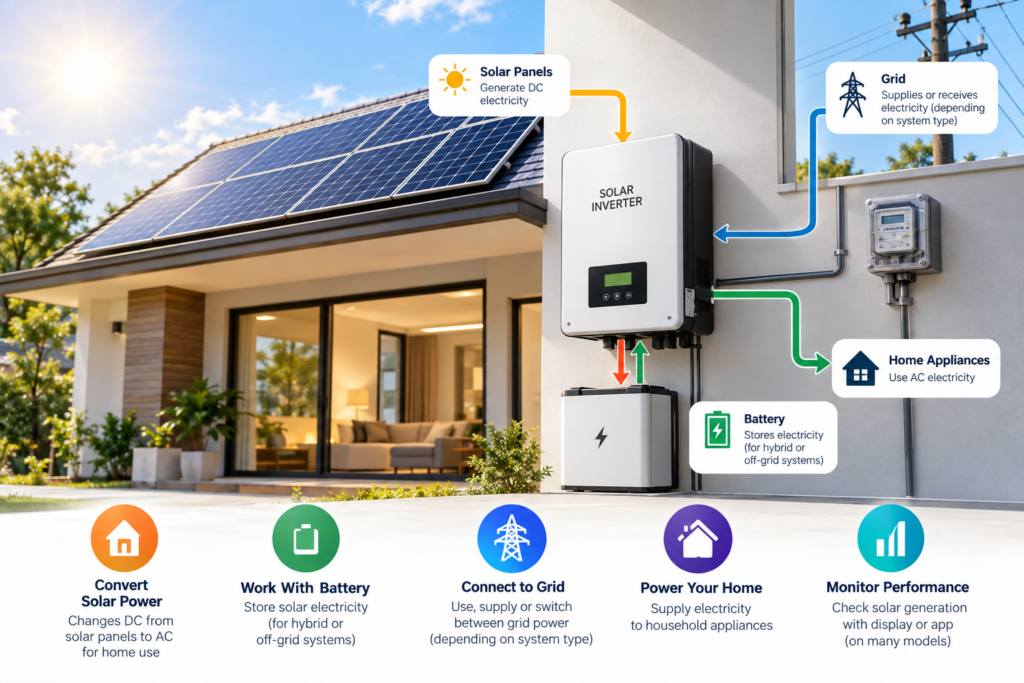
Table of Contents
A solar inverter for home is a device that changes the electricity produced by solar panels into a form that household appliances can use. Solar panels produce electricity as DC (direct current), while most appliances in a home use AC (alternating current). The solar inverter makes this conversion so the electricity generated by your solar panels can power lights, fans, televisions, refrigerators and other appliances.
The inverter is an important part of a home solar system because it does more than convert electricity. Depending on the type of inverter, it can also manage the flow of solar power between your solar panels, home, battery and the electricity grid.
For example, during the day, your solar panels may produce electricity while your home is using power. The inverter helps supply that solar electricity to your home. If your system produces more electricity than your home needs, the way that extra power is handled depends on your system type. In an on-grid system, excess electricity may be sent to the grid under the applicable rules. In a hybrid system, some of the extra electricity can also be stored in a battery.
Why Is a Solar Inverter Important for a Home?
Without a suitable inverter, electricity generated by standard solar panels cannot be directly used by most household appliances. The inverter also helps the solar system operate safely and, depending on the model, provides useful information about energy generation and system performance.
When choosing a residential solar inverter, homeowners should consider factors such as:
- Solar panel capacity
- Household electricity usage
- Inverter capacity
- Type of solar system
- Battery requirement
- Inverter efficiency
- MPPT range and specifications
- Safety features
- Warranty
- Monitoring options
- Installation and after-sales support
The right choice is not simply the inverter with the highest capacity. It should match the solar panels, electrical load and other parts of the complete solar system.
In simple terms, solar panels generate the electricity, while the solar inverter helps convert and manage that electricity for use in your home. The inverter type and size should therefore be selected as part of the overall solar system design rather than as a separate purchase.
How Does a Solar Inverter Work in a Home Solar System?
A solar inverter works as the link between your solar panels, home appliances, battery and electricity grid. Its main job is to convert the DC electricity produced by solar panels into AC electricity that your home can use.
The basic process is:
Sunlight → Solar Panels → DC Electricity → Solar Inverter → AC Electricity → Home Appliances
Here is how it works step by step:
1. Solar panels generate electricity
When sunlight falls on your solar panels, the panels generate DC electricity. The amount of electricity produced can change during the day depending on sunlight, weather, shading and other conditions.
2. The inverter converts DC power into AC power
The electricity from the solar panels goes to the solar inverter. The inverter converts the DC electricity into AC electricity so it can be used by appliances such as lights, fans, refrigerators and other household equipment.
3. Your home uses the solar electricity
The converted electricity can then be used by appliances in your home. Using solar electricity directly in the home can reduce the amount of electricity that needs to be taken from the grid, depending on your system and electricity use.
4. Extra electricity is handled by the system
If your solar panels produce more electricity than your home is using, what happens to the extra electricity depends on the type of solar system.
In an on-grid solar system, excess electricity may be exported to the electricity grid according to the applicable regulations and metering arrangement.
In a hybrid solar system, excess electricity may also be used to charge a compatible battery. The stored energy can then be used when solar generation is low or when backup power is required, depending on the system design.
5. The inverter monitors the system
Many modern solar inverters can provide information about solar generation, energy use and system performance through a display, mobile application or online monitoring platform. The features available depend on the inverter model.
What Happens When There Is a Power Cut?
A standard grid-connected solar inverter normally stops supplying power when the electricity grid goes down. This is an important safety feature that helps prevent electricity from being fed into a grid that may be under maintenance.
If you want solar power during a power cut, the system needs to be designed for backup operation. A suitable hybrid or off-grid solar inverter, along with the required battery and backup setup, can provide power to selected loads or the home as designed.
This is why choosing a solar inverter should be based on more than solar panel capacity. Your electricity needs, backup requirements, battery plans and grid connection should all be considered before selecting an inverter.
In simple terms, the solar inverter helps your home make practical use of the electricity produced by your solar panels while managing the connection between solar generation, household consumption, batteries and the grid.
Types of Solar Inverters for Home
Solar inverters for homes are available in different types. The right option depends on how your home uses electricity, whether you need battery backup, and whether your solar system will remain connected to the electricity grid.
The main types are on-grid, off-grid and hybrid solar inverters. String inverters and microinverters are also used in and describe how the solar panels are connected to the inverter.
On-Grid Solar Inverter
An on-grid solar inverter is designed for a home that remains connected to the electricity grid. It converts the DC electricity from solar panels into AC electricity for use in the home and works with the grid according to the system’s design and applicable regulations.
During the day, solar electricity can be used by household appliances. If the solar system generates more electricity than the home needs, the excess may be exported to the grid where the required metering and approvals are available.
A standard on-grid system normally does not provide backup power during a grid outage. The inverter shuts down when the grid goes off as a safety measure.
An on-grid solar inverter may suit homeowners who want to use rooftop solar while remaining connected to the electricity grid.
Off-Grid Solar Inverter
An off-grid solar inverter is designed for a solar system that can operate without an electricity-grid connection. These systems generally use batteries to store electricity generated by the solar panels.
During the day, solar power can supply the home and charge the battery. Stored electricity can then be used when solar generation is low or at night, depending on the system design.
Off-grid systems can be considered where grid electricity is unavailable, unreliable or where a home is specifically designed to operate independently of the grid.
Because an off-grid system must manage solar generation, household loads and stored energy, proper system sizing is important.
Hybrid Solar Inverter
A hybrid solar inverter combines solar generation with battery storage and can also work with the electricity grid. It is designed to manage power from multiple sources based on the system configuration.
A hybrid system can use solar power for the home, charge a battery and draw power from the grid when required. With the appropriate backup design, it can also supply selected household loads during a power cut.
Hybrid inverters are therefore useful for homeowners who want both solar power and battery backup in one system.
However, a hybrid inverter does not automatically mean that every appliance in the home will operate during a power cut. The backup capacity, battery size, inverter rating and electrical design determine what can be powered.
String Inverter
A string inverter connects a group, or “string,” of solar panels to a central inverter. It is a common approach for residential rooftop solar systems.
The performance of a string system can be affected when one or more panels in the same string receive significantly less sunlight because of shading, panel orientation or other site conditions.
String inverters can be suitable for rooftops where panels have similar orientation and receive reasonably consistent sunlight.
Microinverter
A microinverter is installed at the individual solar panel level rather than using one central inverter for a group of panels.
Because each panel can have its own inverter, the system can manage panel-level electricity conversion. This can be useful for roofs where panels have different orientations or where shading affects some panels more than others.
Microinverters can also provide panel-level monitoring on compatible systems.
Which Solar Inverter Type Is Right for Your Home?
There is no single solar inverter type that suits every home. Your choice should depend on your electricity connection, solar capacity, backup needs, battery plans, roof conditions and budget.
As a simple guide:
- On-grid: suitable for grid-connected homes that mainly want to use rooftop solar.
- Off-grid: designed for homes that need to operate without relying on the electricity grid.
- Hybrid: suitable when solar power, grid electricity and battery backup need to work together.
- String inverter: commonly used where solar panels have similar orientation and sunlight conditions.
- Microinverter: can be useful when panel-level control or different roof conditions are important.
The final inverter should always be selected using the specifications of the solar panels, inverter, battery and other system components. A professional site assessment can help determine the appropriate configuration for your home.
On-Grid vs Off-Grid vs Hybrid Solar Inverter
Choosing between an on-grid, off-grid and hybrid solar inverter depends mainly on your connection to the electricity grid and whether you need battery backup. Each type is designed for a different way of using solar power.
| Feature | On-Grid Solar Inverter | Off-Grid Solar Inverter | Hybrid Solar Inverter |
|---|---|---|---|
| Grid connection | Yes | No | Yes |
| Battery | Usually not required | Required for most systems | Can use a battery |
| Solar power for home | Yes | Yes | Yes |
| Backup during grid outage | Normally no | Yes, when properly designed | Yes, when properly designed |
| Excess solar power | May be exported to grid | Usually stored or managed within the system | Can be stored or managed according to system design |
| Main purpose | Use solar while connected to the grid | Operate independently of the grid | Combine solar, grid and battery storage |
| Suitable for | Grid-connected homes | Homes designed for off-grid operation | Homes that want solar plus backup |
On-Grid Solar Inverter
An on-grid inverter is connected to the electricity grid. It is commonly used when the main goal is to generate solar electricity and reduce the home’s dependence on grid power.
If the solar system produces more electricity than the home is using, the excess may be sent to the grid when the applicable metering arrangement allows it. However, a standard on-grid inverter normally shuts down during a grid outage.
Off-Grid Solar Inverter
An off-grid inverter is designed for a system that does not depend on the electricity grid. Solar panels and batteries work together to supply electricity to the home.
Because there is no grid to provide power when solar generation is low, battery capacity and system sizing become particularly important.
Hybrid Solar Inverter
A hybrid inverter combines solar generation, battery storage and grid power in one system. It can use solar electricity during the day, charge a compatible battery and draw electricity from the grid when needed.
With the correct backup design, a hybrid system can continue supplying selected loads during a power cut.
Which One Should You Choose?
The choice should be based on your home’s actual requirements rather than simply choosing the most feature-rich inverter.
If your home has a reliable grid connection and you mainly want to use rooftop solar, an on-grid system may meet your needs. If you need a system that can operate independently of the grid, an off-grid system may be considered. If you want solar generation together with battery storage and backup capability, a hybrid system may be suitable.
Before choosing, consider your electricity consumption, power-cut requirements, solar capacity, battery needs, available roof space and local grid requirements. A properly designed system should match the inverter with the solar panels, battery and household electrical load.
What Size Solar Inverter Do You Need for Your Home?
The right solar inverter size for your home depends on more than the number of solar panels. Your solar system capacity, household electricity load, panel specifications, inverter specifications and future requirements should all be considered.
For example, a home with a 5 kW solar system does not automatically require the same inverter configuration as every other 5 kW solar system. The correct choice depends on how the panels are connected and the limits specified by the inverter manufacturer.
Factors That Determine Solar Inverter Size
1. Solar Panel Capacity
Start by checking the total capacity of your solar panels. The inverter must be compatible with the total DC power and electrical characteristics of the panels.
The inverter’s maximum PV input, voltage range and current limits should be checked before installation.
2. Your Home’s Electricity Load
Your daily electricity use and the appliances you operate at the same time are also important.
Consider appliances such as:
- Air conditioners
- Refrigerators
- Water pumps
- Washing machines
- Televisions
- Fans
- Lights
- Computers
- Kitchen appliances
The inverter should be able to handle the expected electrical load according to the system design.
3. Peak Power Requirement
Some appliances can require more power when they start. This is particularly important for equipment such as motors, pumps and air conditioners.
Therefore, selecting an inverter only by adding the normal running power of appliances may not provide the complete picture. The starting or peak requirements should also be considered where applicable.
4. Panel and Inverter Compatibility
Solar panels and inverters have specific electrical limits. These include maximum DC voltage, operating voltage, maximum current and MPPT operating range.
The solar panel configuration should remain within the inverter manufacturer’s specified limits.
5. Battery Requirements
If you are considering a hybrid or off-grid solar inverter, battery requirements also need to be considered.
The inverter must be compatible with the battery technology and capacity used in the system. Backup requirements can also affect the inverter and battery configuration.
What Inverter Size Is Needed for 1 kW, 3 kW or 5 kW Solar?
There is no universal rule that says a particular solar panel capacity must always be paired with one exact inverter size.
For example, 1 kW, 3 kW and 5 kW solar systems can have different inverter configurations depending on the panel specifications, inverter model, system design and applicable installation requirements.
Instead of selecting an inverter based only on a number such as “3 kW solar inverter” or “5 kW solar inverter,” check:
- Total solar panel capacity
- Maximum PV input of the inverter
- DC voltage range
- Maximum input current
- Number of MPPTs
- Household load
- Peak load requirements
- Battery requirements, if applicable
- Grid connection requirements
- Scope for future expansion
Should Solar Panel Capacity and Inverter Capacity Be the Same?
Not necessarily. Solar panels and inverters have different ratings and are designed to work within specified operating limits.
A suitable solar system may have a difference between the total DC capacity of the panels and the inverter’s AC output rating. However, this should not be decided using a general rule alone. The panel-to-inverter combination must remain within the manufacturer’s specifications and the requirements of the complete system.
How to Calculate the Right Solar Inverter Size
A simple way to begin is to identify three things:
1. How much solar power will the panels produce?
Check the total panel capacity and their electrical specifications.
2. How much power does your home need?
List the appliances you normally use and identify the maximum load that may operate at the same time.
3. Do you need battery backup?
If yes, identify which appliances need backup and for how long. This affects both inverter and battery selection.
The final inverter size should then be selected based on the complete system design and the manufacturer’s specifications.
For this reason, a professional assessment is useful before purchasing a solar inverter for home. It helps ensure that the inverter, solar panels, battery and household electrical load work together safely and as intended.
How to Choose a Solar Inverter for Home
Choosing a solar inverter for home should be based on your complete solar system, not just the inverter’s price or capacity. The right inverter should work with your solar panels, household electrical load, battery, if required, and electricity-grid connection.
Here are the main factors to check before buying.
1. Check Your Solar System Capacity
First, identify the total capacity of your solar panels. The inverter should be compatible with the panels and their electrical specifications.
Check the inverter’s maximum PV input, voltage range and current limits before making a decision.
2. Understand Your Household Load
Look at how much electricity your home uses and which appliances normally operate together.
If your home uses high-power appliances such as air conditioners, pumps or other large equipment, the inverter should be selected to handle the expected load according to the system design.
3. Decide If You Need Battery Backup
If you only want to use solar power while remaining connected to the grid, an on-grid system may be suitable.
If you also want backup during power cuts, you will need a system designed for backup, such as an appropriate hybrid or off-grid configuration with a compatible battery.
Decide which appliances you want to keep running during an outage before selecting the inverter and battery.
4. Choose the Right Inverter Type
The three main options are on-grid, off-grid and hybrid solar inverters.
Your choice depends on whether your home is connected to the grid, whether you need battery storage and whether backup power is important to you.
5. Check MPPT Specifications
MPPT stands for Maximum Power Point Tracking. It helps the inverter obtain suitable power from the solar panels as sunlight and operating conditions change.
When comparing inverters, check the number of MPPTs and their voltage and current operating ranges. These specifications should match the planned solar panel configuration.
6. Compare Efficiency
Solar inverter efficiency indicates how effectively the inverter converts the electricity it receives from the solar panels into usable AC electricity.
A higher efficiency rating can reduce conversion losses, but efficiency should not be the only factor used to choose an inverter. System compatibility, safety, warranty and service support are also important.
7. Check Safety Features
A solar inverter is part of your home’s electrical system, so safety should be taken seriously.
Depending on the model, useful protection features may include protection against electrical faults, overvoltage, overheating and other abnormal operating conditions.
The exact protection features should be checked in the manufacturer’s specifications.
8. Check the Warranty
Look at the product warranty before purchasing a solar inverter.
Check:
- Warranty period
- What components are covered
- Conditions of warranty coverage
- Service process
- Availability of service support
A longer warranty can be useful, but it should be considered together with the manufacturer’s service support and the actual warranty terms.
9. Consider Monitoring Features
Many modern solar inverters offer system monitoring through a display, mobile application or online platform.
Monitoring can help you check solar generation, system status and, on supported systems, other energy information.
This can make it easier to identify unusual changes in system performance.
10. Check Battery Compatibility
If you plan to install a battery now or add one later, check whether the inverter supports the required battery type and configuration.
Do not assume that every hybrid inverter works with every battery. Compatibility should be confirmed using the manufacturer’s specifications.
11. Consider Installation and After-Sales Support
The inverter is only one part of a home solar system. Correct installation, electrical protection, wiring, earthing and system commissioning are also important.
Before choosing a supplier, check the installation process and the availability of after-sales service in your area.
12. Think About Future Requirements
Your electricity needs may change over time. You may add an air conditioner, electric vehicle charger or other high-power appliance in the future.
If you expect your solar system to expand, discuss this before installation. The inverter and other equipment should be selected with any planned expansion in mind.
A Simple Checklist Before Buying
Before purchasing a residential solar inverter, ask:
What is my solar system capacity?
What is my home’s maximum electrical load?
Do I need battery backup?
Which inverter type fits my needs?
Are the panels and inverter compatible?
What MPPT range and input limits does the inverter have?
What warranty and service support are available?
Answering these questions can help you compare solar inverter options based on your actual requirements rather than choosing only by price or brand name.
Solar Inverter Price in India
The solar inverter price in India depends on several factors, so there is no single price that applies to every home. The cost can vary based on the inverter’s capacity, type, brand, features and whether battery storage or installation is included.
For a residential solar system, the main factors that can affect the price include:
- Inverter capacity: Higher-capacity inverters generally have different equipment and specifications than smaller residential models.
- Inverter type: On-grid, off-grid and hybrid inverters have different designs and functions.
- Battery compatibility: Hybrid and off-grid systems may require equipment designed to work with batteries.
- Technology and features: MPPT configuration, monitoring and other features can affect the product selected.
- Brand and warranty: Warranty terms, product specifications and service support can differ between manufacturers.
- Installation: Electrical work, protection equipment, wiring and commissioning can affect the overall project cost.
- System design: The inverter must be compatible with the solar panels and other components used in the installation.
Does a Higher-Priced Solar Inverter Mean Better Performance?
Not necessarily. Price alone should not be used to decide which solar inverter is right for your home.
A suitable inverter should match your solar panel capacity, household load, battery requirements, grid connection and other system specifications. A more expensive inverter may include features that you do not need, while a lower-cost option may not provide the required capacity or compatibility.
It is therefore better to compare the complete specifications, warranty, installation support and after-sales service rather than comparing only the purchase price.
What Should You Ask for in a Solar Inverter Quote?
When comparing quotes, check whether the price includes:
- Solar inverter
- Installation
- Required wiring and protection equipment
- Monitoring equipment or setup, where applicable
- Battery, if part of the system
- Commissioning
- Warranty
- After-sales support
- Applicable taxes and other charges
This makes it easier to compare two quotations fairly.
Is the Solar Inverter Included in a Complete Home Solar System?
In a complete rooftop solar installation, the inverter is normally one of the key components of the system along with solar panels, mounting structures, electrical protection and other required equipment. The exact components depend on the system type and design.
For this reason, homeowners should compare the total solar system cost rather than looking only at the standalone solar inverter price.
If you are considering a solar inverter for home, a site-specific quotation can provide a more accurate cost because the required equipment depends on your home’s solar capacity, electricity usage, roof conditions and chosen system configuration.
Solar Inverter With Battery vs Without Battery
Whether you need a solar inverter with battery depends mainly on how you want to use your solar power. A battery stores electricity for later use, while a solar system without a battery generally uses solar power when it is available and may use the electricity grid when additional power is needed.
Solar Inverter Without Battery
A typical on-grid solar system can operate without a battery. During the day, solar panels generate electricity and the inverter converts it for use by the home.
If your home needs more electricity than the solar panels are producing, the system can draw additional power from the grid. If the system produces more electricity than the home is using, excess electricity may be exported to the grid where the applicable rules and metering arrangement allow it.
A standard on-grid system normally does not provide power during a grid outage.
A battery-free system may therefore suit a homeowner who has a grid connection and mainly wants to use rooftop solar to meet daytime electricity needs.
Solar Inverter With Battery
A battery allows solar electricity to be stored and used later. In a hybrid or off-grid system, the inverter manages the flow of electricity between the solar panels, battery, home and, where applicable, the electricity grid.
For example, solar electricity generated during the day can be used by the home while some available energy is stored in the battery. That stored energy can then be used when solar generation is low or when backup power is required, depending on the system design.
A battery system can be useful when:
Your home experiences power cuts
You want backup power for selected appliances
You want to store some solar energy for later use
You need a system that can operate with limited or no grid support
Which Option Is Right for Your Home?
There is no universal answer. Your choice should depend on your electricity usage, grid reliability, backup requirements and budget.
| Requirement | Without Battery | With Battery |
|---|---|---|
| Use solar electricity during the day | Yes | Yes |
| Store solar electricity | No | Yes |
| Backup during grid outage | Normally no | Possible with a suitable system |
| Battery maintenance/replacement | Not applicable | Required over the battery’s service life |
| System complexity | Generally lower | Generally higher |
A battery also adds another major component to the solar system, so its capacity should be selected based on the loads you want to support and the required backup duration.
If your main goal is to use rooftop solar while staying connected to the grid, a battery may not be necessary. If backup power or storing solar electricity is important, a compatible hybrid or off-grid system with a suitable battery may be more appropriate.
The best choice should be based on your home’s actual electricity requirements rather than assuming that every solar installation needs a battery.
Can a Solar Inverter Work During a Power Cut?
A standard on-grid solar inverter normally does not work during a power cut. When the electricity grid goes down, the inverter shuts down to prevent electricity from being sent back into the grid.
This safety function is important because electricity workers may be working on the grid during an outage. A solar system must not continue feeding electricity into a grid that has been switched off for maintenance or repair.
Can Solar Power Still Be Used During a Power Cut?
Yes, but the solar system must be specifically designed for backup operation.
A hybrid solar inverter with a compatible battery can be designed to supply power to selected appliances or circuits during a grid outage. An off-grid solar system can also provide electricity without depending on the grid when properly designed.
The backup setup may include:
- Hybrid or off-grid solar inverter
- Solar panels
- Compatible battery
- Backup or essential-load circuit
- Appropriate electrical protection
- Correct system sizing
Will All Home Appliances Work During a Power Cut?
Not necessarily.
The appliances that can operate during an outage depend on the inverter’s output capacity, battery capacity and the way the backup circuit is designed.
For example, a homeowner may choose to keep essential loads such as:
- Lights
- Fans
- Wi-Fi router
- Television
- Refrigerator
running during an outage, while larger appliances may require a higher-capacity system.
High-power appliances such as air conditioners, water pumps and electric heating equipment can place a much larger load on the system. Whether they can run during a power cut depends on the inverter, battery and complete electrical design.
What Happens When Solar Generation Is Low?
A battery-backed system can use stored energy when the solar panels are not producing enough electricity. At night, for example, the system can use energy stored in the battery.
How long the backup lasts depends on factors such as battery capacity, the appliances being used, their power consumption and the system’s operating conditions.
What Should You Check Before Buying?
If power-cut backup is important to you, do not assume that any solar inverter will provide it. Ask the installer to confirm:
Whether the inverter supports backup operation.
Which appliances or circuits will receive backup power.
What battery capacity is required.
How much load the backup output can support.
How long the expected backup may last under the planned load.
Whether the system has the required electrical protection and installation arrangement.
In simple terms, installing rooftop solar does not automatically mean your home will have electricity during a power cut. If backup is required, the solar system needs an inverter, battery and electrical design that are specifically suitable for backup operation.
Solar Inverter vs Normal Home Inverter
A solar inverter and a normal home inverter both deal with electricity, but they are designed for different purposes. The main difference is that a solar inverter is designed to work with electricity generated by solar panels.
A normal home inverter is generally used as a backup system. It stores electricity in a battery and supplies power to selected appliances when the main electricity supply is unavailable.
A solar inverter, depending on its type, can manage electricity from solar panels, the home, the battery and the electricity grid.
| Feature | Normal Home Inverter | Solar Inverter |
|---|---|---|
| Main purpose | Backup power | Use and manage solar electricity |
| Works with solar panels | Not necessarily | Yes |
| Converts solar-panel DC electricity | No | Yes |
| Battery | Commonly used | Depends on inverter type |
| Grid interaction | Limited | Depends on system type |
| Solar generation monitoring | Generally not available | Available on many models |
| Power during grid outage | Usually designed for backup | Depends on inverter and system design |
Can a Normal Home Inverter Be Used With Solar Panels?
Not every normal home inverter is designed to work with solar panels. Solar panels have specific electrical characteristics, and the inverter must be designed to accept and manage their DC output.
Some products are specifically designed as solar-compatible or solar hybrid inverters. Their specifications should be checked before connecting them to a solar system.
Which One Does a Home Need?
It depends on the purpose of the system.
If you only need backup electricity during power cuts, a conventional home inverter and battery may meet that requirement.
If you want to generate electricity from rooftop solar panels, you need an inverter designed for the solar system. If you also want battery backup, a suitable hybrid solar inverter can combine solar generation, battery storage and grid power.
In short, a normal home inverter is mainly focused on backup, while a solar inverter is designed to convert and manage electricity generated by a solar system. The right choice depends on whether your goal is backup power, solar generation, battery storage or a combination of these needs.
Solar Inverter Installation for Home
Proper solar inverter installation for home is important for the safety and performance of the complete solar system. The inverter should be installed according to the manufacturer’s instructions and the requirements of the solar panels, electrical system and grid connection.
A typical residential installation involves several steps.
1. Assess the Home and Solar System
Before installation, the installer checks the solar capacity, household electrical load, available installation space and the planned inverter configuration.
If battery backup is required, the battery location and backup loads should also be considered.
2. Select the Inverter Location
The inverter should be installed in a suitable location with adequate ventilation and protection from conditions that could affect its operation.
The manufacturer’s installation requirements should always be followed. The area should also allow technicians to safely access the inverter for inspection or service.
3. Connect the Solar Panels
The solar panels are connected to the inverter according to the planned system configuration.
The installer must check the panel voltage, current and string arrangement against the inverter’s permitted operating range. Incorrect connections can affect system operation and safety.
4. Complete Electrical Connections
The inverter is connected to the relevant electrical circuits using suitable cables, protection equipment and other required components.
Depending on the system, this may include DC and AC protection, isolators, earthing and surge protection.
5. Connect the Battery, If Required
For a hybrid or off-grid system, a compatible battery can be connected according to the inverter and battery manufacturer’s requirements.
The battery capacity and configuration should match the planned backup loads and system design.
6. Connect to the Electricity Grid
For an on-grid or grid-connected system, the installation must follow the applicable electricity distribution and metering requirements.
The required approvals, inspections and metering arrangements can vary depending on the location and applicable regulations.
7. Test and Commission the System
After installation, the system is checked to confirm that the solar panels, inverter, electrical protection and other components are operating correctly.
Monitoring can also be configured where supported by the inverter.
Why Professional Installation Matters
A solar inverter is part of a home’s electrical system. Incorrect wiring, unsuitable equipment or poor installation can create safety and performance problems.
For this reason, homeowners should use qualified professionals and ensure that the inverter is compatible with the solar panels, battery and electrical system.
The installer should also explain how to monitor the system, what the inverter’s warning indicators mean and how to contact the service team if a problem occurs.
A correctly designed and installed system helps ensure that the solar inverter for home operates within its intended specifications and works properly with the rest of the rooftop solar system.
Common Solar Inverter Problems
A solar inverter continuously manages electricity from the solar panels and, depending on the system, the battery and electricity grid. Like any electrical equipment, it can sometimes show a warning, error or change in performance.
Some common solar inverter problems include the following.
Inverter Shows an Error or Warning
Modern inverters can display error codes or warning messages when they detect an unusual condition.
The cause may be related to the grid, solar-panel input, temperature, communication or another part of the system.
If an error appears, check the inverter’s user manual for the meaning of the message. If the problem continues, contact the installer or qualified service professional instead of opening or repairing the inverter yourself.
Inverter Shuts Down
An inverter may shut down for different reasons, including a grid outage, abnormal grid conditions, high temperature or an electrical protection event.
For an on-grid system, shutting down during a grid outage can be normal because of its safety function.
If the inverter repeatedly shuts down when the grid and solar conditions appear normal, the system should be checked by a qualified professional.
Solar Generation Is Lower Than Expected
Lower solar generation does not always mean that the inverter is faulty.
Possible factors include:
- Reduced sunlight
- Cloudy weather
- Shading
- Dust or dirt on panels
- Changes in panel temperature
- Panel or system faults
- Electrical or inverter issues
Comparing the system’s performance over time can help identify unusual changes. An installer can investigate further if generation remains lower than expected.
Inverter Gets Too Hot
Solar inverters produce some heat during operation. However, excessive temperature can cause an inverter to reduce its output or shut down as a protective measure.
The inverter should have adequate ventilation and should be installed according to the manufacturer’s requirements.
Do not cover the inverter or block its ventilation openings.
Battery Is Not Charging
For a hybrid or off-grid solar system, a battery may fail to charge because of several possible reasons, including insufficient solar generation, battery settings, battery condition or communication issues between system components.
Battery and inverter compatibility should also be checked.
Because batteries involve electrical energy storage, troubleshooting should be handled according to the manufacturer’s instructions or by a qualified service professional.
Monitoring App Is Not Updating
If your inverter uses an online monitoring system, the app may occasionally stop showing current data.
This can be caused by an internet connection problem, communication issue or a temporary problem with the monitoring service. It does not necessarily mean that the solar panels or inverter have stopped working.
What Should You Do If Your Solar Inverter Has a Problem?
First, note the warning message or error code shown by the inverter. Check the manufacturer’s instructions for basic information, but avoid opening the inverter or attempting electrical repairs yourself.
If the issue continues, contact your solar installer or an appropriately qualified technician.
Regular monitoring and professional maintenance can help identify problems early and keep your solar inverter for home operating safely and effectively.
How to Maintain a Solar Inverter
A solar inverter generally needs less routine attention than some other parts of a solar system, but regular checks can help identify problems early. Good installation, suitable operating conditions and timely service are important for keeping a solar inverter for home working as intended.
Keep the Inverter Area Clean and Clear
Keep the area around the inverter free from objects that can block ventilation. Do not cover the inverter or place items directly against it.
Dust and dirt should be managed according to the manufacturer’s cleaning instructions.
Check the Inverter Display or Monitoring App
If your inverter has a display or online monitoring system, check it from time to time.
Look for:
- Error messages
- Warning indicators
- Unexpected changes in solar generation
- Communication problems
- Unusual system shutdowns
A change in performance does not always mean that the inverter is faulty, but repeated warnings should be investigated.
Keep an Eye on the Solar System
The inverter is connected to other parts of the solar system, including the panels and electrical equipment. A problem elsewhere in the system can affect inverter performance.
If solar generation remains unusually low or the inverter repeatedly shows an error, contact the installer or a qualified technician.
Follow the Manufacturer’s Maintenance Instructions
Different solar inverter models have different maintenance requirements. Always follow the instructions provided by the manufacturer rather than using a general maintenance schedule.
Electrical connections, protection equipment and other system components should be checked by a qualified professional when required.
Do Not Attempt Electrical Repairs Yourself
A solar inverter is electrical equipment and can contain hazardous voltages even when the system is not producing electricity.
Do not open the inverter, change internal components or attempt electrical repairs unless you are appropriately qualified and trained to do so.
Professional inspection is the safer option when the inverter shows a persistent fault or warning.
Good maintenance does not mean constantly servicing the inverter. It means keeping the installation area suitable, watching for unusual behaviour and getting professional help when something does not appear normal.
How Long Does a Solar Inverter Last?
The service life of a solar inverter depends on the inverter model, installation conditions, operating environment, usage and maintenance. There is no single lifespan that applies to every solar inverter.
The inverter is also different from solar panels. Solar panels can continue producing electricity for many years, while the inverter may need replacement earlier depending on its design and operating conditions.
What Can Affect Solar Inverter Life?
Several factors can influence how an inverter performs over time.
Operating temperature: Excessive heat can affect electrical equipment. Installing the inverter in a suitable, well-ventilated location can help it operate within the manufacturer’s recommended conditions.
Installation quality: Correct wiring, electrical protection, earthing and proper system design are important for safe operation.
Usage conditions: An inverter operating under conditions close to its limits may experience different operating demands from one used under lighter conditions.
Dust and environment: The installation environment can affect equipment performance, particularly where there is significant dust, moisture or poor ventilation.
Maintenance: Monitoring the system and addressing warnings or faults promptly can help prevent small problems from being ignored.
What About the Solar Inverter Warranty?
The warranty period is an important factor to consider when buying a residential solar inverter. However, the warranty period should not be treated as the guaranteed service life of the product.
Before purchasing, check:
- Product warranty period
- What the warranty covers
- Warranty conditions
- Service and replacement process
- Availability of authorised service support
The exact warranty depends on the manufacturer and inverter model.
When Should a Solar Inverter Be Replaced?
A solar inverter may need replacement if it develops a major fault, reaches the end of its useful service life, or is no longer suitable for the solar system.
Repeated error messages, unexpected shutdowns or a significant unexplained change in system performance may indicate that professional inspection is needed.
If the inverter needs replacement, the new model should not be selected based only on the old inverter’s capacity. The solar panels, electrical load, battery requirements and current system design should be reviewed again.
For homeowners, the best approach is to choose a suitable inverter from a manufacturer with clear warranty terms and reliable service support, install it correctly and monitor its performance over time.
Is a Solar Inverter Worth It for a Home?
Whether a solar inverter is suitable for your home depends on your electricity use, solar plans, grid connection, backup requirements and budget. A solar inverter is a required part of most rooftop solar systems because it converts the electricity produced by solar panels into electricity that household appliances can use.
A solar inverter may be relevant if you:
- Plan to install rooftop solar panels
- Want to use electricity generated by your solar panels
- Want to reduce the amount of electricity your home takes from the grid
- Need a system that can work with battery storage
- Want to monitor solar electricity generation
- Need backup power as part of a suitably designed solar system
However, the right inverter depends on your actual requirements.
For example, a home with a reliable grid connection and mainly daytime electricity use may have different requirements from a home that experiences frequent power cuts and needs battery backup.
Similarly, a home with a small solar system does not necessarily need the same inverter configuration as a larger home with a higher electrical load.
What Should You Consider Before Buying?
Before choosing a solar inverter for home, look at the complete system rather than the inverter alone.
Consider:
Your electricity consumption — How much electricity does your home normally use?
Solar capacity — How much solar power do you plan to install?
Electrical load — Which appliances may operate at the same time?
Power cuts — Do you need backup power?
Battery storage — Do you want to store solar electricity?
Roof and panel conditions — Are there shading or different roof orientations?
Grid connection — Will the system remain connected to the electricity grid?
Budget and long-term support — What warranty and after-sales service are available?
The purpose is not to find the most expensive or highest-capacity inverter. It is to find an inverter that is compatible with your solar panels, electrical load, battery requirements and overall system design.
If you are unsure which configuration is suitable, a professional site assessment can help determine the solar capacity, inverter type and other equipment required for your home.