


3KW SOLAR SYSTEM GUIDE • HYDERABAD & INDIA
3kW Solar System: Price, Subsidy, Generation, Cost & Complete Guide
A 3kW solar system is a popular choice for homes that want to generate their own electricity and reduce their monthly power bills. But before installing one, it is important to understand the 3kW solar system price, subsidy, electricity generation, roof space, installation cost and expected savings.
A 3kW system can be suitable for many homes, but the right system size depends on your actual electricity use, available roof space, shading and other site conditions. The total cost can also change based on the solar panels, inverter, mounting structure, installation work and other project requirements.
In this guide, Natural Power explains everything you need to know about a 3kW solar system in India, including its price with subsidy, how much electricity it can generate, how many panels you may need, how much roof space is required, and whether a 3kW system is suitable for your home.
If you are planning 3kW rooftop solar in Hyderabad, this guide will also help you understand the key points to check before choosing a solar system or installer.
3kW
System capacity
10–15
Indicative units/day
6*
Example 550W panels
₹2,05,400
Example project cost*
What Is a 3kW Solar System?
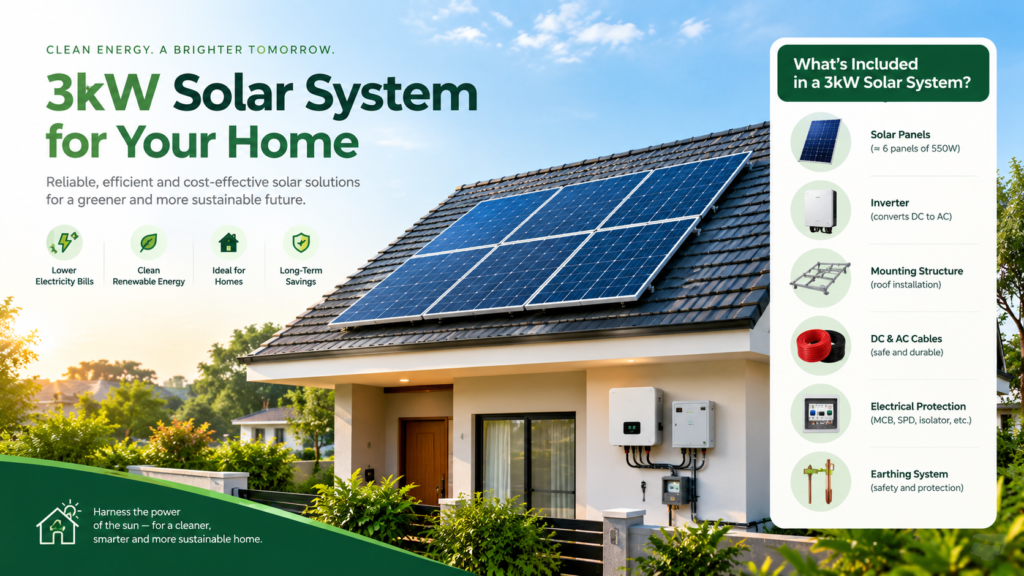
A 3kW solar system is a solar power system with a capacity of 3 kilowatts. It uses solar panels to convert sunlight into electricity that can be used in a home or other property. A typical system includes solar panels, a solar inverter, mounting structures, cables and electrical safety equipment.
The actual electricity generated by a 3kW solar system depends on factors such as sunlight, weather, roof direction, shading, panel efficiency and system design. So, 3kW refers to the system’s capacity, not a fixed number of electricity units it will produce every day.
For a home, a 3kW rooftop solar system can be a practical option when the household has moderate electricity use and enough suitable roof space. However, the right size should be selected after checking your electricity bills and property.
A 3kW system can be installed as an on-grid, off-grid or hybrid solar system, depending on your electricity needs. An on-grid system is connected to the electricity grid, while a hybrid system can also use batteries for backup.
Before choosing a 3kW solar system, it is important to check your monthly electricity consumption, available roof area, shading and local installation requirements.
A 3kW system can suit many homes with moderate electricity consumption. The right size depends on your bills, appliance usage, roof space, shading and future requirements.
Rooftop Solar
A rooftop system uses available roof space to generate electricity from sunlight and can reduce electricity purchased from the grid.
Three System Types
On-grid systems focus on grid-connected bill savings, off-grid systems use batteries for independent operation, and hybrid systems combine grid connection with battery backup.
3kW Solar System: Complete Overview
A 3kW solar system can be a practical choice for a home with moderate electricity use. Before installation, understand its price, subsidy, generation, panels, roof area, battery needs, savings and installation process.
What You Should Check First
Review your recent electricity bills, daily appliance usage, available shadow-free roof space and any future loads such as an AC or electric vehicle. A professional site assessment can then help determine whether 3kW is the right capacity.
What Is Included?
A complete system may include photovoltaic panels, a solar inverter, mounting structure, DC and AC cables, electrical protection, earthing and other components required by the site and system design.
System design
Capacity should match electricity use and practical site conditions.
Equipment
Ask for clear panel, inverter and component specifications.
Installation
Mounting, wiring, earthing and protection should be part of a properly planned project.
How Much Does a 3kW Solar System Cost?
The 3kW solar system price in India depends on the type of system, solar panels, inverter, mounting structure, installation requirements and other project costs. The final price can also vary based on the property, roof condition and electrical work required.
For a typical residential project, a 3kW system can include:
- Solar panels or PV modules
- A suitable solar inverter
- Mounting structure
- DC and AC cables
- Electrical protection equipment
- Earthing and other safety components
- Installation and commissioning
Example 3kW Project Cost
Total Project Cost: ₹2,05,400
Government Subsidy*: ₹78,000
Effective Cost After Subsidy*: ₹1,32,120
*Pricing and subsidy figures must be confirmed for the customer’s current eligibility, project scope and applicable government rules. The supplied effective-cost figure does not mathematically equal total cost minus subsidy, so the final quotation should be verified before publication or purchase.
What Changes the Final Price?
System capacity, panel and inverter selection, roof condition, mounting requirements, cabling, electrical protection, installation complexity, approvals and applicable incentives can all affect the final project cost.
The 3kW solar system subsidy can reduce the upfront cost of an eligible residential rooftop solar installation. In India, subsidy support is linked to applicable government rooftop solar schemes, so the amount and eligibility should always be checked against the latest official rules before installation.
For a 3kW system, the subsidy can make rooftop solar more affordable for homeowners. However, the final amount you pay depends on the system price, applicable subsidy, installation requirements and whether the project meets the scheme’s eligibility conditions.
3kW Solar Subsidy in India
The PM Surya Ghar: Muft Bijli Yojana is an important government initiative for residential rooftop solar. Eligible households can apply through the applicable government process and follow the required steps for installation and subsidy processing.
Natural Power can help customers understand the solar installation requirements and the steps involved in planning a rooftop system. However, subsidy eligibility and the amount approved are determined under the applicable government rules and should not be assumed without verification.
What Should You Check Before Applying?
Before purchasing a 3kW solar system with subsidy, check:
- Whether your property and electricity connection are eligible
- The current government subsidy rules
- Whether the selected solar system meets applicable requirements
- The approved installation and application process
- Required documents and approvals
- Grid connection and net-metering requirements
- The final project cost before and after any applicable subsidy
A subsidy can reduce the initial investment, but it should not be the only factor when choosing a solar system. Equipment quality, system design, installation standards, expected electricity generation and after-sales support are also important for a long-term solar investment.
Government Support
The PM Surya Ghar: Muft Bijli Yojana is a key current rooftop solar scheme for eligible residential consumers. The applicable amount depends on the scheme rules and system capacity.
Apply Through the Official Process
Subsidy generally involves registration, an eligible installation process, required approvals, installation, inspection or verification and other scheme requirements.
Do Not Assume a Fixed Net Cost
Always verify the current subsidy, eligibility and final quotation. Do not calculate your investment using an outdated subsidy figure or an unverified net-cost claim.
How Many Units Does a 3kW Solar System Generate?
A 3kW solar system can generate several units of electricity per day, but the exact output depends on sunlight, weather, panel efficiency, shading, roof orientation, system design and other site conditions. This means there is no single fixed number of units that every 3kW system will produce.
As a general planning estimate, a 3kW system may generate around 10–15 units of electricity per day under suitable conditions. Actual generation can be higher or lower depending on the location and season.
3kW Solar System Units Per Day
The daily output changes throughout the year. On days with strong sunlight, the system may produce more electricity, while cloudy or rainy weather can reduce generation.
For example, if a 3kW solar system produces an average of around 12 units per day, its monthly generation could be approximately 360 units. This is only an estimate and should not be treated as a guaranteed output.
What Affects 3kW Solar Generation?
Several factors can affect the electricity generated by your solar system:
- Sunlight: More usable sunlight generally means higher generation.
- Shading: Trees, buildings and other obstructions can reduce output.
- Panel orientation: Panel positioning affects how much sunlight the modules receive.
- Panel efficiency: Different PV modules can have different performance levels.
- Weather: Clouds, rain and extreme temperatures can affect generation.
- System losses: Inverter, cable and other electrical losses can reduce the usable output.
- Maintenance: Dust and dirt on panels can affect performance.
For this reason, the expected 3kW solar system daily output should be calculated based on the actual property rather than relying only on a general estimate.
Natural Power can assess the site and system requirements to help estimate expected solar generation before installation.
Daily Generation
A planning example of 12 units per day would equal roughly 360 units in a 30-day month. This is an estimate, not a guaranteed output.
Monthly Generation
Monthly production changes throughout the year. Sunny periods can produce more energy, while cloudy weather, shading and other conditions can reduce output.
Annual Generation
The best estimate comes from a site-specific solar assessment using location, roof orientation, shading, equipment and expected system performance.
How Many Solar Panels Are Needed for 3kW?
The number of panels needed for a 3kW solar system depends on the wattage of the solar panels selected. For example, a system using 550W panels would need about 6 panels to reach approximately 3.3kW of panel capacity, while lower-wattage panels may require more modules.
The final panel configuration is decided during system design based on the selected panel model, inverter compatibility, available roof space and installation requirements. Therefore, the number of panels should not be considered separately from the complete system design.
How Much Roof Space Is Required for a 3kW Solar System?
A 3kW rooftop solar system generally needs a suitable area of several hundred square feet, but the exact space requirement varies with panel size, layout, mounting arrangement and roof conditions.
Before installation, the roof should be checked for:
- Available usable area
- Shade from trees or nearby buildings
- Roof orientation and layout
- Structural suitability
- Access for installation and maintenance
- Space needed between panel rows, where applicable
- Safe placement of other solar equipment
A roof with enough total area may still have less usable space if parts of it are shaded or unsuitable for mounting. This is why a site assessment and shadow analysis are important before finalizing a 3kW solar system.
For homes in Hyderabad and other parts of India, Natural Power can assess the available roof space and electricity requirements before recommending a suitable solar system design.
Example Panel Configuration
550W panel × 6 panels = 3.3kW of DC panel capacity. This example shows why panel count should not be judged without checking individual panel wattage.
Why Panel Wattage Matters
Higher-wattage panels can reduce the number of panels required for a given capacity, but roof layout, panel dimensions, shading and system design still need to be considered.
How Much Roof Space Does a 3kW System Need?
A 3kW rooftop system needs several hundred square feet of usable, shadow-free roof area. The exact requirement depends on panel dimensions, panel wattage, layout, roof shape, setbacks and mounting design.
Usable Space
Roof area occupied by tanks, walls, equipment or other obstructions may not be usable for panels.
Shading
Shadows from buildings, trees and rooftop structures can affect solar generation and should be considered during site assessment.
Roof Condition
The roof should be checked for structural suitability, access, orientation and overall condition before mounting the system.
Is a 3kW Solar System Enough for Your Home?
A 3kW solar system for home can be suitable for a household with moderate electricity consumption, but the right system size depends on your monthly electricity usage and the appliances you regularly use. A 3kW system may work well for some 2 BHK or 3 BHK homes, while homes with higher consumption may need a larger system.
Before choosing a 3kW solar system, check your recent electricity bills and look at your average monthly units. You should also consider appliances such as air conditioners, refrigerators, washing machines, water pumps, televisions and other high-power equipment.
Check Your Electricity Use
Look at your recent monthly units and identify major loads such as air conditioners, refrigerators, pumps, washing machines and other appliances. Also consider future loads.
2 BHK
A 3kW system may be suitable depending on actual electricity consumption.
3 BHK
A 3kW system can suit some homes, but higher usage may require more capacity.
AC-heavy homes
Check appliance loads carefully before deciding system size.
What Can a 3kW Solar System Run?
A 3kW solar system can support many common household appliances, but the exact load it can handle depends on the power rating of each appliance, how many appliances are running at the same time, and the type of solar system and inverter used.
For a typical home, a 3kW system may help power appliances such as:
- LED lights and ceiling fans
- Television and computers
- Refrigerator
- Washing machine
- Water pump
- Kitchen appliances
- Other normal household electrical loads
Everyday Loads
Lighting, fans, refrigerator, TV, Wi-Fi equipment, computers and other moderate household loads can be supported when the total load is within the system’s practical capacity.
Air Conditioner
A 1.5-ton inverter AC may be possible in a properly designed system, but the AC’s actual power consumption and other simultaneous loads must be checked.
Load Management
Solar generation changes during the day. A load assessment helps determine what can run together and whether additional capacity or storage is required.
On-Grid vs Off-Grid vs Hybrid 3kW Solar System
A 3kW solar system can be designed as an on-grid, off-grid or hybrid solar system. The best option depends on your electricity needs, power-cut frequency, budget and whether you need battery backup.
On-Grid
Connected to the electricity grid and normally uses a grid-tied inverter. Surplus generation may be exported through an approved net-metering arrangement. Standard systems shut down during grid outages.
Off-Grid
Designed to operate without depending on the grid and normally requires battery storage. It can suit locations where reliable grid power is unavailable.
Hybrid
Combines solar, grid connection and battery storage. It can provide backup during outages when designed with appropriate backup functionality.
Do You Need a Battery for a 3kW Solar System?
No. A standard on-grid 3kW solar system does not normally need a battery. Batteries are mainly considered when you need backup power, want to store solar energy, or are choosing an off-grid or hybrid system.
Without Battery
On-grid systems can be simpler and focus on reducing electricity purchased from the grid.
With Battery
Battery storage can provide backup power, but adds cost, space requirements and additional system considerations.
Choose Based on Need
If power cuts are a major concern, discuss critical loads, backup duration and battery capacity before choosing the system.
However, the addition of batteries generally increases the 3kW solar system cost.
| System Type | Grid Connection | Battery | Main Benefit |
|---|---|---|---|
| On-Grid | Yes | Usually no | Reduce grid electricity use |
| Off-Grid | No | Yes | Energy independence and backup |
| Hybrid | Yes | Yes | Solar + storage + grid flexibility |
For most homeowners, the right choice should be based on electricity consumption, power-cut requirements, budget and the property’s existing electrical setup rather than choosing a system type based on price alone.
3kW Solar System Savings and ROI
A 3kW solar system can reduce your electricity bill by generating solar power that your home can use instead of buying the same electricity from the grid. Your actual savings depend on how much electricity the system generates, how much power your home consumes during solar generation hours, your electricity tariff and applicable net-metering rules.
Monthly Savings
Estimate savings by comparing expected solar generation with the electricity you currently buy from the grid.
Payback Period
Payback depends on net project cost, solar generation, tariffs, subsidy and actual consumption. A fixed payback period should not be promised without a project-specific calculation.
Zero Bill?
Solar can significantly reduce purchased electricity, but a zero bill is not guaranteed because fixed charges, tariffs, consumption and applicable billing rules still matter.
3kW Solar System in Hyderabad
A 3kW solar system in Hyderabad can be a practical option for homes with moderate electricity consumption and suitable rooftop space. The right system depends on your monthly electricity usage, roof area, shading, appliance load and the type of solar system you choose.
Hyderabad receives good sunlight for much of the year, but actual solar generation still changes with weather, season, panel orientation, shading and system efficiency. A site assessment is therefore important before deciding on the final system design.
For Homes
A 3kW rooftop system may suit homes with moderate electricity consumption. Recent bills and major appliance loads should be reviewed first.
For Rooftops
Usable shadow-free roof space, roof condition and mounting access should be checked before finalizing the system.
For Subsidy
Eligible residential customers should verify the current PM Surya Ghar process and applicable requirements before calculating final cost.
For Grid Connection
Where applicable, net metering and DISCOM-related processes should be planned as part of the installation journey.
3kW Solar System Installation Process
A good installation starts with understanding the property and ends with testing and commissioning. The exact timeline depends on site conditions, equipment availability and applicable approvals.
SITE ASSESSMENT
Assess the Site
Review electricity consumption, roof space, shading, roof condition and installation access.
SYSTEM DESIGN
Design the System
Select system capacity, panels, inverter, mounting and required electrical protection.
QUOTATION
Explain the Proposal
Review equipment, scope, expected generation, costs, warranty and applicable processes.
INSTALLATION
Install Equipment
Install mounting structures, panels, inverter, cables, earthing and required protection.
COMMISSIONING
Test & Commission
Check the system and complete applicable grid connection or net-metering requirements.
SUPPORT
After-Sales Service
Monitor performance and handle maintenance or service requirements after installation.
3kW Solar System Maintenance and Lifespan
A solar system is a long-term investment. Routine monitoring, cleaning, inspection and timely service can help maintain performance. Different components have different warranties and service lives.
Panel Cleaning
Dust and dirt can reduce the amount of sunlight reaching panels. Cleaning frequency depends on local conditions and soiling.
System Checks
Monitor generation and inspect cables, mounting, connections and electrical protection as recommended.
Component Life
Solar panels are designed for long-term use, while inverters and batteries may have different service lives and warranty periods. Check manufacturer specifications.
2kW vs 3kW vs 5kW Solar System
System capacity should match electricity consumption and available roof space. The following is a simple planning comparison, not a fixed household rule.
2kW
Can suit lower household electricity consumption and smaller roof requirements.
3kW
A common residential choice for moderate electricity consumption and rooftop solar applications.
5kW
Can suit homes or properties with higher electricity consumption and more usable roof space.
How to Choose a 3kW Solar Installer
Choosing the right 3kW solar installer is important because installation quality can affect the safety, performance and long-term reliability of your system. Do not compare solar companies only by the lowest quoted price. Instead, look at the complete project scope and the support you will receive after installation.
What to Check
Look at solar experience, system design, equipment details, installation quality, project scope, warranty, after-sales support and complete pricing. A proper site assessment should be completed before final system selection.
Natural Power has been working in the solar industry since 2008 and provides residential, commercial and industrial solar solutions. Its experience includes rooftop solar, solar EPC, system design, engineering, installation, commissioning and support.
Solar experience
Check experience with residential rooftop systems and similar project sizes.
Complete quotation
Compare equipment, installation, electrical work, approvals and support rather than only headline price.
After-sales support
Ask how monitoring, maintenance and service requests are handled.
Get a 3kW Solar System Quote
If you are planning a 3kW rooftop solar system for your home in Hyderabad, Natural Power can help you understand system size, roof requirements, equipment, installation and applicable subsidy processes.
Before You Request a Quote
Keep your recent electricity bill, approximate monthly consumption, roof details and major appliance information ready. A proper site assessment can then help determine whether 3kW is the right choice for your property.
Last updated: October 2026. Solar generation, pricing, subsidy, eligibility and grid procedures can change. Confirm current government rules and the final project quotation before making a purchase decision.
Choosing a solar company is an important decision. A solar system is a long-term investment, so you need a company that understands your requirements and can support you beyond installation.
Experience You Can Rely On
Natural Power has worked on solar projects across different sizes and applications. Our experience includes residential systems, rooftop projects, commercial installations, industrial projects, and large-scale solar power plants.
Complete Solar Support
We provide support across the solar project journey, from design and engineering to installation, commissioning, and after-sales service.
Solutions for Different Needs
Whether you are a homeowner looking for rooftop solar, a business looking to reduce electricity costs, or an industry planning a larger solar project, Natural Power provides solar solutions based on the needs of the project.
Understand first
We consider electricity use, available space and project requirements before recommending a system.
End-to-end approach
Design, engineering, installation, commissioning and support are brought together in one project journey.
Long-term focus
The goal is a practical, reliable solar system built for long-term use.
Frequently Asked Questions About a 3kW Solar System
What is a 3kW solar system?
How much does a 3kW solar system cost?
How many units does a 3kW solar system generate per day?
How many solar panels are needed for 3kW?
How much roof space is required for a 3kW solar system?
Is 3kW solar enough for a home?
Can a 3kW solar system run a 1.5-ton AC?
Does a 3kW solar system work during a power cut?
Is a battery required for a 3kW solar system?
What is the difference between on-grid and off-grid 3kW solar?
How much can a 3kW solar system save?
How long does a 3kW solar system last?
What is the 3kW solar system price in Hyderabad?
How do I choose a 3kW solar installer?
Can a 3kW solar system reduce my electricity bill to zero?
How do I apply for a 3kW solar subsidy?
Ready to Plan Your 3kW Solar System?
Talk to Natural Power about your electricity use, rooftop space and solar requirements. We can help you understand the right system approach and next steps for your property.