


The solar panel requirement for a home depends mainly on your monthly electricity use, the wattage of the solar panels, available roof space, and sunlight at your location. There is no single panel count that works for every home.
For example, a home using around 300 units of electricity per month may need a 2–3 kW solar system, while a home using around 500 units may need about 3–5 kW, depending on local solar generation and system design. The number of panels then depends on their wattage. A 3 kW system, for example, would require about 6 panels of 500W each.
The best way to find your solar panel requirement for home is to first check your average monthly electricity consumption, estimate the required solar capacity, and then divide that capacity by the panel wattage.
This guide explains the calculation with simple examples, including 1BHK, 2BHK, 3BHK, and larger homes.
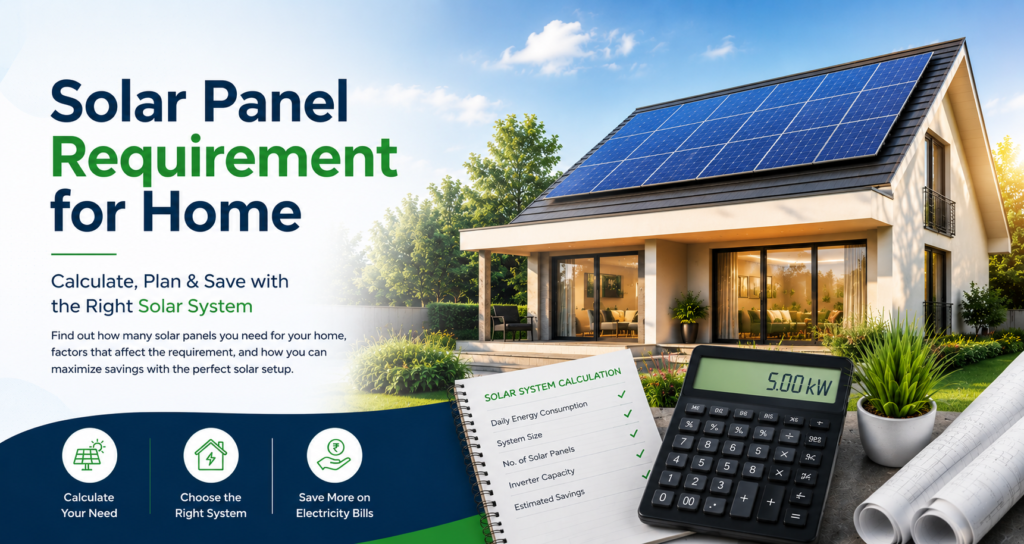
How Many Solar Panels Are Required for a Home?
The number of solar panels required for a home depends mainly on monthly electricity consumption and solar panel wattage. As a simple estimate, a typical home may need a 2 kW to 5 kW solar system, but the right size can be higher or lower depending on electricity usage.
For example, if you choose 500W solar panels:
- 1 kW system: 2 panels
- 2 kW system: 4 panels
- 3 kW system: 6 panels
- 4 kW system: 8 panels
- 5 kW system: 10 panels
However, solar system size should not be decided only by the number of rooms or the size of the house. Your average monthly electricity units, roof space, sunlight, shading, and future power needs are more important.
To calculate your solar panel requirement, first find your average monthly electricity consumption. Then estimate the required solar system capacity and divide it by the wattage of the solar panel you plan to install.
How to Calculate Solar Panel Requirement for Your Home
Calculating the solar panel requirement for your home is easier when you follow three simple steps. You do not need to start by counting the number of rooms or appliances. Start with your electricity consumption and then calculate the solar system size you need.
Step 1: Check Your Monthly Electricity Consumption
Look at your latest electricity bills and check how many units (kWh) you use each month. It is better to check the last 6–12 months and calculate the average, because your usage may change during summer or winter.
Step 2: Calculate Required Solar System Size
Convert your monthly electricity use into an approximate daily requirement and compare it with the expected solar generation in your location. This helps determine whether you may need a 1 kW, 2 kW, 3 kW, 5 kW, or larger solar system.
Step 3: Calculate the Number of Solar Panels
Once you know the required system size, use this simple formula:
Number of Solar Panels = Required Solar Capacity (W) ÷ Panel Wattage (W)
For example, a 3 kW system using 500W panels would need:
3,000 ÷ 500 = 6 panels
The final solar panel requirement should be confirmed after checking your roof space, shading, sunlight, and actual electricity usage.
Solar Panel Requirement Based on Monthly Electricity Consumption
Your monthly electricity consumption is one of the most important factors when calculating the solar panel requirement for your home. The more electricity your home uses, the larger the solar system you may need.
The figures below are general estimates for understanding your requirement. Actual solar generation can vary based on location, sunlight, shading, panel orientation, and system losses.
100 Units per Month
A home using around 100 units per month may need approximately a 1 kW solar system. With 500W panels, this would require about 2 panels.
200 Units per Month
For around 200 units per month, a 1.5–2 kW solar system may be suitable. With 500W panels, this could mean around 3–4 panels.
300 Units per Month
A home using around 300 units per month may need approximately a 2–3 kW solar system. A 3 kW system with 500W panels would use 6 panels.
500 Units per Month
For around 500 units per month, you may need approximately a 3–5 kW solar system. A 5 kW system using 500W panels would require 10 panels.
1,000 Units per Month
A home using around 1,000 units per month may require a 7–10 kW or larger system, depending on local solar conditions and energy usage. The exact requirement should be calculated through a proper site and electricity-consumption assessment.
Remember: Monthly units are a starting point, not the only factor. A professional assessment can help determine the right solar capacity and panel count for your home.
Solar Panel Requirement for Different House Sizes
The solar panel requirement for a home cannot be decided only by the number of bedrooms. Two homes with the same number of rooms can have very different electricity bills. Air conditioners, water heaters, refrigerators, pumps, EV chargers, and other appliances can greatly increase electricity use.
Still, house size can give you a rough starting point when planning residential solar.
1BHK Home
A 1BHK home with low to moderate electricity use may need around 1–2 kW of solar capacity. The actual requirement depends on the monthly electricity units consumed.
2BHK Home
A typical 2BHK home may consider around 2–3 kW of solar capacity if electricity usage is moderate. Homes with heavy AC or appliance usage may need more.
3BHK Home
A 3BHK home may require around 3–5 kW of solar capacity, depending on the number of appliances and monthly electricity consumption.
4BHK and Large Homes
Larger homes may need 5 kW or more, especially when they have multiple ACs, large water heaters, EV charging, or other high-power appliances.
The best approach is to size solar based on your actual electricity consumption, not simply your BHK size. Checking your electricity bills and available roof space will give a much more accurate starting point.
How Many Solar Panels Do You Need Based on Panel Wattage?
The number of solar panels you need also depends on the wattage of each solar panel. A higher-wattage panel can produce more power from each panel, which may reduce the total number of panels needed for the same solar system size.
The basic formula is:
Number of Panels = Required Solar System Capacity ÷ Panel Wattage
For example, a 3 kW solar system requires 3,000 watts of total panel capacity.
400W Solar Panels
A 3 kW system would need about 8 panels of 400W each, providing 3.2 kW of panel capacity.
450W Solar Panels
A 3 kW system would need about 7 panels of 450W each, providing 3.15 kW of panel capacity.
500W Solar Panels
A 3 kW system would need 6 panels of 500W each, providing exactly 3 kW of panel capacity.
Using higher-wattage panels can be useful when roof space is limited, but panel selection should also consider efficiency, quality, warranty, inverter compatibility, roof layout, and overall system design.
The final panel count should always be based on the actual system design rather than panel wattage alone.
How Much Roof Space Is Required for Solar Panels?
The roof space required for solar panels depends on the solar system size, panel wattage, panel dimensions, spacing, and the layout of your roof. You also need enough shadow-free space to allow the panels to receive good sunlight throughout the day.
As a simple estimate, a 1 kW rooftop solar system may require around 80–100 sq. ft. of usable roof area, while larger systems need more space.
For example:
- 1 kW system: around 80–100 sq. ft.
- 2 kW system: around 160–200 sq. ft.
- 3 kW system: around 240–300 sq. ft.
- 5 kW system: around 400–500 sq. ft.
These are only approximate figures. Actual space requirements can change based on the size and wattage of the panels, roof shape, panel arrangement, water tanks, staircases, nearby buildings, and shading.
Before installing solar, the roof should be checked to identify the best available area. A professional site assessment can determine how many panels can safely fit and the most suitable layout for your home.
Common Mistakes When Calculating Solar Requirements
Calculating the solar panel requirement for your home may look simple, but a few common mistakes can lead to choosing a system that is too small or too large. Avoid these mistakes before making a solar investment.
1. Calculating Solar Requirement Only by House Size
A 2BHK or 3BHK does not automatically need a fixed solar capacity. Your actual electricity consumption is more important.
2. Looking at Only One Electricity Bill
Electricity use can change during different months. Check several months of bills to get a better average.
3. Ignoring Future Electricity Needs
If you plan to add an air conditioner, EV charger, water heater, or other appliances, consider that future usage before choosing your system size.
4. Ignoring Roof Space and Shading
Even if you need a large solar system, your roof must have enough usable, shadow-free space for the required panels.
5. Choosing Panels Only by Wattage
Higher-wattage panels are not automatically the best choice. Panel efficiency, quality, warranty, inverter compatibility, roof layout, and overall system design also matter.
6. Assuming an Online Estimate Is the Final Answer
Online calculations provide a useful starting point, but the final solar panel requirement for home should be confirmed through electricity-bill analysis and a proper site assessment.
Should You Install More Solar Panels Than You Need?
Installing more solar panels than your current requirement is not always the best choice. The right approach is to select a solar system that matches your present electricity consumption, available roof space, and expected future needs.
If you expect your electricity use to increase, installing a slightly larger system may make sense. For example, if you are planning to buy an electric vehicle, add an air conditioner, or install other high-power appliances, you can discuss these future needs when designing your solar system.
However, an oversized system can increase your initial investment without providing a useful benefit if you do not consume enough electricity. The amount of electricity you can export to the grid may also depend on applicable net-metering rules and local DISCOM requirements.
Before increasing your solar capacity, consider:
- Your average monthly electricity consumption
- Future electricity requirements
- Available roof space
- Solar generation at your location
- Applicable grid and net-metering rules
- Your budget and expected savings
The goal is not to install the maximum number of panels. The goal is to install the right solar capacity for your home.
Get a Professional Solar Requirement Assessment
Knowing your approximate solar panel requirement for home is a good first step, but the final system size should be based on your actual electricity usage and roof conditions.
Natural Power can help you assess your requirements and choose a solar system that fits your home. The assessment can consider your electricity bills, monthly power consumption, available roof space, shading, sunlight, panel capacity, and future electricity needs.
Instead of guessing how many solar panels you need, you can get a system recommendation based on your home’s actual requirements. This can help you avoid installing a system that is too small or paying for more capacity than you need.
Want to Know How Many Solar Panels Your Home Needs?
Get a Free Solar Consultation from Natural Power.
Share your recent electricity bill and let our solar team help you understand:
Recommended solar system capacity
Approximate number of solar panels
Required rooftop area
Expected solar generation
Suitable system configuration
Installation requirements
Call Natural Power: 8019355353
Email: info@naturalpower.in
Website: naturalpower.in
Get Free Solar Consultation →
Frequently Asked Questions
How many solar panels are required for a home?
How do I calculate my solar panel requirement?
How many solar panels are required for a 2BHK home?
How many solar panels are required for a 3BHK home?
How many 500W solar panels are needed for 3 kW?
How much roof space is needed for home solar?
Can solar panels power my entire home?
Should I install more solar panels for future use?
Is house size enough to calculate solar panel requirements?
How can I find the exact solar panel requirement for my home?
READY TO GO SOLAR?
Types of Home Solar Systems: Complete Guide to Choosing the Right Solar System
- July 31, 2026