


Hybrid Solar System for Home
A hybrid solar system is a smart option for homeowners who want to use solar power, store extra energy in a battery, and stay connected to the electricity grid. Unlike a basic on-grid solar system, a hybrid system can combine solar panels, a hybrid inverter, battery storage, and grid power to manage electricity based on your home’s needs. During the day, solar energy can power your home and charge the battery. Stored energy can then be used when solar generation is low or when backup power is needed, depending on the system design.
A residential solar system can help reduce your dependence on grid electricity and make better use of the energy produced by your rooftop solar panels. The right system depends on your monthly electricity use, roof space, power-cut needs, budget, and local electricity rules. In this guide, you will learn about on-grid, off-grid, and hybrid solar systems, how they work, their costs, benefits, battery needs, and installation process.
- MNRE approved
- Quality products and warranty
- Expert installation team
- After sales support
What Is a Hybrid Solar System?
A hybrid solar system is a home solar power system that combines solar panels, a hybrid inverter, battery storage, and the electricity grid. It allows your home to use solar power during the day, store available excess energy in a battery, and use stored energy when solar power is not available. Grid electricity can also be used when the solar and battery supply is not enough.
A typical hybrid solar system for home works in three ways:
- Solar power: Solar panels generate electricity during the day to run your home.
- Battery storage: Extra solar energy can be stored in the battery for later use.
- Grid power: The electricity grid can supply power when solar generation and stored energy are insufficient.
The hybrid inverter manages the flow of electricity between the solar panels, battery, home, and grid. Depending on the system design, it can also provide backup power to selected home appliances during a grid outage.
A hybrid system can therefore combine the main benefits of rooftop solar, battery storage, and grid connection in one residential solar system.
How Does a Hybrid Solar System Work?
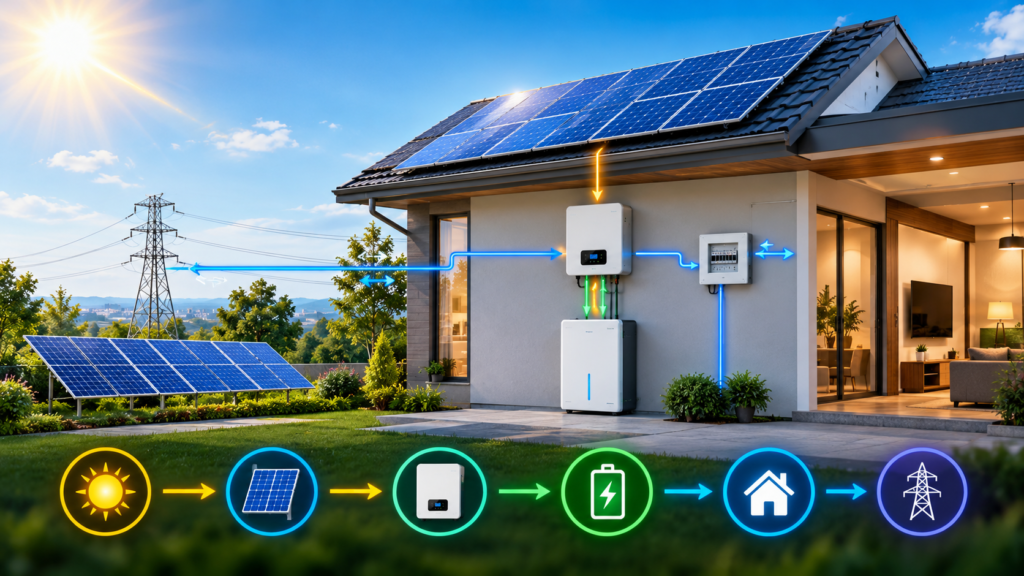
A hybrid solar system works by managing electricity from three main sources: solar panels, a battery, and the electricity grid. A hybrid inverter controls how power moves between these sources and your home.
1. Solar panels generate electricity
During the day, sunlight falls on the solar panels installed on your roof. The panels convert sunlight into electricity. This electricity is sent to the hybrid inverter, which manages the power for your home and battery.
2. Solar power runs your home
The electricity produced by the solar panels can be used to run appliances such as lights, fans, refrigerators, televisions, and other household equipment.
3. Extra solar power charges the battery
If the solar panels produce more electricity than your home is using, the available excess energy can be used to charge the battery. This allows some of the solar energy generated during the day to be saved for later.
4. Stored energy can be used later
When solar generation becomes low, such as in the evening or at night, the battery can supply stored electricity to the home. How long the battery can provide power depends on its usable capacity and the electricity load connected to it.
5. The grid supplies power when needed
If solar generation and available battery energy are not enough to meet your home’s demand, electricity can be taken from the grid. The exact operating sequence depends on the inverter settings and system design.
6. What happens during a power cut?
If the hybrid system is designed with backup functionality, the inverter can supply selected backup loads using battery power and, when available, solar generation. Not every appliance needs to be connected to the backup circuit, and the available backup time depends on the battery capacity and connected load.
Simple Example
Daytime:
Solar panels → Home appliances
↓
Extra solar energy → Battery
Evening/night:
Battery → Home appliances
When solar and battery are insufficient:
Grid → Home
During a grid outage:
Solar + Battery → Selected backup loads, if the system is designed for backup
This flexible flow of electricity is what makes a hybrid solar power system different from a basic on-grid solar system.
Main Components of a Hybrid Solar System
A hybrid solar system uses several components that work together to generate, store, manage, and supply electricity to your home. Each component has a specific job.
1. Solar Panels
Solar panels capture sunlight and convert it into electricity. The number and capacity of panels required depend on your home’s electricity usage, available roof space, and the amount of solar power you want to generate.
2. Hybrid Solar Inverter
The hybrid inverter is the main control unit of the system. It manages electricity from the solar panels, battery, home, and grid. It converts the electricity produced by the panels into a form that household appliances can use and controls battery charging and discharging according to the system design.
3. Solar Battery
The battery stores available solar energy for later use. This stored energy can be useful during the evening, at night, or during a grid outage when the system is configured to provide backup power.
Battery size should be selected based on your required backup load, backup duration, solar generation, and budget.
4. Mounting Structure
A mounting structure securely holds the solar panels on the roof or another suitable location. The structure should be selected according to the roof type, panel arrangement, site conditions, and installation requirements.
5. Protection and Safety Devices
Electrical protection equipment helps protect the solar system and connected appliances from electrical faults. Depending on the system design, this can include suitable AC and DC protection devices, isolators, surge protection, earthing, and other required safety equipment.
6. Net Meter or Metering System
Where applicable, a suitable metering arrangement allows electricity consumption and electricity exported to the grid to be measured according to local electricity regulations and the approved system configuration. The exact requirements can vary by location and utility.
7. Solar Monitoring System
A monitoring system can show information such as solar generation, battery status, household consumption, and grid usage. Depending on the equipment, this information may be available through an inverter display or mobile application.
How These Components Work Together
Solar panels generate electricity → Hybrid inverter manages the power → Home uses the electricity → Battery stores available excess energy → Grid provides additional power when required.
The exact equipment and configuration should be selected after checking the home’s electricity usage, roof conditions, backup requirements, and local electrical requirements.
On-Grid vs Off-Grid vs Hybrid Solar System
Choosing the right residential solar system depends on how you use electricity, how reliable your grid supply is, and whether you need battery backup. The three common options are on-grid, off-grid, and hybrid solar systems.
| Feature | On-Grid Solar | Off-Grid Solar | Hybrid Solar |
|---|---|---|---|
| Grid connection | Yes | No | Yes |
| Solar panels | Yes | Yes | Yes |
| Battery storage | Normally not required | Required | Yes |
| Grid electricity | Available | Not used | Available |
| Backup during grid outage | Normally no | Yes | Yes, when designed for backup |
| Solar energy storage | Normally no | Yes | Yes |
| Net metering | Where permitted | Not applicable | Depends on system and applicable rules |
| Main purpose | Reduce electricity bills | Generate and store power without the grid | Solar generation + battery storage + grid support |
| Suitable for | Homes with reliable grid supply | Homes needing an independent power source | Homes wanting solar, storage and backup |
On-Grid Solar System
An on-grid solar system is connected to the electricity grid. Solar power is used by the home, while electricity can be taken from the grid when solar generation is not enough. Where local rules allow, excess electricity may be exported to the grid through an approved metering arrangement.
This type of system is commonly considered when the main goal is to generate solar electricity and reduce grid electricity consumption.
Off-Grid Solar System
An off-grid solar system operates without a grid connection. Solar panels generate electricity and batteries store energy for use when sunlight is unavailable.
Battery capacity is important because the stored energy needs to support the home’s required loads when solar generation is low.
Hybrid Solar System
A hybrid solar system combines solar panels, battery storage, and grid connection. It can use solar energy during the day, store available excess energy in the battery, and use stored energy later. Grid electricity can support the home when solar and battery power are insufficient.
A properly designed hybrid system can also provide backup power to selected loads during a grid outage.
Which System Should You Consider?
There is no single solar system that suits every home. An on-grid system may suit a home that mainly wants to reduce electricity purchases from the grid. An off-grid system may suit a property that needs to operate without a grid connection. A hybrid solar system may suit homeowners who want solar generation together with battery storage, grid support, and backup capability.
Your electricity usage, roof space, grid availability, backup requirements, battery needs, budget, and local electricity rules should be considered before selecting a system.
Benefits of a Hybrid Solar System for Homes
A hybrid solar system for home combines solar generation, battery storage, and grid electricity. This gives homeowners more ways to manage the electricity they generate and use. The actual benefits depend on the system size, battery capacity, electricity usage, local grid conditions, and system design.
1. Use More of Your Solar Energy
Solar panels produce electricity mainly during the day. If your home is not using all the electricity being generated, the available excess energy can be stored in the battery for later use, depending on the system configuration.
2. Get Battery Backup During Power Cuts
A hybrid system can provide backup power when the electricity grid goes down if the inverter and battery are designed for backup operation. The battery can supply selected appliances such as lights, fans, Wi-Fi equipment, or other essential loads.
The backup time depends on the battery’s usable capacity and the amount of electricity being used.
3. Reduce Dependence on Grid Electricity
Solar energy can supply part of your home’s electricity needs during the day. Stored solar energy can also be used later when the system is designed for battery operation. This can reduce the amount of electricity your home needs to take from the grid.
4. Store Solar Energy for Later Use
One of the main features of a hybrid solar power system is energy storage. Instead of using all available solar electricity immediately, the system can store some of it in the battery for use when solar generation is low.
5. Manage Solar, Battery and Grid Power
The hybrid inverter manages the flow of electricity between the solar panels, battery, home, and grid. This allows the system to automatically use the available energy according to its settings and operating conditions.
6. Support Essential Home Loads
A hybrid system can be designed to keep selected appliances running during a grid outage. Instead of trying to power every appliance, homeowners can choose essential loads based on their backup requirements and available battery capacity.
7. Combine Solar Power and Battery Storage
An on-grid solar system and a battery-based backup system serve different purposes. A hybrid solar system brings solar generation and battery storage together while maintaining a grid connection.
8. Better Control Over Home Energy Use
With a suitable monitoring system, homeowners can track solar generation, battery status, household consumption, and grid usage. This information can help identify when and where electricity is being used.
Important Point
A hybrid solar system does not automatically guarantee a specific amount of electricity-bill savings or backup time. Results depend on factors such as solar system capacity, battery size, household consumption, sunlight availability, appliance load, roof conditions, and local electricity rules.
A proper site assessment and system design can help determine the right solar and battery capacity for your home.
Is a Hybrid Solar System Right for Your Home?
A hybrid solar system can be considered by homeowners who want to generate solar electricity, store energy in a battery, and keep a connection to the electricity grid. Whether it is suitable for your home depends on your electricity usage, power-cut needs, roof space, budget, and local electricity conditions.
A Hybrid Solar System May Suit Your Home If:
- You want to use solar power during the day and store available excess energy.
- Your home experiences regular power cuts and you need battery backup.
- You use a significant amount of electricity in the evening or at night.
- You want solar generation together with battery storage.
- You want the grid available as an additional source of electricity.
- You need backup power for selected essential appliances.
- You have suitable roof space for solar panels.
An On-Grid System May Suit Your Home If:
- Your main goal is to reduce electricity purchased from the grid.
- Your area has a reliable electricity supply.
- You do not need battery backup.
- You want a simpler solar setup without adding battery storage.
An Off-Grid System May Suit Your Home If:
- A reliable grid connection is not available.
- You need a solar power system that can operate independently of the grid.
- You are prepared to install enough battery storage for your electricity needs.
What Should You Check Before Choosing?
Before installing a hybrid solar system for home, consider:
Monthly electricity consumption – Check your recent electricity bills to understand how much energy your home uses.
Power-cut frequency – Consider how often outages occur and how long you need backup power.
Backup loads – Decide which appliances must continue working during an outage.
Roof space – Check whether enough suitable space is available for the required solar panels.
Battery capacity – Choose storage based on the backup load and required backup duration.
Solar capacity – The solar system should be sized according to your electricity usage and available roof space.
Local electricity rules – Check the current requirements of the relevant electricity distribution company before installation.
Total system cost – Consider the solar panels, inverter, battery, mounting structure, electrical protection, installation, and other required equipment.
There is no single hybrid solar system size that is suitable for every home. A site survey and electricity-use assessment can help determine the appropriate solar capacity, hybrid inverter, and battery storage for your requirements.
Hybrid Solar System Cost in India
The hybrid solar system cost depends on the size of the solar panels, battery capacity, inverter, installation requirements, and the type of equipment selected. There is no single price that fits every home because each residential solar system is designed according to the home’s electricity needs.
The main factors that affect the hybrid solar system price in India include:
Solar System Capacity
A larger solar system requires more panels and related equipment. The required capacity depends on your monthly electricity consumption, available roof space, and the amount of solar power you want to generate.
Battery Capacity
Battery storage can make a significant difference to the overall system cost. A larger battery stores more energy and can provide longer backup, but it also increases the initial investment.
Hybrid Inverter
The inverter must be selected according to the solar capacity, battery system, household load, and required backup configuration. Different inverter capacities and features can have different prices.
Solar Panel Type
The type, efficiency, warranty, and manufacturer of the solar panels can affect the overall cost of the system.
Installation and Electrical Work
The final cost may also include mounting structures, electrical protection equipment, wiring, installation, testing, commissioning, and other site-specific work.
Roof and Site Conditions
A simple rooftop installation may have different requirements from a site with difficult roof access, additional structural work, long cable runs, or other installation challenges.
Hybrid Solar System Price: What Should You Compare?
When comparing quotations, do not look only at the total price. Check:
- Solar panel capacity and specifications
- Hybrid inverter capacity and warranty
- Battery type and usable capacity
- Mounting structure
- Protection and safety equipment
- Installation and commissioning
- Monitoring system
- Warranty and after-sales support
- Applicable taxes and other charges
- Any applicable government scheme or local requirements
For an accurate hybrid solar system cost for your home, the system should be sized after reviewing your electricity bills, roof space, household load, and backup requirements.
Natural Power can assess your requirements and help you understand the suitable solar and battery configuration before installation.
How Much Solar Capacity Does Your Home Need?
The right solar system capacity for a home depends mainly on your electricity consumption, available roof space, sunlight conditions, and the amount of electricity you want your solar system to generate. There is no single solar capacity that is right for every house.
Common residential solar system sizes include 2 kW, 3 kW, 5 kW, 7.5 kW, and 10 kW, but the suitable size should be decided after checking your actual electricity usage and site conditions.
Start With Your Electricity Bill
Your recent electricity bills are a useful starting point. Look at your monthly or annual electricity consumption to understand how much energy your home uses.
For example, a home with a higher electricity demand may require a larger solar system than a home with lower consumption. Appliances such as air conditioners, refrigerators, water heaters, pumps, and other high-power equipment can also affect the required capacity.
Check Your Available Roof Space
Solar panels need suitable space with good exposure to sunlight. The required roof area depends on the panel size, panel efficiency, system capacity, roof layout, and installation arrangement.
Shading from nearby buildings, trees, or other structures should also be checked because it can affect solar generation.
Consider Your Future Electricity Needs
When choosing a solar capacity, think about whether your electricity use may increase in the future. For example, you may plan to add an air conditioner, electric vehicle charger, water heater, or other electrical equipment.
Solar Capacity and Battery Capacity Are Different
For a hybrid solar system, the solar panel capacity and battery capacity should be considered separately.
- Solar capacity determines how much solar electricity the panels can generate.
- Battery capacity determines how much energy can be stored for later use.
- Inverter capacity determines how much electrical power the system can manage and supply according to its design.
A larger solar system does not automatically mean longer backup. Backup duration depends mainly on the usable battery capacity and the electricity load connected during backup.
How to Choose the Right Size
A proper assessment should consider:
Recent electricity consumption
Major household appliances
Available roof area
Shading and roof orientation
Required solar generation
Backup load
Required backup duration
Battery capacity
Future electricity requirements
Local electrical and grid requirements
For an accurate recommendation, a solar site survey and electricity-use assessment should be completed before selecting the final system size.
How Much Battery Storage Does a Home Need?
The right battery capacity for a hybrid solar system depends on how much electricity your home needs during the time you want battery backup. It is not necessary to size the battery only by looking at the solar panel capacity.
A battery should be selected based on your backup load, required backup time, usable battery capacity, solar generation, and budget.
Start With Your Backup Loads
First, identify the appliances you want to keep running during a power cut. These may include:
- Lights
- Fans
- Refrigerator
- Wi-Fi router
- Television
- Computers
- Security systems
- Other essential appliances
High-power appliances such as air conditioners, electric water heaters, induction cookers, and pumps may require significantly more battery capacity if you want to operate them during an outage.
Consider How Long You Need Backup
Think about how many hours you want your battery to support the selected appliances.
For example, a home that only needs a few essential appliances for a short outage may need less storage than a home that wants to operate several appliances for many hours.
A simple way to understand battery sizing is:
Required battery energy ≈ Backup load × Required backup time
The actual battery size also needs to account for usable battery capacity, inverter efficiency, battery limits, and other system losses.
Battery Capacity and Solar Capacity Work Together
In a hybrid solar system, the solar panels generate energy while the battery stores available energy for later use. The solar system should therefore be designed so that the panels, inverter, battery, and household loads work together.
A battery that is too small may not provide the required backup duration. A battery that is much larger than your actual needs may increase the initial system cost without providing a useful benefit.
What Battery Type Should You Choose?
Residential solar systems can use different battery technologies. Lithium-based batteries, including lithium iron phosphate (LiFePO4) batteries, are commonly used in modern energy-storage applications. Battery selection should consider usable capacity, expected operating conditions, warranty, safety features, installation requirements, and overall cost.
What Information Is Needed to Size a Battery?
Before selecting a battery for your home hybrid solar system, check:
Which appliances need backup?
How much power do those appliances use?
How many hours of backup are required?
How much solar energy is available?
What battery chemistry is being considered?
What usable battery capacity is available?
What inverter capacity is required?
A professional site assessment can help match the solar panels, hybrid inverter, and battery storage to your home’s actual electricity and backup requirements.
Does a Hybrid Solar System Work During a Power Cut?
Yes, a hybrid solar system can provide backup power during a grid outage when it is designed and installed with backup functionality. The battery supplies stored energy to the selected backup loads, and solar panels may continue to generate electricity when sunlight is available and the system is designed to operate in this condition.
A standard on-grid solar system normally shuts down during a grid outage because it is connected directly to the electricity grid and must follow grid-safety requirements. A hybrid system can be configured differently because it includes a battery and an inverter capable of supporting backup loads.
What Happens During a Power Cut?
When the grid supply fails, the hybrid inverter detects the outage and switches the configured backup loads to the available battery supply.
The basic flow is:
Battery → Hybrid inverter → Backup loads
When sunlight is available:
Solar panels + Battery → Hybrid inverter → Backup loads
The exact operation depends on the inverter, battery, system configuration, and applicable safety requirements.
How Long Will the Backup Last?
Backup time depends on several factors, including:
- Battery’s usable capacity
- Number of appliances connected
- Power consumed by those appliances
- Solar generation during the outage
- Inverter efficiency
- Battery condition and operating limits
For example, running a few lights, fans, and a Wi-Fi router will generally use much less energy than running several air conditioners and other high-power appliances.
Can the Whole House Run During a Power Cut?
Not necessarily. A hybrid solar system can be designed to supply selected backup loads or, where the equipment and system design allow it, a larger portion of the home’s load.
The backup system should be sized according to the appliances you actually want to operate during an outage. High-power appliances can require a much larger inverter and battery system.
Can Solar Charge the Battery During a Power Cut?
In a suitably designed system, solar generation can continue to support the backup loads and charge the battery when sunlight is available. However, this depends on the hybrid inverter’s capabilities, system configuration, battery state, and safety requirements.
For this reason, homeowners should discuss their expected backup loads and outage requirements with the installer before choosing a hybrid solar system for home.
Hybrid Solar System and Net Metering
Net metering is a system that measures electricity moving between a home and the electricity grid. When a grid-connected solar system produces more electricity than the home is using, eligible excess electricity may be exported to the grid. Electricity taken from the grid is also measured according to the approved metering arrangement.
For a hybrid solar system, the relationship between battery storage, solar generation, and the grid depends on the system design and the rules followed by the local electricity distribution company.
How Does Net Metering Work With Solar?
A simple example is:
Solar generation → Home consumption → Available excess → Grid export
When the home needs more electricity than the solar system is producing:
Grid → Home consumption
The actual billing treatment depends on the applicable electricity regulations and approved metering arrangement.
Does a Hybrid Solar System Need a Net Meter?
Not every hybrid system has the same metering arrangement. A hybrid system can be designed with different operating modes depending on whether it is intended to interact with the electricity grid and whether grid export is permitted.
If you want to use a hybrid solar system with net metering, the system should be checked against the current requirements of the relevant electricity distribution company before installation.
Hybrid Solar vs On-Grid Solar With Net Metering
An on-grid solar system is primarily designed to work with the electricity grid and can use an approved net-metering arrangement where permitted.
A hybrid solar system adds battery storage to the solar and grid connection. This gives the system another way to use available solar energy by storing it for later use.
The key difference is the presence of battery storage and backup capability, not simply the presence of a net meter.
What Should Homeowners Check?
Before installing a grid-connected hybrid system, check:
- Current net-metering rules in your area
- Requirements of the local DISCOM
- Approved system capacity limits, if applicable
- Metering and interconnection requirements
- Whether the selected inverter is suitable for the proposed configuration
- Applicable government scheme or subsidy requirements
- Required approvals and documentation
Because electricity regulations and implementation requirements can change, homeowners should confirm the latest requirements with the relevant DISCOM or authorized installer before finalizing the system.
For Natural Power customers, the system design can be planned around the home’s electricity usage, solar capacity, battery requirement, and applicable grid requirements.
Hybrid Solar System Installation Process
Installing a hybrid solar system for home involves more than simply placing solar panels on the roof. The solar panels, hybrid inverter, battery, electrical protection, grid connection, and backup loads need to work together safely.
A typical hybrid solar installation process includes the following steps.
1. Electricity Bill and Load Assessment
The process starts by reviewing your recent electricity bills and understanding how much electricity your home uses. The installer should also identify major appliances and the loads you want to keep running during a power cut.
2. Solar Site Survey
A site survey checks the available roof space, sunlight exposure, shading, roof condition, panel placement, cable routes, and other installation requirements.
This helps determine whether the proposed solar capacity can be installed safely and effectively.
3. Solar and Battery System Design
Based on the electricity usage and site conditions, the system can be designed with the appropriate:
- Solar panel capacity
- Hybrid inverter
- Battery capacity
- Mounting structure
- Protection equipment
- Backup loads
- Electrical connections
The battery should be sized according to the required backup load and backup duration rather than simply choosing the largest available battery.
4. Equipment Selection
The required solar panels, hybrid inverter, battery, mounting structure, cables, protection devices, and other equipment are selected according to the approved system design.
Product specifications, warranties, compatibility, safety requirements, and applicable standards should be checked before installation.
5. Solar Panel Installation
The mounting structure is installed on the suitable roof area, followed by installation of the solar panels. Panels are positioned to receive suitable sunlight while considering shading, roof conditions, and the overall system layout.
6. Inverter and Battery Installation
The hybrid inverter and battery are installed in suitable locations with appropriate ventilation, protection, accessibility, and electrical connections.
The inverter is then connected to the solar panels, battery, household electrical system, and grid according to the system design.
7. Electrical Protection and Grid Connection
Required electrical protection equipment, earthing, isolation, wiring, and other safety measures are completed. Where the system is connected to the grid, the applicable utility and metering requirements must also be followed.
8. Testing and Commissioning
After installation, the system is tested to check solar generation, battery charging and discharging, grid operation, monitoring, and backup functionality where applicable.
The installer should also explain the basic operation and monitoring of the system to the homeowner.
9. System Monitoring
After commissioning, homeowners can monitor important information such as solar generation, household consumption, battery status, and grid usage, depending on the inverter and monitoring system installed.
A properly planned installation helps ensure that the solar panels, hybrid inverter, battery, home loads, and grid connection operate together as intended.
Hybrid Solar System Maintenance
A hybrid solar system needs regular basic care to keep the solar panels, inverter, battery, and electrical connections working properly. The exact maintenance needs depend on the equipment installed, site conditions, weather, and battery type.
1. Keep Solar Panels Clean
Dust, dirt, bird droppings, and other material can reduce the amount of sunlight reaching the panels. Regular cleaning can help keep the panels operating properly.
The cleaning frequency depends on the local environment. Areas with more dust may need more frequent cleaning.
2. Monitor Solar Generation
Check the system monitoring app or inverter display regularly, if available. A sudden or unusual drop in solar generation may indicate shading, equipment issues, wiring problems, or other faults that need inspection.
3. Check the Battery
The battery should be monitored according to the manufacturer’s instructions. Important factors can include battery status, temperature, charging and discharging behavior, and warning messages.
Lithium-based batteries generally have different maintenance requirements from older battery technologies, so always follow the manufacturer’s instructions.
4. Inspect the Hybrid Inverter
The inverter should be kept in a suitable location and protected from excessive heat, moisture, and other conditions that could affect its operation. Warning lights, error messages, or unusual system behavior should be checked by a qualified technician.
5. Check Electrical Connections
Electrical connections, cables, protection devices, earthing, and other system components should be inspected when required. Any damaged cable, loose connection, unusual smell, overheating, or electrical fault should be handled by a qualified professional.
6. Check the Mounting Structure
The solar panel mounting structure should be inspected for signs of corrosion, loose fasteners, damage, or other issues, especially after severe weather.
7. Review System Performance
It is useful to compare your solar generation and electricity consumption over time. This can help identify changes in system performance and determine whether professional inspection is required.
How Often Should a Hybrid Solar System Be Serviced?
There is no single maintenance schedule for every home hybrid solar system. Follow the maintenance recommendations provided by the equipment manufacturers and installer. Professional inspections can also be scheduled based on the system type, site conditions, and warranty requirements.
Good maintenance helps protect your investment and allows potential problems to be identified before they become larger issues.