
On Grid Solar System for Home
An on grid solar system is a rooftop solar power system that is connected to the electricity grid. It allows your home to use electricity generated by solar panels during the day and send extra power to the grid through an approved net metering setup. When your solar panels are not producing enough electricity, such as at night, your home can continue to use power from the grid. Unlike an off-grid or hybrid solar system, a standard on-grid solar system usually does not need batteries, which can make it a more affordable choice for homes that already have a reliable grid connection.
A residential solar system can help reduce your dependence on grid electricity and make better use of the energy produced by your rooftop solar panels. The right system depends on your monthly electricity use, roof space, power-cut needs, budget, and local electricity rules. In this guide, you will learn about on-grid, off-grid, and hybrid solar systems, how they work, their costs, benefits, battery needs, and installation process.
- MNRE approved
- Quality products and warranty
- Expert installation team
- After sales support
What Is an On Grid Solar System?
An on grid solar system is a solar power system that is connected directly to the electricity grid. It uses solar panels to generate electricity for your home and a grid-connected solar inverter to convert the electricity into a form that your household appliances can use.
During the day, your solar panels produce electricity from sunlight. Your home uses this solar power first. If the panels produce more electricity than your home needs, the extra power can be sent to the electricity grid through net metering, where permitted by the local electricity regulations.
When your solar system is not producing enough power, such as at night or during periods of low sunlight, your home can take electricity from the grid as usual.
Unlike an off-grid or hybrid solar system, a standard on-grid solar system for home normally does not include batteries. This can make it a practical choice for homeowners who already have a reliable grid connection and mainly want to reduce their electricity bills.
How Does an On Grid Solar System Work?
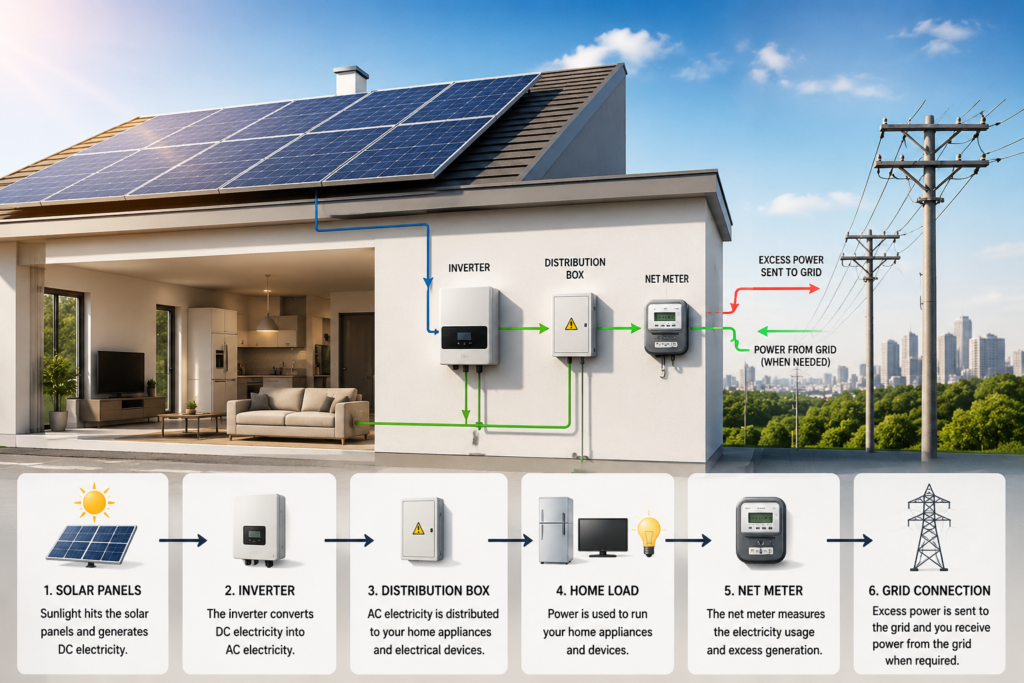
An on grid solar system works by connecting your home’s solar panels to the electricity grid through a grid-connected solar inverter. The system does not normally need batteries because the electricity grid can supply power when your solar panels are not producing enough electricity.
The process is simple:
- Solar panels capture sunlight and generate DC electricity.
- The solar inverter converts DC electricity into AC electricity that your home appliances can use.
- Your home uses solar power first to run appliances such as fans, lights, refrigerators and other electrical equipment.
- Extra solar electricity can be sent to the grid through an approved net-metering arrangement.
- When solar power is not enough, your home can take electricity from the grid.
For example, if your on grid solar system for home produces more electricity than your house needs during the afternoon, the extra electricity may flow to the grid. A bi-directional meter records electricity flowing in both directions, where the applicable rules allow it.
One important point is that a standard on-grid system normally does not provide backup during a grid power outage. This is because grid-connected solar systems are designed to stop supplying power when the grid is down, helping protect people working on the electricity network.
The exact connection, net-metering process and applicable requirements can vary by state and DISCOM. MNRE recognizes grid-connected rooftop solar as a residential solar option, while state-level rules govern many practical grid-connection details.
On Grid Solar System Components
An on grid solar system has several important components that work together to generate and use solar electricity safely. Each part has a specific job, from producing electricity to sending extra power to the grid.
| Component | What it does |
|---|---|
| Solar panels | Capture sunlight and generate electricity. |
| Grid-connected solar inverter | Converts the electricity from the panels into electricity that your home appliances can use. |
| Mounting structure | Holds the solar panels securely on the roof. |
| DCDB | Helps protect the DC side of the solar system from electrical problems. |
| ACDB | Provides protection on the AC side between the inverter and your home/grid connection. |
| Solar cables | Carry electricity between the solar panels, inverter, home and electrical system. |
| Earthing system | Provides an important safety path for unwanted electrical current. |
| Net meter | Records electricity moving between your home and the grid, where net metering is approved. |
| Solar monitoring system | Helps you check solar generation and system performance. |
The exact components can vary depending on the on grid solar system size, equipment selected, roof conditions and local electrical requirements. A properly designed residential on-grid solar system should include suitable protection and be installed according to applicable electrical and grid-connection requirements.
Benefits of an On Grid Solar System
An on grid solar system for home can be a practical choice for homeowners who already have a reliable electricity connection and want to reduce their dependence on grid electricity. Because the system is connected to the grid, your home can use solar power when it is available and draw electricity from the grid when needed.
1. Helps Reduce Electricity Bills
Your solar panels generate electricity during daylight hours. Your home can use this electricity to run everyday appliances such as fans, lights, refrigerators, televisions and other equipment. This can reduce the amount of electricity you need to buy from the grid.
2. Usually Does Not Need Batteries
A standard on grid solar system normally works without a battery. This can reduce the upfront cost and avoids the need to maintain and replace a battery as part of the solar system.
This makes on-grid solar different from an off-grid system, where batteries are generally needed to store electricity for use when solar power is unavailable.
3. Extra Solar Power Can Go to the Grid
If your solar panels produce more electricity than your home is using, the extra electricity can be exported to the grid through an approved net-metering arrangement.
A suitable meter records electricity flowing between your home and the grid according to the applicable rules.
4. Makes Good Use of Your Rooftop
A residential rooftop can be used to generate electricity instead of leaving the available roof space unused. Solar PV systems can generate power close to where it is consumed, which is one reason rooftop solar is an important part of India’s distributed solar development.
5. Can Be a Good Long-Term Investment
A properly sized and installed residential on-grid solar system can continue generating electricity for many years. The financial benefit depends on the system cost, electricity bill savings, solar generation, maintenance and applicable policies.
Before buying a system, it is better to compare the expected cost and savings rather than choosing a system only because it has a lower price.
6. Residential Solar Support May Be Available
Eligible residential consumers may be able to receive government financial support for grid-connected rooftop solar under applicable schemes. The current PM Surya Ghar framework provides Central Financial Assistance for eligible residential rooftop solar installations, subject to the scheme’s conditions and process.
7. Can Reduce Dependence on Grid Electricity
By generating part of your home’s electricity from sunlight, an on grid solar system can reduce the amount of electricity you need to purchase from the grid during suitable solar-generation hours.
Disadvantages of an On Grid Solar System
An on grid solar system can help reduce electricity bills, but it is not the right choice for every home. Before installing one, homeowners should understand its limitations as well as its benefits. This helps you make a better and more informed decision.
It Usually Does Not Provide Backup During a Power Cut
A standard on-grid solar system for home normally does not work as a backup power source when the electricity grid goes down. The solar inverter is designed to stop supplying power during a grid outage.
This is an important safety feature because the solar system must not continue sending electricity into a grid that may be under repair. Grid-connected inverters are required to have protection against islanding.
It Depends on the Electricity Grid
An on-grid system is designed to work along with the local electricity grid. If there is a grid failure, the normal system will not continue powering your home simply because the sun is shining.
This is one of the main differences between an on-grid, off-grid and hybrid solar system.
Initial Installation Cost
Installing an on-grid solar system requires an upfront investment for solar panels, inverter, mounting structure, cables, protection equipment and installation.
The final on grid solar system price depends on factors such as system capacity, equipment, roof condition, installation work and applicable requirements. A cheaper quotation is not always the best choice if it uses poor-quality equipment or does not include important installation and safety work.
Net Metering Depends on Applicable Rules
The benefit of exporting extra solar electricity depends on the applicable net-metering or other grid-settlement arrangement and the requirements of the local DISCOM.
For residential rooftop solar under the PM Surya Ghar scheme, the official guidelines define a residential rooftop system as a grid-connected solar system linked to a residential electricity connection of the local DISCOM.
Your Roof Must Be Suitable for Solar
Not every roof is ideal for solar panels. Available space, shade, roof condition, direction, panel placement and structural considerations can affect the system design.
A proper site survey should be completed before deciding the on grid solar system size.
Solar Generation Changes With Weather
Solar panels need sunlight to generate electricity. Generation can be lower during cloudy or rainy weather and there is no solar generation from the panels at night.
Your home can continue receiving electricity from the grid when solar generation is not enough, but the amount of solar power produced will naturally change throughout the day and year.
Submit Required Documents
You may need to submit the required installation and bank-related documents through the applicable process. Make sure all information is correct to avoid delays.
Subsidy Processing
Once the installation, verification, and required documentation are successfully completed, the applicable subsidy is processed according to the current government guidelines.
Is an On Grid Solar System Still a Good Choice?
For a home with a reliable grid connection and a main goal of reducing electricity bills, an on-grid solar system can still be a practical option. However, if your main priority is backup power during outages, you should consider a hybrid or battery-based solution.
The right choice depends on your electricity usage, roof, budget, grid reliability and energy needs—not simply the lowest on grid solar system price.
On Grid Solar System Price
The on grid solar system price for a home depends on the system capacity, solar panels, inverter, mounting structure, electrical protection, installation work and other requirements. There is no single price that is correct for every house.
The most important step is to first find out how much solar power your home actually needs. A system that is too small may not provide the expected savings, while a system that is much larger than your electricity needs may increase the initial investment without giving the best value.
What Affects the On Grid Solar System Price?
Several factors can change the final cost:
- Solar system capacity – such as 1 kW, 2 kW, 3 kW or 5 kW
- Solar panel type and quality
- Solar inverter and its capacity
- Mounting structure required for your roof
- Cables and electrical protection equipment
- Roof type and installation difficulty
- System design and site conditions
- Net-metering and grid-connection requirements
- Applicable government subsidy or CFA
The price should therefore be based on your actual home requirements rather than a standard per-kW figure.
What Is the Price of a 1 kW, 2 kW, 3 kW or 5 kW On Grid Solar System?
The following capacities are commonly considered for residential solar:
| System Size | Generally Suitable For |
|---|---|
| 1 kW | Smaller electricity requirements |
| 2 kW | Small homes with moderate usage |
| 3 kW | Homes with moderate to higher electricity usage |
| 5 kW | Larger homes or higher electricity consumption |
These are only general examples. Your electricity bills and available roof space should be checked before choosing the system size.
Does Solar Subsidy Reduce the Cost?
Eligible residential consumers may receive Central Financial Assistance (CFA) under the applicable PM Surya Ghar: Muft Bijli Yojana rules. The official scheme provides CFA for eligible residential rooftop solar systems, with the current structure covering the first 2 kW and an additional 1 kW, subject to the scheme’s conditions.
The PM Surya Ghar scheme is scheduled to run through 31 March 2027, according to the official implementation guidelines.
However, subsidy should not be treated as a fixed discount on every solar quotation. Eligibility, approved equipment, installation, verification and other requirements apply. The Ministry of New and Renewable Energy also states that residential rooftop solar CFA is linked to installation and verification through the applicable process.
How to Find the Right Price for Your Home
Instead of choosing a solar system based only on its advertised price, compare:
Your electricity consumption → Required system capacity → Equipment → Installation → Applicable subsidy → Expected savings
How Much Solar Capacity Does Your Home Need?
Choosing the right on grid solar system for home starts with your electricity consumption. A larger solar system is not always better. The ideal size should match your monthly electricity use, available roof space, sunlight and local requirements.
As a general guide, the PM Surya Ghar programme gives indicative rooftop solar capacity based on household electricity consumption. Homes using around 0–150 units per month may need about 1–2 kW, those using 150–300 units may need around 2–3 kW, while homes using more than 300 units may need a system above 3 kW. These are only starting points, not a fixed rule for every home.
How to Choose Your On Grid Solar System Size
Start with your recent electricity bills and check your average monthly consumption.
For example:
| Average Monthly Consumption | Indicative Solar Capacity |
|---|---|
| 0–150 units | 1–2 kW |
| 150–300 units | 2–3 kW |
| Above 300 units | 3 kW or more |
Your actual requirement can be different because solar generation depends on factors such as sunlight, roof conditions, shading, panel efficiency and system design.
How Much Roof Space Is Required?
Roof space is another important factor. The National Portal for Rooftop Solar states that a 1 kW rooftop solar system generally needs around 10 square metres of shadow-free area, although the actual space can vary depending on the panels and their placement.
So, before choosing a 3 kW or 5 kW on grid solar system, a professional site assessment should check your usable roof area and shading.
What Is the Best Solar System Size for Your Home?
The best size is the one that matches your electricity consumption and practical roof conditions. A solar professional can review your electricity bills, inspect your roof and recommend a suitable system capacity.
On Grid Solar System and Net Metering
Net metering is an important part of many residential on grid solar systems. It allows electricity generated by your rooftop solar panels to be used in your home and, where approved under the applicable rules, allows surplus electricity to flow to the electricity grid.
How Does Net Metering Work?
The process is simple:
Solar panels generate electricity → Your home uses solar power → Extra power goes to the grid → Meter records the electricity flow
For example, imagine your solar panels are producing more electricity than your home needs in the afternoon. Instead of wasting the extra electricity, the surplus can be exported to the grid under the applicable net-metering arrangement.
When your home needs more electricity than the solar system is producing, such as at night, electricity can be taken from the grid.
A bi-directional meter records electricity moving in both directions. The final billing or settlement is then handled according to the rules applicable to your location and electricity provider.
What Is a Net Meter?
A net meter is a meter that can record both:
- Electricity your home takes from the grid
- Electricity your solar system sends to the grid
This makes it different from a basic electricity meter that only records electricity coming into your home.
Does Every On Grid Solar System Have Net Metering?
Not automatically. The availability, approval process and settlement method depend on the applicable state regulations and DISCOM requirements.
For residential consumers under the national rooftop solar programme, the Ministry of New and Renewable Energy also provides for grid-connected rooftop solar through the applicable government process and DISCOM verification.
Why Is Net Metering Important for Homeowners?
Net metering can make an on grid solar system for home more useful because electricity that your solar panels produce but your home does not immediately need can be exported to the grid, subject to the applicable rules.
However, homeowners should not assume that every unit exported will automatically result in the same amount being deducted from their bill. The actual billing and settlement method depends on the current regulations and the arrangement approved by the local DISCOM.
On Grid Solar System Subsidy
Homeowners can reduce the initial cost of an on grid solar system through eligible government subsidy support. In India, the PM Surya Ghar: Muft Bijli Yojana provides Central Financial Assistance (CFA) for eligible residential rooftop solar installations. The scheme is designed for residential consumers and is implemented through the national rooftop solar portal and the concerned DISCOM process.
How Much Subsidy Is Available?
Under the current PM Surya Ghar CFA structure:
| Solar Capacity | Applicable CFA Structure |
|---|---|
| First 2 kW | 60% of the applicable benchmark cost |
| Additional 1 kW | 40% of the applicable benchmark cost |
| Above 3 kW | No additional CFA |
The published scheme documents also describe the commonly stated maximum residential CFA as ₹78,000 for systems of 3 kW or more, subject to the scheme’s eligibility and applicable conditions.
Who Can Get the Subsidy?
The CFA is intended for eligible residential electricity consumers installing qualifying grid-connected rooftop solar systems. The installation and verification process must follow the applicable government and DISCOM requirements.
This means you should not assume that every solar installation automatically qualifies for the subsidy.
How Does the Solar Subsidy Process Work?
The general process involves:
Apply through the approved portal → Choose an eligible vendor → Install the rooftop solar system → DISCOM verification → Subsidy/CFA processing
The Ministry of New and Renewable Energy states that, under the national portal mechanism, the CFA is transferred to the consumer’s account after successful installation by an empanelled vendor and verification by the State DISCOM.
Is an On Grid Solar System Eligible for Subsidy?
Eligible residential grid-connected rooftop solar systems can qualify under PM Surya Ghar, subject to the scheme’s conditions. This makes an on grid solar system for home particularly relevant for homeowners looking to reduce their electricity bills while using available government support.
On Grid Solar System vs Off Grid vs Hybrid Solar System
When choosing solar for your home, you may come across three common options: on-grid, off-grid and hybrid solar systems. All three use solar panels, but they work differently and are designed for different needs.
On Grid Solar System
An on grid solar system is connected to the electricity grid. Your home can use solar power during the day, while electricity can come from the grid when solar generation is not enough. Surplus solar electricity may be exported to the grid through an approved arrangement such as net metering.
A standard on-grid system usually does not include batteries.
Off Grid Solar System
An off-grid solar system is designed to work without depending on the electricity grid. It normally uses batteries to store solar electricity for use when the panels are not generating enough power.
Hybrid Solar System
A hybrid solar system combines solar panels, the electricity grid and battery storage. It can use solar power during the day, store extra electricity in batteries and use stored power when needed, depending on the system design.
Best suited for: Homes that want solar savings as well as backup power during grid outages.
On Grid vs Off Grid vs Hybrid Solar System
Off-Grid Solar
On-Grid Solar
Hybrid Solar
Which Solar System Is Better for Your Home?
There is no single best solar system for every home.
If you have a reliable electricity connection and mainly want to reduce your electricity bill, an on-grid solar system for home may be a practical choice.
If you regularly experience power cuts and need electricity during outages, a hybrid solar system with battery storage may be more suitable.
If your property has little or no access to the electricity grid, an off-grid solar system may be worth considering.
Your electricity usage, roof space, budget, grid reliability and need for backup should all be considered before choosing a system.
In simple terms:
- On Grid: Solar + Grid
- Off Grid: Solar + Battery
- Hybrid: Solar + Battery + Grid
How Much Electricity Can an On Grid Solar System Generate?
The electricity generated by an on grid solar system depends on several factors, so there is no single generation number that applies to every home. System capacity, sunlight, roof direction, shading, weather, panel quality and system design can all affect the actual output.
For example, a 3 kW on grid solar system can generate a different amount of electricity at two different homes if one roof receives more sunlight or has less shade.
What Affects Solar Electricity Generation?
The main factors include:
- Solar system capacity – A larger system can generally generate more electricity.
- Sunlight available – More useful sunlight usually means higher generation.
- Roof direction and panel placement – Proper placement helps the panels receive better sunlight.
- Shading – Trees, nearby buildings and other objects can reduce generation.
- Weather – Cloudy and rainy conditions can reduce solar output.
- Panel condition – Dust and dirt can affect the amount of sunlight reaching the panels.
- Inverter and system design – The inverter and other system components also affect overall performance.
- Location – Solar conditions vary from one part of India to another.
How Do You Estimate Solar Generation?
A simple way to think about it is:
Solar system capacity × available sunlight × system performance = estimated electricity generation
However, this is only an estimate. A professional solar assessment can provide a more useful generation estimate based on your location, roof, system size and expected sunlight.
For a homeowner, the important question is not only “How much electricity can solar panels generate?” but also “How much of my home’s electricity can this solar system cover?”
For example, if your home uses most of its electricity during the daytime, you may be able to use a larger share of the solar power directly in your home. If your usage is mainly at night, more of your daytime solar generation may be exported to the grid where the applicable arrangement allows it.
Does a 5 kW Solar System Always Generate the Same Amount?
No. A 5 kW on grid solar system does not produce exactly the same amount of electricity every day.
Generation changes with sunlight, weather, shading, panel condition and other factors. This is why solar companies should avoid promising a fixed amount of generation or savings without first checking the site and electricity usage.
How Can You Track Solar Generation?
Many modern solar inverters include a monitoring system or app that allows homeowners to check information such as:
- Daily solar generation
- Monthly generation
- System performance
- Inverter status
- Possible system alerts
This makes it easier to notice unusual changes in generation and arrange maintenance when needed.
On Grid Solar System Installation Process
Installing an on grid solar system for home involves more than simply placing solar panels on the roof. The system needs to be correctly sized, safely installed and connected to the electricity grid according to the applicable requirements.
A typical on grid solar installation follows these steps:
1. Check Your Electricity Usage
The first step is to review your recent electricity bills. Your monthly electricity consumption helps determine the approximate solar capacity your home may need.
For example, a home using around 200 units per month may have different solar requirements from a home using 500 units per month.
2. Conduct a Rooftop Site Survey
A solar professional checks your roof to understand:
- Available roof area
- Sunlight received
- Shading from trees or buildings
- Roof condition
- Suitable panel placement
- Electrical connection
- Space for the inverter and other equipment
This helps avoid problems after installation.
3. Decide the Solar System Size
Based on your electricity consumption and roof conditions, the installer recommends a suitable on grid solar system size, such as 1 kW, 2 kW, 3 kW or 5 kW.
The system should be sized according to your actual needs rather than choosing the largest system that can fit on the roof.
4. Select the Solar Equipment
The installation normally includes solar panels, a grid-connected inverter, mounting structure, cables and electrical protection equipment.
The quality and compatibility of these components matter because the complete system—not just the panels—needs to work safely and reliably.
5. Complete the Required Grid-Connection Process
For a grid-connected residential solar system, the applicable application and approval process with the local DISCOM needs to be followed.
The exact process can differ depending on the state, electricity provider and current regulations.
Under the PM Surya Ghar programme, the National Portal is used for the residential rooftop solar process, including vendor selection and the applicable DISCOM-related steps.
6. Install the Solar Panels
Once the required approvals and preparations are complete, the mounting structure is installed on the roof and the solar panels are securely fixed.
The panels should be positioned to receive suitable sunlight while keeping shading as low as possible.
7. Install the Inverter and Protection Equipment
The solar inverter and required electrical protection equipment are installed and connected to the solar panels and home’s electrical system.
Proper wiring, earthing and protection are important parts of a safe solar installation.
8. Connect the System to the Grid
After installation, the system is connected to the home’s electrical system and the grid according to the approved design and applicable requirements.
Where net metering is used, the required meter installation or replacement is completed through the applicable process.
9. Inspection and Commissioning
The completed system may be inspected and verified by the relevant authority or DISCOM as required.
Once the required process is completed, the on grid solar system can be commissioned for normal operation.
10. Monitor Your Solar Generation
After commissioning, homeowners can monitor their solar system’s electricity generation through the inverter display or available monitoring system.
Regular monitoring can help you identify unusual changes in performance early.
How Long Does On Grid Solar Installation Take?
The actual installation work can often be completed much faster than the complete approval and grid-connection process. The total time can vary depending on the roof, system size, equipment availability, DISCOM procedures, inspection and other local requirements.
Therefore, it is better to ask your solar installer about the complete expected timeline, including approvals and net-metering, rather than looking only at the physical installation time.
How to Maintain an On Grid Solar System
An on grid solar system generally needs regular but simple maintenance. Good maintenance helps keep the solar panels clean, allows you to notice problems early and helps the system continue working as expected.
You do not need to check every part of the system every day. However, it is useful to monitor your solar generation and arrange professional checks when required.
1. Keep Solar Panels Clean
Dust, bird droppings, leaves and other dirt can cover part of the panel surface and reduce the sunlight reaching the solar cells.
The cleaning frequency depends on your location, weather and how quickly the panels become dirty. In dusty areas, panels may need cleaning more often.
Use suitable cleaning methods and avoid harsh chemicals or rough materials that could damage the panel surface.
2. Check Solar Generation
Keep an eye on your on grid solar system’s daily or monthly electricity generation through the inverter display or monitoring app, if available.
A sudden and unusual drop in generation may indicate:
- Heavy dirt or shading
- Inverter problems
- Loose or damaged connections
- A fault in part of the system
- Changes in weather or sunlight
A lower output on a cloudy or rainy day is normal, so generation should be compared over a suitable period rather than based on one day.
3. Watch for New Shading
Trees can grow and nearby buildings or structures can create new shadows over time. Even partial shading can affect solar generation.
Check the roof from time to time and make sure new objects are not blocking sunlight from the panels.
4. Check the Inverter
The inverter is one of the most important parts of a residential on-grid solar system. Check its display or monitoring system for warning messages or unusual behaviour.
If the inverter shows a fault that does not clear normally, contact a qualified solar technician rather than trying to repair electrical equipment yourself.
5. Inspect Cables and Electrical Equipment
Solar cables, connectors, protection devices and other electrical components should be checked by a trained professional when required.
Look for visible signs such as:
- Damaged cables
- Loose parts
- Burn marks
- Water entry
- Unusual smells
- Physical damage
Do not open electrical equipment or attempt repairs without the proper knowledge and safety precautions.
6. Check the Mounting Structure
The mounting structure keeps your solar panels securely attached to the roof. Professional inspections can check for loose fasteners, corrosion, damage or other problems that may affect the installation.
This is especially important after severe weather.
7. Check Earthing and Protection
Earthing and electrical protection are important for the safe operation of a rooftop solar system. These should be checked as part of professional electrical maintenance according to the applicable requirements.
8. Keep Records of Solar Performance
It is useful to keep track of your monthly solar generation and electricity bills.
This can help you understand how your on grid solar system is performing and make it easier to identify a significant change in output.
How Often Should an On Grid Solar System Be Serviced?
There is no single maintenance schedule that applies to every solar system. Cleaning needs depend on how quickly the panels become dirty, while electrical and equipment inspections should follow the manufacturer’s recommendations and applicable safety requirements.
A professional solar service provider can recommend a suitable maintenance schedule based on your system, location and equipment.
Is an On Grid Solar System Right for Your Home?
An on grid solar system can be a good choice for a home if you already have a reliable electricity connection and your main goal is to reduce your electricity bill by generating solar power. However, the right solar system depends on your home’s electricity usage, roof, budget and need for backup power.
Before choosing an on grid solar system for home, consider the following factors.
Choose an On Grid Solar System If:
- Your home has a regular electricity connection.
- You want to reduce the amount of electricity you buy from the grid.
- Your rooftop receives enough sunlight.
- You have suitable shadow-free roof space.
- You do not need solar power to run your home during a grid outage.
- You want a solar system that normally works without batteries.
- You are comfortable following the applicable net-metering and DISCOM process.
For many grid-connected homes, these conditions can make an on-grid system a practical option.
Consider a Hybrid Solar System If:
A hybrid solar system may be better if backup power is important to you.
You may want to consider hybrid solar if:
- Your area has frequent power cuts.
- You need important appliances to keep running during an outage.
- You want to store some solar electricity in a battery.
- You want both grid connection and battery backup.
A hybrid system generally costs more than a standard on-grid system because it includes battery storage and additional equipment.
Consider an Off Grid Solar System If:
An off-grid solar system may be more suitable when a property does not have a reliable electricity grid connection.
It can be considered for locations such as:
- Remote homes
- Farmhouses
- Rural properties
- Locations with limited grid access
Off-grid systems generally require battery storage because they cannot simply depend on the electricity grid when solar generation is low.
What Should You Check Before Buying?
Before choosing your residential on-grid solar system, check these five things:
1. Electricity consumption
Look at your recent electricity bills to understand how much power your home uses.
2. Available roof space
Make sure there is enough suitable space for the required solar panels.
3. Sunlight and shading
Trees, buildings and other objects can reduce solar generation.
4. Grid reliability
If your area has frequent power cuts, consider whether you need battery backup.
5. Budget and expected savings
Compare the complete installation cost with the expected reduction in electricity purchases. Do not base your decision only on the advertised on grid solar system price.
Which Solar System Is Best for Your Home?
There is no single answer to “Which solar system is best for home?”
If your main goal is lower electricity bills and you have a reliable grid connection, an on grid solar system may be a suitable choice.
If you want solar savings plus backup power, a hybrid system may be more appropriate.
If you need electricity in a location without a dependable grid connection, an off-grid system may be worth considering.
The best solar system is the one that matches your actual electricity needs, roof conditions, budget and backup requirements. A professional site assessment can help you make this decision before investing in a system.
How to Choose the Right On Grid Solar System for Your Home
Choosing the right on grid solar system for home is not just about selecting the highest capacity or the lowest price. The system should match your electricity usage, available roof space, budget and long-term energy needs.
1. Check Your Electricity Bills
Start by checking your electricity bills from the last 6–12 months. Look at your average monthly electricity consumption and identify whether your usage is increasing.
This gives you a better starting point for deciding the required solar system capacity.
2. Choose the Right System Capacity
Common residential options include:
- 1 kW – for lower electricity consumption
- 2 kW – for smaller homes with moderate usage
- 3 kW – for many homes with moderate electricity consumption
- 5 kW – for homes with higher electricity usage
These are only general examples. A proper system size should be decided after checking your electricity consumption, roof space and expected solar generation.
3. Check Your Roof
Your roof should have enough suitable space for the solar panels. It should also receive good sunlight with as little shading as possible.
A site survey can identify:
- Available roof area
- Shading
- Panel placement
- Roof condition
- Suitable mounting arrangement
- Space for other solar equipment
4. Compare the Complete System, Not Just the Panels
When comparing quotations, look at the complete on grid solar system, including:
- Solar panels
- Solar inverter
- Mounting structure
- Cables
- Electrical protection
- Earthing
- Installation
- Monitoring system
- Applicable grid-connection work
Two quotations may have the same system capacity but different equipment and installation specifications.
5. Select Suitable Solar Panels and Inverter
The solar panels and inverter should be compatible and suitable for your system size and site conditions.
Do not choose equipment only because a brand is popular. Check the product specifications, applicable warranty, service support and whether the equipment meets the relevant requirements.
6. Understand Net Metering
Ask your installer how the net-metering process will work for your home and what steps are required from the local DISCOM.
Do not assume that the process is exactly the same in every state or for every electricity connection.
7. Check the Subsidy Before Calculating Your Final Cost
If you are eligible for residential rooftop solar support under PM Surya Ghar, understand the applicable CFA, eligibility conditions and application process before calculating your final investment.
Always check the latest official information because government schemes and procedures can change.
8. Compare Expected Savings
A good solar quotation should help you understand:
System cost → Applicable subsidy → Expected solar generation → Expected electricity savings → Estimated payback
Savings are not guaranteed to be the same for every home. They depend on electricity consumption, tariff, solar generation, system size and other factors.
9. Check Installation and After-Sales Support
Solar panels may last for many years, so the installer you choose matters.
Before selecting a solar company, ask about:
- Installation experience
- Equipment warranties
- Installation warranty
- Service support
- Monitoring
- Maintenance
- Assistance with applicable DISCOM procedures
Simple Checklist Before Buying
Before installing an on grid solar system, make sure you know:
✓ How much electricity your home uses
✓ How much roof space is available
✓ What system capacity you need
✓ What equipment is included
✓ How net metering will be handled
✓ Whether you qualify for subsidy
✓ What the complete installation costs
✓ What savings you can reasonably expect
✓ What warranty and service support you receive
Choosing solar based on these factors can help you avoid focusing only on the on grid solar system price and instead choose a system that is suitable for your home and long-term electricity needs.
READY TO GO SOLAR?
Frequently Asked Questions About On Grid Solar Systems
What is an on grid solar system?
How does an on grid solar system work?
Does an on grid solar system need a battery?
Can an on grid solar system work during a power cut?
If you need backup power during outages, a hybrid solar system with battery storage may be more suitable.
What is net metering in an on grid solar system?
How much does an on grid solar system cost?
The cost of a 1 kW system will be different from a 3 kW or 5 kW system. A site assessment and electricity-bill analysis can provide a more accurate quotation.
How many solar panels are needed for a home?
For example, a 3 kW system can require a different number of panels depending on whether the selected panels are 540 W, 550 W or another capacity.
Therefore, it is better to decide the solar system capacity first and then calculate the number of panels.
Is subsidy available for an on grid solar system?
Homeowners should check the latest official information before calculating the final cost after subsidy because eligibility, procedures and scheme requirements can change.
Is an on grid solar system good for a home?
However, if backup during power cuts is a major requirement, a hybrid system may be a better choice.
How long does an on grid solar system last?
How much electricity does an on grid solar system generate?
A professional solar assessment can provide a more realistic estimate for your home.
Does an on grid solar system reduce the electricity bill to zero?
A properly sized system can significantly reduce electricity purchased from the grid, but “zero electricity bill” should not be promised without considering the individual home’s usage and applicable billing rules.
What is the difference between on grid, off grid and hybrid solar?
Off grid: Solar + batteries, designed to operate without depending on the grid.
Hybrid: Solar + batteries + electricity grid.
The right option depends on whether your priority is bill savings, energy independence, backup power or a combination of these.
How do I install an on grid solar system?
Electricity bill analysis → Site survey → System sizing → Design and quotation → Applicable approval process → Installation → Grid connection → Inspection/verification → Commissioning