


Solar Net Metering in Telangana: How It Works, Rules & Application Process (2026)
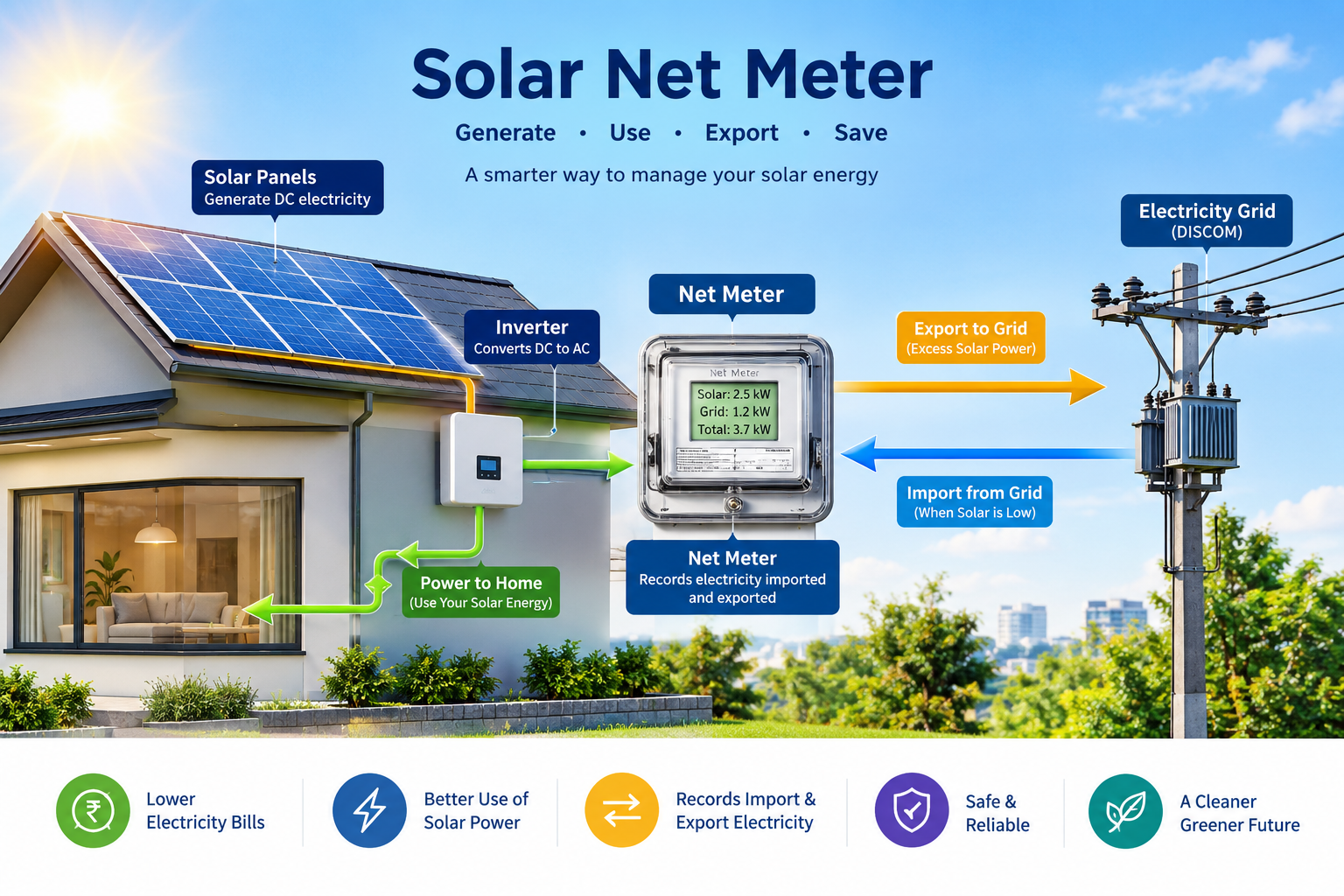
Net metering is a way to pay less for electricity when you have solar panels. A special two-way meter counts the power you take from the grid and the extra power your panels send back. At the end of the billing period, you pay for the difference in units, plus fixed charges. So if your panels make more than you use, your bill can drop a lot.
In Hyderabad and the rest of Telangana, your power company, TGSPDCL or TGNPDCL, handles net metering under rules from the state regulator, TGERC. Telangana brought in new rooftop solar rules in November 2025, so older guides may be out of date.
In this guide, you will learn how net metering works, who can get it, the steps to apply, and what you may save. We wrote it using official sources and our own work as an MNRE-empanelled solar company since 2008.
Net Metering in Telangana at a Glance
| Question | Short answer |
|---|---|
| What is net metering? | A billing method where a two-way meter counts the power you use from the grid and the extra power your solar panels send back. |
| Who makes the rules? | The Telangana Electricity Regulatory Commission (TGERC). Its rooftop solar regulation took effect on 15 November 2025 and replaced the 2016 rules. |
| Who gives the connection? | TGSPDCL for Hyderabad and southern Telangana. TGNPDCL for northern Telangana. |
| Which types are there? | Four: net, gross, group net and virtual net metering. |
| Smallest system | 1 kW for net and gross metering. 10 kW for group net and virtual net metering. |
| Biggest system | Up to 500 kW for net metering. Homes and government buildings can install up to 100% of sanctioned load. Businesses and industries, up to 80%. |
| Feasibility study | Not needed for systems up to 10 kW. |
| Meter | A two-way smart meter for net metering. A solar generation meter for gross metering. |
| Do I still get a bill? | Yes. You pay for net units, plus fixed charges and taxes. |
| Subsidy | Homes can also claim the PM Surya Ghar subsidy. You apply through the same national portal. |
Rules can change. Check with TGSPDCL or TGNPDCL before you apply.
How Does Net Metering Work?
Net metering works like a bank account for electricity. Your solar panels put units into the account during the day. You take units out when you need them. At the end of the billing period, you pay only for the difference.
What is a net meter?
A net meter is a two-way meter. A normal meter counts only the power coming into your home. A net meter counts power in both directions. It keeps two separate counts: the units you take from the grid (import) and the units your panels send to the grid (export).
How the power moves, step by step
- Sunlight hits your solar panels, and they make electricity.
- The inverter changes it into the kind of power your home uses.
- Your fans, lights and fridge use this power first.
- If the panels make more than your home needs, the extra goes out to the grid through the net meter.
- At night or on dark days, your home takes power from the grid. The meter counts these units too.
- When your bill is made, the power company compares the units you took with the units you sent.
A simple one-day example
These numbers are made up to show the idea. Yours will be different.
| Time of day | What happens | Units |
|---|---|---|
| Daytime | Panels make power | 12 made |
| Daytime | Your home uses some of it | 5 used |
| Daytime | The extra goes to the grid | 7 sent (export) |
| Evening and night | Your home takes power from the grid | 8 taken (import) |
Net result: You took 8 units and sent 7 units. So you are billed for just 1 unit for that day.
Net metering lowers the charge for the units you use. It does not remove fixed charges, meter charges or taxes. So most homes still get a bill, but it can be much smaller.
Net Metering Rules in Telangana (2026)
Telangana has a new set of rooftop solar rules. If you read an older guide, some facts may be wrong.
What are the new rules?
TGERC made a new rooftop solar regulation, called the Rooftop Solar PV Grid Interactive Systems Regulation, 2025. It took effect on 15 November 2025 after it was published in the State Gazette. It replaces the old 2016 net metering rules. The rules apply to power companies, all eligible consumers, and third-party owners of rooftop systems. So if a company owns the panels on your roof, the rules still cover you.
Main points to know
- System size. The smallest system is 1 kW for net and gross metering. For group net and virtual net metering, it is 10 kW. Consumers in all categories can install up to 500 kW under net metering.
- Load limit. Homes and government buildings can install up to 100% of their sanctioned load. Industrial and commercial users are limited to 80%. Sanctioned load is the power limit written on your electricity connection. You can find it on your bill.
- Smart meters. Net and group net metering use two-way smart meters with time-of-day features. Gross and virtual net metering use solar generation meters.
- Fewer extra charges. Net and gross metering users do not pay banking, wheeling, cross-subsidy or additional surcharges. For group and virtual net metering, the exemptions are only partial.
- Open access. You can use open access along with net or gross metering, but the open access capacity plus the rooftop capacity must stay below your contracted load.
- Unpaid bills. Consumers with pending arrears cannot use any metering arrangement. Clear your dues first.
- Feasibility study. Systems up to 10 kW do not need a technical feasibility study. For bigger systems, the study period is 15 days, and approval is treated as given if the study is not finished in time.
What changed from the old rules?
| Topic | Old rules (2016) | New rules (2025) |
|---|---|---|
| Types of metering | Mainly net metering | Net, group net, gross and virtual net metering |
| Biggest size | 1 kW to 1 MW | Up to 500 kW |
| Meters | Normal two-way meters | Smart meters with time-of-day features |
| Apartments and societies | Hard to join | Group and virtual metering make it possible |
Some details may change in later updates. Always check with TGSPDCL or TGNPDCL before you apply.
Types of Solar Metering: Which One Is Right for You?
Net metering. The most common choice for homes, shops and small businesses. Your solar power runs your building first. The extra goes to the grid. One two-way meter records both directions, and you pay for the difference.
Gross metering. All the power your panels make goes to the grid, and you are paid for it at a rate set by TGERC. Your building keeps using grid power as usual. This suits people who want income from their roof more than lower bills.
Group net metering. Several connections share the benefit of one solar system. For example, an apartment block can share a system on the common roof. Domestic consumers and townships or residential colonies can use it, and the smallest system is 10 kW.
Virtual net metering. The solar system does not have to be on your own roof. Power is made in one place and the credit is shared with the connections that take part. It helps people in flats or with shaded roofs. The smallest size is also 10 kW.
| Net | Gross | Group net | Virtual net | |
|---|---|---|---|---|
| Solar power | Used first, extra goes to grid | All goes to grid | Shared by a group | Credit shared |
| Suits | Homes, shops, offices, factories | People who want income | Apartments, societies, many meters | No roof or little space |
| Smallest system | 1 kW | 1 kW | 10 kW | 10 kW |
| Meter | Two-way smart | Solar generation | Two-way smart | Solar generation |
Which one to pick? A house with a good roof: net metering. A flat with a common roof: group net metering. No roof or a shaded roof: virtual net metering. Want income, not savings: gross metering.
Who Can Get Net Metering in Telangana?
You can usually get net metering if you have a valid electricity connection from TGSPDCL or TGNPDCL, the right to use the roof or space, and a system that fits the size limits.
- Domestic consumers can apply for net metering and can also join group net metering.
- Shops, offices, factories, schools and hospitals. Consumers in all categories can install rooftop solar under net metering.
- Apartment blocks and colonies. They can use group net metering.
- Owners of leased systems. The rules also cover third-party owners.
- Existing large systems. Consumers who already have systems above 500 kW can keep their net metering benefits.
Single-phase or three-phase? TGSPDCL’s FAQ says net metering is mainly for three-phase consumers, and that single-phase consumers can also get it for rooftop systems up to 5 kW. That FAQ describes the older process, so confirm with TGSPDCL.
Before you apply, you need:
- An electricity connection in your own name, or in the name of the building owner.
- Proof that you can use the roof or space. For a rented building, you may need a letter from the owner.
- A roof with enough open space and good sunlight.
- A system that meets the utility’s safety and technical rules.
- An installer approved by your power company.
Net metering may not suit you if your roof is mostly in shade, the roof owner will not agree, or you have unpaid electricity bills. Virtual net metering may fit better if you have no usable roof.
How to Apply for Net Metering in Hyderabad
You choose a system size, pick an approved installer, apply online, wait for approval, get the system installed, pass the utility’s inspection, and then the utility fits your two-way meter.
- Check your bill and roof. Look at your last few bills and your sanctioned load. Then check how much open, sunny space your roof has.
- Pick an approved installer. Ask to see their approval before you pay anything. The installer puts in the system and helps you file the application.
- Register and apply online. TGSPDCL’s portal is linked with the PM Surya Ghar portal 2.0, so one registration helps with both. The application form is also on the TGSPDCL website. Keep your registration number safe.
- Feasibility check, only if needed. Not needed up to 10 kW. For bigger systems, the utility checks whether its local lines can take your extra power.
- Get the system installed. It must meet the power company’s technical standards. Ask for the warranty papers and the single-line diagram.
- Utility inspection and agreement. The utility checks the project, you sign an agreement, and an officer may visit your site.
- Two-way meter installed. The utility replaces your old meter with a two-way meter.
- Start and check your first bill. Look at both the units you took and the units you sent. If anything looks wrong, ask the utility to check the meter reading.
Check your status. TGSPDCL’s website has a know your application status link under its solar rooftop net metering page. You enter the unique registration number from your acknowledgement.
| Document | Why it is needed |
|---|---|
| ID proof (Aadhaar or similar) | To confirm who you are |
| Latest electricity bill | To match your connection and load |
| Proof of ownership or roof rights | To show you can place panels there |
| System layout and capacity details | So the utility can check safety and size |
Your power company may ask for more, so check their current list.
How Much Does Net Metering Cost in Telangana?
The solar system is the biggest cost by far. The fees and the meter are small in comparison, and they may be zero for homes that use the PM Surya Ghar scheme.
- The solar system. Panels, inverter, wiring, mounting and work. The price depends on size, brand and roof. See our 3kW solar system guide for a price breakdown.
- The application fee. TGSPDCL’s solar FAQ lists Rs 2,500 for low-tension consumers. That page describes the older process, so the fee may now be different. Check the current figure before you pay.
- The net meter. The two-way meter’s rating should match your sanctioned load. Ask the utility for the current price in writing.
Can some fees be free? Possibly. The Ministry of Power has asked states to waive net metering agreements and charges under PM Surya Ghar, including application, meter testing and commissioning fees. It said that 17 states and union territories had already done so. We could not find a clear notice for Telangana, so ask TGSPDCL or your installer, and ask for the answer in writing.
Costs people forget: changing your sanctioned load, extra wiring or earthing, a roof structure change, and yearly cleaning and checks. If a quote has only one total number, ask for a breakdown.
How Net Metering Changes Your Electricity Bill
Your bill is based on net units: the units you took from the grid minus the units your panels sent back. Net metering only reduces the energy part of the bill. Fixed charges, demand charges, duty and meter charges still have to be paid.
Example 1: A usual month
These numbers are made up to show the idea. We assume a flat Rs 7 per unit to keep the maths easy. Real home tariffs are set in slabs, so check your own bill.
| Item | Units |
|---|---|
| Power the home used | 400 |
| Solar power made | 360 |
| Solar power used directly | 150 |
| Power taken from the grid (import) | 250 |
| Extra solar power sent to the grid (export) | 210 |
| Net units to pay for (250 – 210) | 40 |
Without solar, 400 units at Rs 7 is Rs 2,800. With solar, 40 units at Rs 7 is Rs 280. The energy charge falls by Rs 2,520. Fixed charges and taxes stay.
Example 2: A very sunny month
| Item | Units |
|---|---|
| Power the home used | 300 |
| Solar power made | 420 |
| Solar power used directly | 180 |
| Power taken from the grid | 120 |
| Extra solar power sent to the grid | 240 |
| Net units (120 – 240) | -120 |
Here the panels sent more than the home took, so there are 120 extra units. What happens to extra units depends on the settlement rules from TGERC and TGSPDCL. Ask your utility how leftover units are carried forward or settled, and ask for the answer in writing.
Why your savings may be smaller or bigger
Your daytime use, the sunshine, your system size, shade on the roof, your tariff slab, and dust on the panels all change the result.
Simple ways to save more: run the washing machine and water pump in the daytime, clean the panels regularly, read the import and export units on each bill, and ask your installer for a yearly check.
The examples above are only for learning. We cannot promise any exact amount.
Net Metering and the PM Surya Ghar Subsidy
PM Surya Ghar: Muft Bijli Yojana is a central government scheme that gives money back to homeowners who install rooftop solar. Net metering is how your system connects to the grid. The subsidy is paid after your system is connected, checked and started.
| System size | Central subsidy |
|---|---|
| 1 kW | Rs 30,000 |
| 2 kW | Rs 60,000 |
| 3 kW or bigger | Rs 78,000 (top limit) |
The scheme covers 60% of the cost for systems up to 2 kW and 40% of the extra cost between 2 kW and 3 kW. A 5 kW system gets the same subsidy as a 3 kW system. Group housing societies can get Rs 18,000 per kW for common facilities, up to 500 kW.
Who can get it? The main conditions are that you are an Indian citizen, you own your home, you have a valid electricity connection, and you have not taken a solar subsidy before. Check the official portal for the full list.
How the steps fit together: register on the portal, choose an approved installer, get the system installed, apply for net metering, pass the inspection, and then the subsidy is paid into your bank account. The time taken differs from case to case.
The scheme aims to reach one crore households by March 2027, and dates can change. We do not want you to rush because of pressure. Make a careful choice with a clear quote. For more, read our guide: PM Surya Ghar Subsidy for Home Solar.
Net Metering for Businesses, Factories and Institutions
Businesses use most of their power in the daytime, which is when solar makes power. That is why solar often works well for them. Telangana allows systems up to 500 kW, but the limit for commercial and industrial users is 80% of sanctioned load or contracted demand, lower than the 100% for homes.
| Option | Best for | Main point |
|---|---|---|
| Net metering | Most shops, offices, hospitals, schools, small factories | Rooftop power runs your site first, extra goes to the grid |
| Gross metering | Owners who want income from the roof | All solar power goes to the grid |
| Group net metering | Campuses or owners with several meters | One system, shared credit |
| Open access | Large users of 100 kW and above | Buy renewable power from another site, with extra charges |
What makes a business project work well: busy daytime use, a strong and unshaded roof, the right system size, a higher tariff, and regular upkeep. We do not give a payback number here, because it differs a lot from site to site.
Collect before you plan: your last 12 months of bills, your sanctioned load or contracted demand, a roof plan with size and age, your working hours, and proof that no dues are pending.
Avoid: sizing the system on the roof area instead of the bills, forgetting the 80% limit, leaving dues unpaid, skipping a roof strength check, and treating a tax benefit as certain. Ask your accountant about depreciation and other benefits.
See our commercial solar page for more.
Common Net Metering Mistakes and How to Avoid Delays
The most common causes of delay are mismatched names or documents, a wrong system size, an installer the utility does not approve, and booking the inspection before the work is finished.
| Mistake | How to avoid it |
|---|---|
| Unpaid electricity dues | Clear all dues first and keep the receipt. |
| Name on the bill differs from the applicant | Use the exact name on the bill, or change the name on the connection first. |
| Wrong system size | Check your sanctioned load before you choose the size. |
| Installer not approved | Ask for proof of approval and check it on the utility’s website. |
| Blurry or missing documents | Scan every page clearly. |
| Lost registration number | Save the acknowledgement as soon as you get it. |
| Inspection called too early | Finish wiring, earthing and safety items first. |
| Wrong meter rating | The two-way meter’s rating should match your sanctioned load. |
| Not reading the first bill | Look at import and export units, not only the amount. |
| Skipping cleaning and checks | Dusty panels make less power, so savings drop quietly. |
If your file is stuck: check your status online, ask the utility for the reason in writing, ask your installer to follow up on the portal, and remind the utility that for systems above 10 kW the study should finish in 15 days or approval is treated as given. If nothing moves, ask how to take your complaint to the utility’s grievance forum.
Why Choose Natural Power for Your Net Metering Project
Net metering depends on good design, correct paperwork and a safe installation. Natural Power is a solar company based in Hyderabad. We have worked in solar since 2008, and we are empanelled with MNRE.
- We plan around your bill. We check your bills, sanctioned load and roof before we suggest a size.
- We help with net metering. Our team supports you from the first form to the meter fitting.
- We cover homes, businesses and industries.
- We stay after the install. We offer monitoring, maintenance and technical support.
- We keep the quote clear. Ask for a written breakdown of every cost.
Get a free consultation
Send us your latest electricity bill on WhatsApp, and we will tell you which type of metering suits you and what to expect.