


1kW Solar System Price in India: Cost, Subsidy, Generation & Installation
The 1kW solar system price in India depends on the type of system, solar panels, inverter, battery requirement, roof condition, and installation work. A 1kW rooftop solar system may suit a home with modest electricity use, but the right size should be chosen after checking your monthly electricity bills and available roof space.
When comparing the 1kW solar panel price, make sure you know whether the quote covers only the panels or the complete system, including the inverter, mounting structure, cables, safety equipment, installation, and required approvals. Eligible households may also be able to receive support under the PM Surya Ghar scheme, subject to current government rules.
In this guide, you will understand the 1kW solar system cost, subsidy, daily electricity generation, system types, and installation needs. Natural Power provides residential rooftop solar solutions, from system design and installation to net-metering support and maintenance, to help you compare quotations confidently.
What Is the 1kW Solar System Price in India?
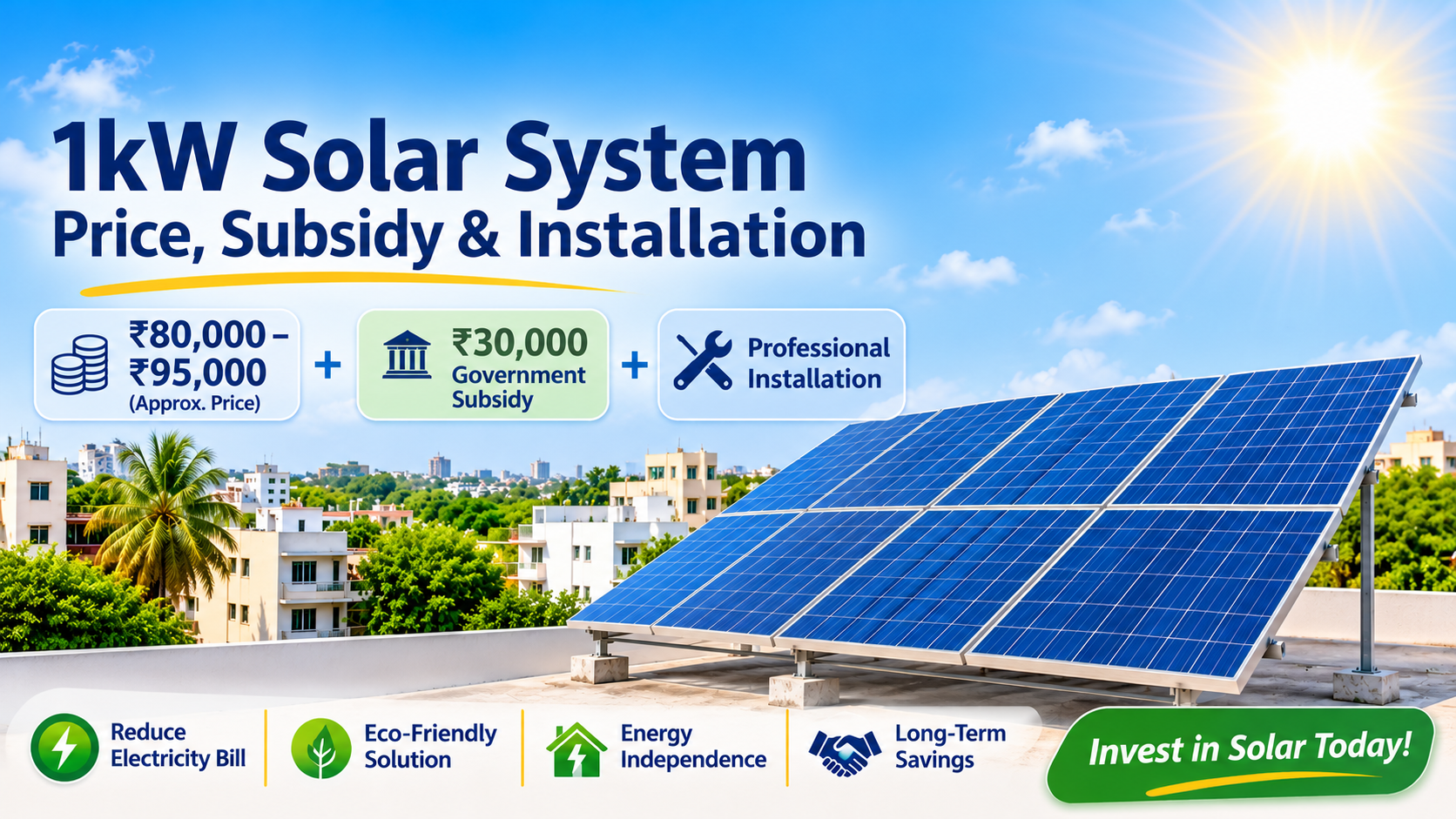
The 1kW solar system price in India is approximately ₹80,000 to ₹95,000 before government subsidy for a standard residential on-grid rooftop solar system in 2026. Eligible households may receive a central subsidy of ₹30,000 under the PM Surya Ghar scheme, bringing the estimated cost after subsidy to around ₹50,000 to ₹65,000.
These are indicative prices, not fixed rates. The actual 1kW solar system cost depends on the solar panel brand, inverter, mounting structure, roof condition, installation work, and location.
1kW Solar System Price Before and After Subsidy
| Price details | Estimated amount |
|---|---|
| Complete 1kW on-grid system price | ₹80,000–₹95,000 |
| Eligible central government subsidy | ₹30,000 |
| Estimated cost after subsidy | ₹50,000–₹65,000 |
Price estimates are for a standard residential on-grid system. Actual quotations may vary depending on equipment, installation requirements, taxes, and local conditions. Subsidy is subject to government rules and eligibility.
What Does This Price Include?
A complete 1kW rooftop solar system generally includes:
- Solar panels to generate electricity from sunlight.
- A solar inverter to convert the electricity into usable power.
- A mounting structure to hold the panels securely.
- Cables and electrical safety equipment.
- Installation, testing, and system commissioning.
The price of a system with battery backup can be higher because it requires additional battery equipment. A standard on-grid system usually does not provide backup during a power cut.
Is the 1kW Solar System Price the Same for Every Home?
No. Two homes may receive different quotations for the same 1kW capacity. Roof type, available space, equipment selection, electrical work, and installation conditions can all affect the final price.
Natural Power provides customized residential rooftop solar solutions, including site assessment, system design, installation, net-metering support, and maintenance. A site assessment helps identify the right system and prepare a quotation based on your home’s actual requirements.
Before choosing a 1kW solar system, compare the complete installation cost, equipment specifications, warranty, and eligible subsidy—not just the solar panel price.
What Is Included in a 1kW Solar System?
A complete 1kW solar system includes more than solar panels. It needs an inverter, mounting structure, electrical cables, safety equipment, and other parts to generate and supply electricity safely to your home. The exact components depend on whether you choose an on-grid, off-grid, or hybrid solar system.
Here are the main components you should expect in a 1kW rooftop solar installation.
1. Solar Panels
Solar panels capture sunlight and convert it into electricity. A 1kW system may use different numbers of panels depending on their individual wattage.
For example, a system could use two 500W panels or three panels of around 350W each. The final number depends on the panel capacity and system design.
2. Solar Inverter
Solar panels produce DC (Direct Current) electricity, while most home appliances use AC (Alternating Current). The solar inverter converts DC electricity into AC electricity that your home can use.
The inverter must be suitable for the system capacity and compatible with the selected solar panels.
3. Mounting Structure
The mounting structure holds the solar panels securely on your roof. It keeps them at a suitable angle to receive sunlight and helps them withstand outdoor conditions such as rain and wind.
The structure is selected based on your roof type and installation requirements.
4. Solar Cables and Connectors
Special cables connect the solar panels to the inverter and other electrical equipment. Good-quality cables and connectors help reduce power loss and keep electrical connections safe.
5. Safety Equipment
A solar system needs electrical protection to help prevent damage and reduce safety risks. This may include:
- DC and AC distribution boxes
- Circuit breakers and isolators
- Surge protection devices
- Proper earthing and lightning protection, where required
The exact safety equipment depends on the system design and applicable electrical standards.
6. Net Meter
An on-grid solar system uses a suitable bidirectional meter to record electricity imported from the grid and excess electricity exported to it. This helps the electricity provider calculate your bill under the applicable net-metering or other billing arrangement.
Metering requirements and approval processes depend on your local electricity distribution company (DISCOM).
7. Monitoring System
A monitoring system helps you check how much electricity your solar panels generate. Depending on the inverter and package, you may be able to view system performance through a display or mobile app.
Does a 1kW Solar System Include a Battery?
Not always. A standard on-grid 1kW solar system usually works without a battery. It supplies solar electricity to your home and can export surplus power to the grid, subject to applicable approvals.
An off-grid or hybrid system may include batteries to store electricity for use when solar generation is low or during power cuts. Adding batteries increases the total system cost.
Check These Items Before Buying
Before accepting a 1kW solar system price quotation, check whether it includes:
- Solar panels and their make, model, and wattage
- Inverter make, model, and capacity
- Mounting structure and installation work
- Cables, connectors, and safety equipment
- Metering and approval-related charges, where applicable
- Testing, commissioning, and after-sales support
- Product and performance warranty details
A low quotation may cover only selected equipment and leave out important installation or electrical items. Always compare the complete system specifications before making a decision.
Natural Power provides residential rooftop solar solutions that cover site assessment, system design, installation, testing, commissioning, and net-metering support. This helps homeowners understand what their solar package includes before installation.
What Is the 1kW Solar System Price With Subsidy?
The 1kW solar system price with subsidy in India can be lower for eligible homeowners under the PM Surya Ghar: Muft Bijli Yojana. Under this scheme, eligible residential consumers can receive a central government subsidy of ₹30,000 for a 1kW rooftop solar system.
For example, if your complete 1kW on-grid solar system costs ₹85,000, the estimated amount after a ₹30,000 subsidy would be ₹55,000. This is only an example. Your actual cost depends on the quotation, equipment, installation work, and applicable scheme rules.
1kW Solar Panel Price With Government Subsidy
| Details | Example amount |
|---|---|
| Complete 1kW solar system cost | ₹85,000 |
| Central government subsidy | ₹30,000 |
| Estimated cost after subsidy | ₹55,000 |
This example assumes the household meets the scheme requirements and receives the full eligible subsidy. The actual installation price may be different.
Who Can Get the PM Surya Ghar Subsidy?
The PM Surya Ghar subsidy is meant for eligible residential electricity consumers. Generally, you need to:
- Have a valid residential electricity connection from your local DISCOM.
- Install a qualifying grid-connected rooftop solar system.
- Select a vendor registered on the national PM Surya Ghar portal for your DISCOM area.
- Follow the scheme’s equipment, installation, and application requirements.
- Complete the required inspection and commissioning process.
The subsidy is not meant for every type of solar installation. Commercial buildings, factories, and fully off-grid systems should not assume they qualify under this residential subsidy scheme.
How to Apply for the 1kW Solar System Subsidy
Follow these general steps to apply:
- Visit the official PM Surya Ghar National Portal.
- Register using your state, DISCOM, and electricity consumer details.
- Submit your rooftop solar application through the portal.
- Choose a registered solar vendor for your area.
- Get the 1kW system installed according to the scheme requirements.
- Complete the required inspection and meter installation process.
- Submit the required details on the portal to claim the subsidy.
The subsidy is transferred to the eligible consumer’s bank account after the required checks and approval. Follow the latest instructions on the official portal because application steps and requirements may change.
Does the Subsidy Cover the Battery Cost?
The central subsidy is calculated on eligible rooftop solar capacity, not simply on the total price of every item in a solar package. Do not assume that adding a battery will increase your subsidy.
A grid-connected hybrid system may be considered only where the applicable rules and approved metering arrangements allow it. A fully off-grid system does not qualify under the standard residential grid-connected scheme.
Important Things to Check Before Applying
Before paying for a 1kW solar installation, confirm that your chosen vendor is registered for the scheme, your system meets the technical requirements, and your electricity connection is eligible. Also ask for a written quotation that clearly separates the system cost, installation charges, and any other fees.
Natural Power offers residential rooftop solar solutions, including system design, installation, and net-metering support. The right system should be selected after checking your electricity use, roof conditions, and local DISCOM requirements.
Remember: The ₹30,000 subsidy is a government benefit for eligible residential consumers, not an instant discount guaranteed to every buyer. Always check your eligibility and the latest scheme rules before making a purchase.
Difference Between On-Grid, Off-Grid and Hybrid 1kW Solar Systems
A 1kW solar system can be installed in three main types: on-grid, off-grid, and hybrid. The biggest difference is how each system uses the electricity grid and whether it has a battery.
- On-grid solar system: Connects to the electricity grid and usually works without a battery.
- Off-grid solar system: Works without an electricity grid and uses batteries to store solar power.
- Hybrid solar system: Connects to the grid and also uses batteries for backup.
Your choice depends on your home’s electricity supply, power cuts, backup needs, and budget.
On-Grid vs Off-Grid vs Hybrid Solar System
| Feature | On-grid | Off-grid | Hybrid |
|---|---|---|---|
| Connected to electricity grid | Yes | No | Yes |
| Battery included | Usually no | Yes | Yes |
| Can supply power during a grid outage | No, standard systems shut down | Yes, if battery has charge | Yes, for supported backup loads |
| Can send extra power to the grid | Yes, subject to approval | No | Yes, subject to system design and approval |
| Initial cost | Usually lowest | Higher due to batteries | Usually highest |
| Best suited for | Homes with reliable grid supply | Homes without reliable grid supply | Homes that need backup during power cuts |
1. 1kW On-Grid Solar System
An on-grid solar system connects your solar panels to the local electricity grid through a solar inverter.
During the day, solar power runs your home appliances. If your panels generate more electricity than your home uses, the extra power can be sent to the grid through an approved meter. When solar power is not enough, your home can draw electricity from the grid.
Main benefits:
- Lower installation cost because a battery is usually not needed.
- Helps reduce electricity bills.
- Can export extra electricity to the grid under the applicable billing arrangement.
- Eligible residential systems may qualify for the PM Surya Ghar subsidy.
One important point: A standard on-grid system shuts down during a power cut for safety. It does not provide backup unless it has a suitable backup arrangement.
2. 1kW Off-Grid Solar System
An off-grid solar system works without connecting to the electricity grid. It uses batteries to store the electricity generated by solar panels.
The stored power can be used at night or when sunlight is not available. This makes off-grid solar useful for remote homes, farms, and places where grid electricity is unavailable or unreliable.
Main benefits:
- Works without a grid connection.
- Stores solar electricity for later use.
- Can provide power during grid outages because it does not depend on the grid.
One important point: Batteries increase the total installation cost. You must also choose enough battery capacity to meet your electricity needs.
3. 1kW Hybrid Solar System
A hybrid solar system combines solar panels, a grid connection, and battery storage. It can use solar electricity during the day, store extra energy in batteries, and draw power from the grid when needed.
During a power cut, a properly designed hybrid system can supply electricity to selected home appliances through its backup output.
Main benefits:
- Provides battery backup during power cuts.
- Can use grid electricity when solar generation is low.
- Can store extra solar electricity for later use.
- May support grid export where the system and local rules allow it.
One important point: A hybrid system usually costs more than a basic on-grid system because it needs batteries and a compatible inverter.
Which 1kW Solar System Is Best for Your Home?
The right choice depends on your needs:
- Choose on-grid solar if you have a reliable electricity connection and mainly want to reduce your monthly electricity bill.
- Choose off-grid solar if your home has no reliable grid connection and needs battery storage.
- Choose hybrid solar if you want to reduce your electricity bill and also need backup during power cuts.
For many homes with a regular grid connection, an on-grid system can be a practical starting point. However, if power cuts are frequent, a hybrid system may be worth considering.
Which 1kW Solar System Is Eligible for Government Subsidy?
The PM Surya Ghar scheme supports eligible residential consumers installing qualifying grid-connected rooftop solar systems. Do not assume that a fully off-grid system qualifies for this subsidy. If you are considering a hybrid system, confirm the current scheme requirements and permitted system configuration with your registered vendor before purchasing.
Natural Power provides residential rooftop solar solutions based on your electricity use, roof conditions, and installation needs. A site assessment can help you compare the available system types and choose one that suits your home.
Before comparing the 1kW solar system price, decide whether you need only electricity bill savings or battery backup as well. This will help you choose the right system without paying for equipment you may not need.
How Many Solar Panels Are Required for a 1kW Solar System?
A 1kW solar system usually needs 2 to 3 solar panels, depending on the wattage of each panel. The total capacity of all the panels should add up to around 1,000 watts (1kW).
For example, you can use two 500W panels or three panels of around 335W each. The exact number depends on the panel model and the system design.
Number of Solar Panels Required for 1kW
| Solar panel wattage | Number of panels | Total capacity |
|---|---|---|
| 250W | 4 | 1,000W |
| 330W | 4 | 1,320W |
| 400W | 3 | 1,200W |
| 450W | 3 | 1,350W |
| 500W | 2 | 1,000W |
| 550W | 2 | 1,100W |
These are examples to explain how panel count is calculated. The final panel combination must be compatible with the inverter and the approved system design. A system with a panel capacity above 1kW may not be classified or approved as a 1kW system.
How Do You Calculate the Number of Solar Panels?
You can calculate the number of panels using a simple formula:
Number of panels = Required solar capacity in watts ÷ Wattage of one panel
For example, if you want a 1kW system using 500W solar panels:
1,000W ÷ 500W = 2 panels.
So, you need two 500W panels to make a total capacity of 1kW.
Does the Number of Solar Panels Affect the 1kW Solar System Price?
Yes. The number, wattage, brand, and technology of solar panels can affect the total 1kW solar system price. However, fewer panels do not always mean a cheaper system. Higher-wattage panels may have a different price, and the inverter must be suitable for the panel arrangement.
When comparing quotations, check the total system capacity, panel wattage, brand, model, and product warranty. Do not compare two systems only by counting the panels.
Which Solar Panels Are Suitable for a 1kW Home Solar System?
Monocrystalline solar panels are commonly used in residential rooftop installations. Different models offer different wattages, sizes, and levels of efficiency.
The right panel should be selected based on your roof space, budget, sunlight conditions, and inverter compatibility. A solar professional can help choose a panel arrangement that uses your available roof space well.
Natural Power can assess your roof and electricity needs before recommending a suitable residential solar system. This helps ensure that the panels, inverter, and other equipment work together properly.
In short: A 1kW solar system may need two high-wattage panels or three to four lower-wattage panels. Always check the total rated capacity and complete system design before confirming your purchase.
How Much Electricity Does a 1kW Solar System Generate?
A 1kW solar system in India can generate around 4 to 5 units of electricity per day under good sunlight conditions. This means it may produce approximately 120 to 150 units per month and 1,460 to 1,825 units per year.
Actual electricity generation depends on your location, sunlight, roof direction, panel angle, shade, weather, and equipment quality. These figures are estimates, not a guarantee of daily output.
1kW Solar System Electricity Generation
| Time period | Estimated electricity generation |
|---|---|
| Per day | 4–5 units |
| Per month (30 days) | 120–150 units |
| Per year (365 days) | 1,460–1,825 units |
One electricity unit is equal to 1 kilowatt-hour (kWh). Your electricity meter and solar monitoring system may show generation in kWh or units.
How Much Electricity Does a 1kW Solar System Generate in Hyderabad?
A 1kW rooftop solar system in Hyderabad can be planned around an estimated average of 4 to 5 units per day, depending on the roof and local sunlight conditions.
For example, if your system generates an average of 4.5 units per day:
- Daily generation: 4.5 units
- Monthly generation: Around 135 units
- Yearly generation: Around 1,642 units
This is an illustrative calculation. Your actual generation may be higher in sunny months and lower during cloudy or rainy periods.
What Factors Affect 1kW Solar System Generation?
Your solar system may generate different amounts of electricity on different days. The main reasons include:
- Sunlight: Solar panels generate more electricity when they receive good sunlight. Cloudy weather and heavy rain can reduce output.
- Roof direction and panel angle: Panels should face the right direction and have a suitable tilt to receive sunlight effectively.
- Shade: Trees, nearby buildings, water tanks, and other objects can block sunlight and reduce electricity generation.
- Panel quality: The type, quality, and condition of solar panels affect how much electricity they produce.
- Dust and dirt: Dust on panels can reduce the amount of sunlight reaching the solar cells. Regular cleaning helps maintain good performance.
- Temperature: Very high panel temperatures can reduce their electrical output, even when sunlight is strong.
Does a 1kW Solar System Generate Electricity at Night?
No. Solar panels need sunlight to generate electricity, so they do not produce power at night.
With an on-grid system, your home can draw electricity from the grid when solar power is unavailable. If you need backup during power cuts, you may consider an off-grid or suitable hybrid system with batteries.
How Can You Calculate Your 1kW Solar System’s Electricity Generation?
You can use this simple formula:
Daily solar generation = System capacity × Peak sun hours × System performance factor
For example:
1kW × 5 hours × 0.8 = 4 units per day.
Here, the performance factor allows for normal system losses. The result is an estimate, not an exact daily reading.
Can a 1kW Solar System Reduce Your Electricity Bill?
Yes. A 1kW solar system can reduce the amount of electricity you buy from your electricity provider. The actual saving depends on how much solar electricity your home uses, how much extra power is exported to the grid, and the billing rules set by your DISCOM.
Before choosing a system, compare your average monthly electricity use with the expected solar generation. This will help you decide whether 1kW is enough or whether a larger system would suit your home better.
Natural Power can assess your electricity bills, roof space, and site conditions to recommend a suitable rooftop solar system. This helps you choose a system based on your actual needs rather than a general estimate.
In short: A 1kW solar system can generate around 4–5 units per day in suitable conditions. Check your roof and local sunlight before treating this estimate as your expected monthly generation.
How Much Roof Space Is Required for a 1kW Solar System?
A 1kW solar system generally requires around 80 to 100 square feet of shadow-free roof space. This area should be enough to place the solar panels properly while allowing space for safe installation and maintenance.
The exact roof space depends on the size and wattage of the solar panels, mounting structure, roof shape, and available sunlight. A professional site check can help you find the best place for your panels.
Roof Space Required for Different Solar System Sizes
Here is a simple estimate of the roof space needed for common home solar system sizes:
| Solar system capacity | Approximate roof space |
|---|---|
| 1kW | 80–100 sq. ft. |
| 2kW | 160–200 sq. ft. |
| 3kW | 240–300 sq. ft. |
| 5kW | 400–500 sq. ft. |
| 10kW | 800–1,000 sq. ft. |
These figures are general estimates. The actual space requirement may change depending on panel dimensions, roof layout, spacing, and installation design.
Can You Install a 1kW Solar System on a Small Roof?
Yes. A 1kW solar system can fit on a relatively small rooftop if there is enough usable space without heavy shade.
Before installation, check that:
- The roof has enough open space for all the panels.
- Nearby buildings, trees, and water tanks do not block too much sunlight.
- The roof is strong enough to support the solar panels and mounting structure.
- There is enough room to access the panels for cleaning and maintenance.
- The panel arrangement does not block important roof access or drainage areas.
Does Roof Direction Affect Solar Panel Installation?
Yes. Roof direction and panel angle affect how much sunlight the panels receive during the day.
In India, south-facing panels are commonly preferred for good yearly solar generation. However, east-facing and west-facing roofs may also be suitable, depending on the roof design and your electricity usage.
The best direction and angle should be decided after checking the actual location, nearby shade, and roof conditions.
Can Solar Panels Be Installed on Every Type of Roof?
Solar panels can be installed on many roof types, including:
- RCC or concrete roofs
- Metal sheet roofs
- Sloping roofs
- Tiled roofs
However, each roof needs a suitable mounting method. The installer should check the roof’s condition, strength, available space, and waterproofing needs before starting the work.
How Much Roof Space Is Needed in Hyderabad?
For a home in Hyderabad, you can use 80–100 sq. ft. as an initial estimate for a 1kW rooftop solar system. However, the final area depends on the panel model, roof layout, shade from nearby buildings, and the mounting arrangement.
Strong sunlight alone does not guarantee good solar generation. Panels also need suitable placement and enough open space.
Natural Power recommends checking the roof and household electricity use before deciding on system capacity. A site assessment can help determine how many panels will fit and whether a 1kW system is suitable for your home.
In short: You may need around 80–100 sq. ft. of usable roof space for a 1kW solar system. Before buying, get your roof checked to make sure the panels can be installed safely and receive good sunlight.
What Can a 1kW Solar System Run?
A 1kW solar system for home can generate around 4 to 5 units of electricity per day under suitable sunlight conditions. This makes it useful for homes with low electricity consumption and basic power needs.
The appliances you can run depend on their power consumption, how many hours you use them, and how much electricity your solar system generates.
Appliances You Can Run on a 1kW Solar System
Here are examples of common household appliances that a 1kW solar system may support:
| Home appliance | Typical power use | Can a 1kW system support it? |
|---|---|---|
| LED lights | 8–12W each | Yes |
| Ceiling fan | 50–80W each | Yes |
| LED television | 40–100W | Yes |
| Mobile charger | 5–20W | Yes |
| Laptop | 40–100W | Yes |
| Small refrigerator | Varies by model | Possible, depending on total load |
| Washing machine | 400–800W | For limited use, depending on other loads |
| Electric iron | 750–1,500W | Not recommended with other appliances |
| Electric geyser | 1,500–2,500W | Usually needs a larger system |
| Air conditioner | Depends on capacity and model | Not suitable for a typical 1kW system |
These are approximate appliance ratings. Actual power use varies by brand, model, age, and operating conditions.
Example: Appliances a 1kW Solar System Can Support
For a small home, the following combination may be suitable during good sunlight hours:
| Appliance | Quantity | Approximate total power |
|---|---|---|
| LED lights | 4 | 40W |
| Ceiling fans | 2 | 140W |
| LED television | 1 | 80W |
| Laptop | 1 | 60W |
| Mobile chargers | 2 | 20W |
| Total | 340W |
This example uses approximately 340W at one time, which is below the rated 1kW capacity. Actual performance also depends on inverter capacity, solar generation at that moment, and other system losses.
Can a 1kW Solar System Run an AC?
A typical 1kW solar system is not recommended for running an air conditioner as a regular household load.
An AC can use a large amount of electricity, especially when it starts or works at high cooling demand. A 1kW system may not generate enough power to support the AC along with other home appliances.
If you want to run an AC, ask a solar professional to calculate the required system size based on the AC’s rated power, daily usage, and other household loads.
Can a 1kW Solar System Run a Refrigerator?
Yes, a 1kW solar system may support a small refrigerator along with a limited number of other appliances. However, refrigerator power use changes as its compressor switches on and off.
You should check the refrigerator’s energy rating and daily electricity consumption before including it in your solar load calculation.
Can You Use Appliances at Night With a 1kW Solar System?
Solar panels do not generate electricity at night. Your power supply at night depends on the type of solar system you install.
- On-grid system: Your home draws electricity from the grid when solar power is unavailable.
- Off-grid system: Stored battery power can run connected appliances.
- Hybrid system: Battery backup can supply selected appliances during a power cut, depending on battery capacity and system design.
A standard on-grid solar system does not provide power during a grid outage.
How Do You Know If 1kW Solar Is Enough for Your Home?
Before buying a 1kW solar system, check your electricity bills and list the appliances you use every day.
Pay attention to:
- The total power used by your appliances.
- How many hours you use each appliance.
- Your average daily electricity consumption.
- Whether you need battery backup.
- Whether you plan to add appliances in the future.
Natural Power can review your electricity usage and roof conditions to help you choose a suitable rooftop solar capacity.
In short: A 1kW solar system is best suited for basic household electricity needs. If your home uses an AC, geyser, washing machine, and several other high-power appliances regularly, you may need a larger solar system.
Factors That Affect the 1kW Solar System Installation Cost
The 1kW solar system installation cost is not the same for every home. It depends on the solar panels, inverter, mounting structure, roof type, electrical work, and whether you need battery backup. Even if two homes install the same 1kW system, their final quotations may be different.
To understand the price properly, look at the following factors before choosing a solar installer.
1. Type and Quality of Solar Panels
Solar panels are one of the main parts of a rooftop solar system. Their price depends on the brand, wattage, technology, and product quality.
For example, high-wattage panels may need less roof space than lower-wattage panels. However, the final choice should also consider panel performance, warranty, and compatibility with the inverter.
2. Solar Inverter Type
The inverter converts the electricity generated by solar panels into power that your home can use.
An on-grid inverter, off-grid inverter, and hybrid inverter have different features and prices. A hybrid inverter may cost more because it supports battery storage and backup features.
Your inverter should match the system design and your household’s electricity needs.
3. Battery Requirement
A standard on-grid 1kW solar system usually does not include a battery. This helps keep its initial cost lower.
If you want electricity backup during power cuts, you may need an off-grid or hybrid system with batteries. The battery capacity and type can increase the total 1kW solar system price.
Before adding a battery, think about which appliances you want to run during a power cut and for how long.
4. Roof Type and Installation Conditions
The type and condition of your roof can affect installation charges.
For example:
- A flat RCC roof may need a suitable mounting structure.
- A sloping roof may need a different panel support arrangement.
- A metal sheet roof may require special mounting methods.
- Difficult roof access may need additional installation work.
The installer should inspect the roof before preparing the final quotation.
5. Mounting Structure Quality
The mounting structure holds the panels in place. Its material, design, height, and roof arrangement can affect the cost.
A suitable structure should be strong enough for local weather conditions and designed for the roof type. Do not choose a structure based only on its price.
6. Electrical Safety Equipment and Wiring
A complete solar installation needs suitable cables, connectors, protection devices, earthing, and other electrical parts.
The cost may change depending on the distance between the solar panels, inverter, and main electrical connection. Proper electrical protection is important for safe system operation.
7. Net Metering and Local DISCOM Requirements
For an on-grid system, you may need approval and metering arrangements from your local electricity distribution company (DISCOM).
The process and applicable charges can vary by location and electricity provider. Check whether your quotation includes the required application support, meter-related charges, and other approval costs.
8. Installation and Service Support
The quotation should also explain the installation work, testing, commissioning, and after-sales support.
A very low price may not include all these services. Before making a payment, check what the installer will provide and what support is available if the system develops a problem.
9. Government Subsidy Eligibility
Eligible residential consumers may receive central financial assistance under the PM Surya Ghar scheme. However, the subsidy is subject to scheme rules, approved system requirements, and the application process.
Do not subtract the subsidy from a quotation until you have checked your eligibility and understood how the payment process works.
How to Compare 1kW Solar System Quotations
Before selecting an installer, compare these details:
| What to check | Why it matters |
|---|---|
| Solar panel brand and wattage | Helps you compare panel quality and capacity |
| Inverter brand and model | Confirms compatibility and features |
| Battery details | Shows whether backup is included |
| Mounting structure | Helps assess installation quality |
| Safety equipment and wiring | Important for safe operation |
| Installation charges | Shows the cost of labour and installation |
| Net-metering support | Clarifies help with local approvals |
| Warranty details | Explains what is covered and for how long |
| After-sales service | Helps you understand support after installation |
Why Should You Get a Site Assessment Before Buying?
A site assessment helps the installer understand your roof space, sunlight, shade, electrical connection, and household power needs. Based on this information, the installer can recommend suitable equipment and prepare a more accurate quotation.
Natural Power provides residential rooftop solar services, including site assessment, system design, installation, commissioning, and net-metering support. This helps homeowners understand the equipment and work included in their solar package.
In short: The cheapest 1kW solar quotation may not be the best choice. Compare the complete system, equipment quality, installation work, warranty, and service support before making your decision.
Is a 1kW Solar System Worth the Investment?
A 1kW solar system can be a worthwhile investment for a home with low electricity use and enough suitable roof space. It can help reduce the amount of electricity you buy from the grid and lower your monthly power bill.
However, the savings depend on the system price, daily electricity generation, how much solar power you use, your electricity tariff, and local net-metering rules. Before buying, compare the expected savings with the complete installation cost.
1. Lower Monthly Electricity Bills
A 1kW solar system can generate around 4 to 5 units of electricity per day under suitable sunlight conditions. This may add up to approximately 120 to 150 units per month.
If your home uses this electricity during the day, you can reduce the amount of power you need to buy from the grid.
For example, if your system generates 135 units in a month and your home uses most of that electricity, it may reduce your monthly grid consumption. Your actual bill savings depend on your electricity tariff and billing arrangement.
2. Reduce Your Dependence on Grid Electricity
With rooftop solar, your home can use electricity generated from sunlight during the day. This can reduce your dependence on electricity supplied by your local DISCOM.
However, a standard on-grid solar system does not provide backup during a power cut. If you need backup, you should consider a suitable hybrid or off-grid system with batteries.
3. Get Value From Your Rooftop
Your rooftop can generate electricity instead of remaining unused. A 1kW system generally needs around 80 to 100 square feet of suitable roof space.
If your home has enough open space with limited shade, you can use it to generate solar power for daily household needs.
4. Benefit From Government Subsidy
Eligible residential households can receive central financial assistance under the PM Surya Ghar scheme.
For a qualifying 1kW residential rooftop solar system, the central subsidy is ₹30,000, subject to the scheme’s current rules and approval process.
This can reduce the amount you pay for the installation. However, do not assume that every system or property qualifies. Check your eligibility before including the subsidy in your investment calculation.
5. Long-Term Electricity Savings
Solar panels can generate electricity for many years when properly installed and maintained. This gives homeowners an opportunity to save on electricity costs over the system’s working life.
However, solar panels do not produce exactly the same amount of electricity every year. Their output can reduce gradually with age, and inverters or other parts may need repair or replacement.
Check the product warranty, performance warranty, inverter warranty, and maintenance terms before buying.
How to Calculate the Payback Period of a 1kW Solar System
The payback period tells you how long it may take for your electricity bill savings to recover the amount you invested.
You can use this simple formula:
Payback period = Total installation cost ÷ Annual electricity bill savings
For example, assume:
- Installation cost after eligible subsidy: ₹55,000
- Estimated monthly electricity bill savings: ₹500
- Estimated yearly savings: ₹6,000
The calculation would be:
₹55,000 ÷ ₹6,000 = approximately 5.8 years.
This is only an example, not a guaranteed return. Actual savings may be different depending on your electricity usage, solar generation, tariff, export credits, maintenance, and system performance.
Is a 1kW Solar System Enough for Your Home?
A 1kW system may be suitable if:
- Your household has low daily electricity consumption.
- You mainly use lights, fans, a television, and small appliances.
- You have around 80–100 square feet of suitable rooftop space.
- You want to reduce daytime electricity use.
- You do not need to run several high-power appliances regularly.
If your home uses an air conditioner, electric geyser, or several large appliances, you may need a larger solar system.
When Is a 1kW Solar System Not the Right Choice?
A 1kW system may not be the best option if your electricity consumption is high or your roof receives heavy shade. It may also be unsuitable if you expect it to provide backup during power cuts but choose a standard on-grid system without batteries.
Choosing a system that is too small may not meet your needs. Choosing one that is too large may increase your investment unnecessarily.
Is 1kW Solar Worth It for Homes in Hyderabad?
Homes in Hyderabad can benefit from rooftop solar because the region receives good sunlight during much of the year. However, the actual output depends on roof direction, shade, panel placement, weather, and equipment.
Before deciding, check your recent electricity bills and compare your average monthly consumption with the expected solar generation.
Natural Power can help assess your roof, electricity usage, and installation requirements to recommend a suitable solar system for your home.
In short: A 1kW solar system can be worth the investment for a home with modest electricity needs. Calculate the expected savings, check subsidy eligibility, and choose the right system size before making a purchase.
How to Choose the Right 1kW Solar Installation Company?
Choosing the right solar installation company is just as important as choosing the right solar panels. A good installer helps you select suitable equipment, complete the installation safely, handle required approvals, and get support after the system starts working.
Before finalising your 1kW solar system price, compare the installation company, equipment quality, warranty, and services included in the quotation.
1. Check the Company’s Experience
Choose a company with experience in residential rooftop solar installations. An experienced installer is more likely to understand different roof types, electrical requirements, panel placement, and local approval processes.
Check the company’s website, completed projects, customer reviews, and business details before making a decision.
2. Check Vendor Registration for Government Subsidy
If you plan to apply for the PM Surya Ghar subsidy, check whether the installer is registered on the official national portal for your DISCOM area.
Do not rely only on verbal promises about subsidy approval. Confirm the vendor’s registration and the latest scheme requirements through the PM Surya Ghar portal.
3. Compare Equipment Brands and Specifications
Ask the installer to provide the make, model, and specifications of every major component.
Check details such as:
- Solar panel brand, wattage, and product warranty.
- Inverter brand, model, and capacity.
- Mounting structure material and design.
- Electrical cables and safety equipment.
- Battery details, if backup is included.
This makes it easier to compare quotations from different companies.
4. Ask for a Site Assessment
A reliable solar company should understand your home’s requirements before suggesting a system.
The site assessment should consider:
- Your monthly electricity consumption.
- Available rooftop space.
- Shade from trees and nearby buildings.
- Roof condition and mounting requirements.
- Electrical connection and meter details.
- Your need for battery backup.
This helps the installer recommend a system that matches your actual electricity needs.
5. Compare Complete Installation Quotations
Do not select an installer only because it offers the lowest price.
Ask for a written quotation that clearly explains what is included. Compare the solar panels, inverter, mounting structure, cables, safety equipment, installation work, testing, and any applicable approval or meter-related charges.
Also check whether the quoted price includes taxes and whether any additional costs may apply.
6. Understand the Warranty
Solar systems have different warranties for different components. Do not assume that one warranty covers the entire installation.
Ask the company about:
- Solar panel product warranty.
- Solar panel performance warranty.
- Inverter warranty.
- Mounting structure warranty, where offered.
- Workmanship or installation warranty.
- Service and maintenance terms.
Read the warranty documents carefully and understand whom to contact if a component stops working.
7. Check After-Sales Service
Your solar system needs attention even after installation. You may need help with inverter alerts, generation checks, cleaning guidance, electrical issues, or warranty claims.
Before buying, ask how the company handles service requests and what support is included after commissioning.
8. Check Completed Projects and Customer Feedback
Look for real residential and commercial solar projects completed by the company. Customer feedback can help you understand the installation quality, communication, and service experience.
Where possible, ask for examples of projects similar to your home or system size.
Why Choose Natural Power for Residential Solar Installation?
Natural Power provides end-to-end solar solutions, from system planning and design to installation and after-sales support. Its residential rooftop solar services include customised system design, installation, net-metering support, and maintenance.
The company states that it has been delivering solar solutions across India since 2008. You can explore its services and completed work to understand its experience in the solar industry.
Before choosing a 1kW system, Natural Power can help assess your electricity use and available roof space so the recommended system matches your home’s requirements.
In short: Choose a solar installation company based on experience, equipment quality, transparent pricing, proper approvals, warranty, and after-sales support. A reliable installation can help you get better value from your solar investment over time.
Frequently Asked Questions About 1kW Solar Systems
1. What is the 1kW solar system price in India?
The estimated price of a complete 1kW on-grid solar system in India may range from ₹60,000 to ₹75,000 before subsidy. The final cost depends on the panel brand, inverter, installation work, roof conditions, and other equipment. Ask for a complete quotation before making a decision.
2. What is the 1kW solar panel price with government subsidy?
Eligible residential consumers may receive a central subsidy of ₹30,000 for a qualifying 1kW rooftop solar system under the PM Surya Ghar scheme. For example, if the complete system costs ₹65,000, the estimated cost after subsidy would be ₹35,000. Actual prices and eligibility conditions apply.
3. How many solar panels are required for a 1kW system?
A 1kW solar system may need two 500W panels or three to four lower-wattage panels. The exact number depends on the wattage of each panel and the system design.
4. How many units does a 1kW solar system generate per day?
A 1kW solar system can generate around 4 to 5 units of electricity per day under suitable sunlight conditions. Actual generation depends on location, weather, shade, panel direction, and system performance.
5. How many units does a 1kW solar system generate per month?
A 1kW solar system may generate approximately 120 to 150 units per month, based on an estimated daily generation of 4 to 5 units. Actual monthly output can change with the season and weather.
6. How much roof space is required for a 1kW solar system?
A 1kW rooftop solar system generally needs around 80 to 100 square feet of usable roof space. The exact area depends on panel dimensions, roof layout, mounting structure, and shade.
7. Can a 1kW solar system run an AC?
A standard 1kW solar system is generally not suitable for running an air conditioner as a regular household load. An AC needs considerable electricity, so you may need a larger solar system based on its power rating and daily usage.
8. Can a 1kW solar system run a refrigerator?
Yes, a 1kW system may support a small refrigerator along with a limited number of other appliances. The actual load depends on the refrigerator's power use and the other appliances running at the same time.
9. Does a 1kW solar system work during a power cut?
A standard on-grid solar system automatically shuts down during a grid power cut for safety. To get backup power, you need a suitable off-grid or hybrid system with batteries.
10. Is a battery included in a 1kW solar system?
Not always. A standard on-grid system usually does not include a battery. Off-grid and hybrid systems use batteries to store electricity, which increases the total installation cost.
11. Is a 1kW solar system eligible for government subsidy?
Eligible residential consumers can receive central financial assistance under the PM Surya Ghar scheme for qualifying grid-connected rooftop solar installations. Fully off-grid systems and commercial installations should not assume they qualify under this residential scheme. Always check the latest rules on the official government portal.
12. Can I install a 1kW solar system on a flat roof?
Yes. A 1kW solar system can be installed on a flat RCC roof using a suitable mounting structure. The installer should check the roof condition, available space, shade, and panel placement before installation.
13. Is a 1kW solar system enough for a 2BHK home?
It depends on how much electricity your family uses. A 1kW system may support basic appliances in a home with low electricity consumption. If you regularly use an AC, geyser, washing machine, or other high-power appliances, you may need a larger system.
14. How long does a 1kW solar system last?
Solar panels are designed to generate electricity for many years. Many panels come with performance warranties of around 25 years, but the warranty varies by manufacturer and model. Other components, especially inverters and batteries, may have different lifespans and warranty periods.
15. Is a 1kW solar system worth buying?
A 1kW solar system can be worth buying if your home has low electricity consumption, enough roof space, and suitable sunlight. Before purchasing, compare the installation cost with expected electricity bill savings and check whether you qualify for a government subsidy.
16. Can I increase my solar system capacity later?
In some cases, yes. However, adding more panels later depends on the inverter capacity, electrical design, roof space, and local DISCOM approval requirements. It is better to discuss future expansion with your installer before the first installation.
17. Does a 1kW solar system generate electricity on cloudy days?
Yes. Solar panels can generate electricity on cloudy days, but their output is usually lower than on clear sunny days. The amount depends on cloud cover and sunlight conditions.
18. Does a 1kW solar system need regular maintenance?
Yes, basic maintenance helps keep your solar system working properly. This includes cleaning panels when needed, checking for visible damage, and monitoring system performance. Follow the manufacturer's and installer's maintenance instructions.
19. Can I install a 1kW solar system without a battery?
Yes. A standard on-grid 1kW solar system works without a battery. It can supply solar electricity to your home during the day and export excess power to the grid if permitted under the local billing arrangement.
20. How do I choose the right 1kW solar system?
Check your monthly electricity bills, available roof space, daily appliance use, and need for backup. Then compare equipment quality, complete installation cost, warranty, and after-sales service before selecting a solar installer.
Get a 1kW Solar System Quote from Natural Power
Planning to install a 1kW solar system for your home? Natural Power can help you understand the right system type, equipment requirements, installation cost, and available government support.
The 1kW solar system price depends on your electricity usage, roof space, panel and inverter selection, mounting structure, and whether you need battery backup. That is why getting a customised quotation is better than choosing a system based on a general online price.
Why Contact Natural Power?
Natural Power provides residential rooftop solar solutions with support across system design, installation, net metering, and maintenance. Its team can assess your home’s requirements and help you understand the suitable solar system options.
Before requesting a quotation, keep these details ready:
- Your latest electricity bill.
- Your home location and PIN code.
- Available rooftop space.
- Your average monthly electricity consumption.
- Whether you need battery backup.
- Any plans to add high-power appliances in the future.
Get Started with Your Solar Installation
Contact Natural Power to discuss your rooftop solar requirements and request a quotation based on your home, roof conditions, and electricity usage.
Call: +91 80193 55353
Email: [email protected]
Website: Contact Natural Power
You can also explore Natural Power’s rooftop solar installation services to understand the installation process.
Make an informed choice: Compare the complete system cost, equipment specifications, warranties, subsidy eligibility, and after-sales support before confirming your 1kW solar installation.