


5KW Solar System Price in India (2026): Cost, Subsidy, Generation & Roof Space
A 5kW solar system can be a good choice for homes with higher electricity use, especially when you want to reduce your monthly power bill and use clean energy from your rooftop. However, the right system is not decided by capacity alone. Your electricity usage, roof space, sunlight, system type and equipment all matter.
In this guide, we explain the 5kW solar system price in India, the price with subsidy, 5kW solar panel price, 5kW solar inverter price, expected electricity generation, required roof space, savings and the installation process in simple terms. If you are comparing options, it will help you understand what you are actually paying for.
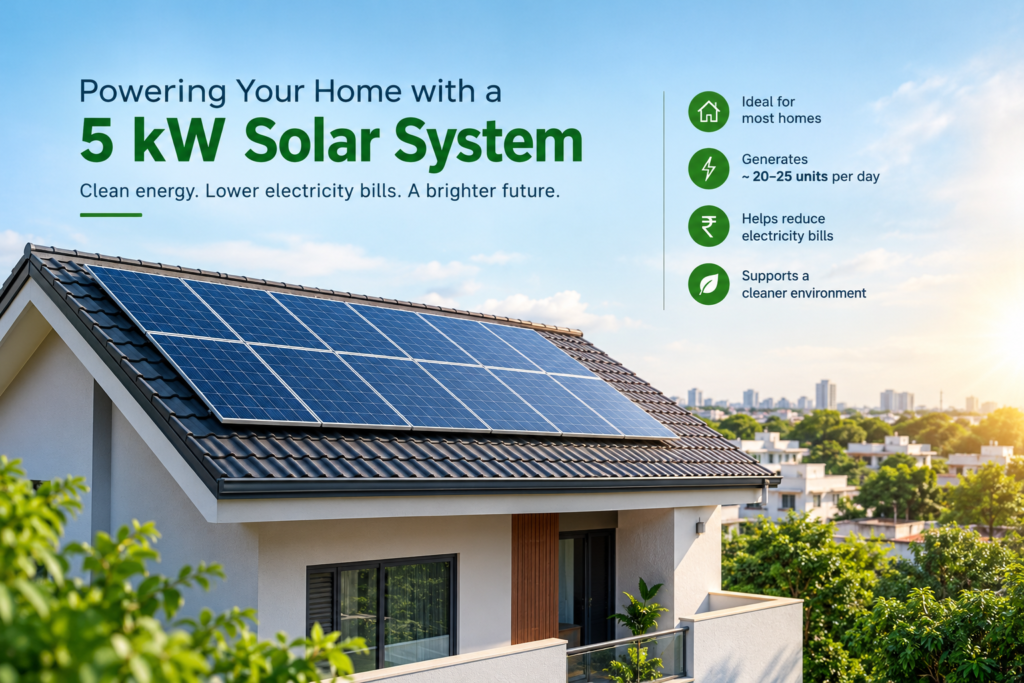
What Is a 5kW Solar System?
A 5kW solar system is a rooftop solar power system designed to generate electricity from sunlight for your home. It has a total solar capacity of 5 kilowatts and can help reduce the amount of electricity you buy from the grid.
A typical system includes solar panels, a solar inverter, mounting structures, cables, electrical protection equipment and other installation components. The panels produce electricity from sunlight, while the inverter converts it into power your appliances can use. The number and type of panels, inverter, roof layout and other equipment change with your electricity use and available roof space.
Natural Power follows a site-based approach: electricity bill, energy usage, rooftop area and location are considered before recommending a system size. A 5kW system can suit homes with relatively high consumption, such as those using air conditioners, refrigerators, washing machines and water pumps. The best capacity should always be decided after checking actual consumption, not because a system is larger.
How Does a 5kW Solar System Work?
- Solar panels receive sunlight and produce electricity.
- The solar inverter converts the electricity into usable power for your home.
- Your appliances use the solar power when it is available.
- If the system produces more than your home needs, the extra may go to the grid through an approved connection and net-metering arrangement.
- When solar power is not enough, your home can draw electricity from the grid, depending on the system type.
A standard on-grid system normally does not provide power during a grid outage because it must shut down for safety. For backup during power cuts, a battery-based hybrid system may be better.
Is a 5kW Solar System Right for Your Home?
A 5kW system may be worth considering if your home has higher consumption and enough shadow-free roof space. Natural Power’s installation guidance recommends sizing by electricity consumption, future requirements, rooftop space, budget and regulations.
5kW does not mean your home will always produce exactly 5kW. Generation changes through the day and depends on sunlight, weather, shade, panel position and site conditions. Look at your electricity bill and have your roof assessed so you do not pay for capacity you may not use. Also remember that the total project cost includes much more than panels, so comparing quotations only by final price can mislead.
5kW Solar System Price in India
The price depends on the system type, panels, inverter, mounting structure, installation work and other equipment. Compare the complete system cost, not only the panel price. For the configuration considered in this guide, the total project cost is ₹3,24,500. For eligible residential customers, the government subsidy can reduce the upfront cost.
| Solar System Capacity | Total Project Cost | Government Subsidy* | Effective Cost After Subsidy* |
|---|---|---|---|
| 5 kW | ₹3,24,500 | ₹78,000 | ₹2,24,220 |
*Subsidy and final customer cost are subject to eligibility, applicable government rules, approved system requirements and the final project quotation.
What Does the 5kW Solar System Price Include?
Depending on the system and project, the price can include: solar panels; solar inverter; mounting structure; solar cables and connectors; DC and AC protection equipment; earthing and safety equipment; installation and commissioning; system testing; net-metering-related support, where applicable; and other required electrical and installation materials.
Natural Power provides end-to-end solar EPC services: site assessment, design, procurement, installation, testing, commissioning and support, so the whole project is handled by one provider.
Why Can the Price of a 5kW Solar System Be Different?
- Solar panel type: power rating, efficiency, warranty and price differ; the number of panels depends on each panel’s wattage.
- Solar inverter: price depends on type, capacity, features, brand and warranty. On-grid and hybrid inverters serve different needs.
- Mounting structure: design depends on roof type, panel arrangement and site conditions.
- Roof and installation conditions: an open rooftop needs less work than one with limited space, shade or difficult access.
- System type: on-grid, hybrid and off-grid systems should not be compared by capacity alone; batteries add equipment and cost.
- Electrical and safety equipment: cables, protection, earthing and connectors are necessary. Cutting them to lower a quotation affects safety and reliability.
Does the 5kW Solar System Price Include Government Subsidy?
Under the PM Surya Ghar: Muft Bijli Yojana, Central Financial Assistance for eligible residential rooftop systems is capped at ₹78,000 for systems of 3kW or higher. There is no additional central subsidy above 3kW. A 5kW system can get the maximum amount if the installation and consumer meet the scheme requirements, but it is not an automatic discount. Check current rules before you buy. See our guides on the PM Surya Ghar subsidy and solar subsidy in Telangana.
What Is the Effective Cost After Subsidy?
- Total project cost: ₹3,24,500
- Government subsidy: ₹78,000
- Effective cost shown for the project: ₹2,24,220
The difference between listed cost and effective cost is ₹1,00,280. Treat the figures as a project-specific example, not a promise that every 5kW installation has the same final cost. Your payable amount can change with site, equipment, taxes or charges, subsidy eligibility and project requirements.
How to Compare Two 5kW Solar Quotations
Do not choose a company only for the lowest number. Ask: Which panels are included, and what are their wattage and technology? Which inverter, and what warranty? What mounting structure? Are installation charges, electrical protection and earthing included? Is net-metering support included? Is subsidy assistance provided? What after-sales support is available, and what happens if there is a problem after installation? A cheaper quotation may not include the same equipment or services. Natural Power’s residential service covers design, installation, net-metering support and maintenance, while its EPC service covers the project from site assessment to commissioning.
Is a 5kW Solar System Worth the Price?
For a home with suitable consumption and usable roof space, it can be a useful long-term investment that lowers monthly electricity expenses. Savings depend on consumption, tariff, generation, performance and how much of the power your home uses, so a good solar company should not promise the same savings to every household. See our residential rooftop solar page, and our 3kW solar system guide if you are comparing sizes. Next, the two biggest components: panels and inverter.
5kW Solar Panel Price
The price depends on wattage, technology, efficiency, brand, warranty and number of panels. It is only one part of the project cost, so the 5kW solar panel price should not be confused with the 5kW solar system price.
How Many Solar Panels Are Needed for 5kW?
| Panel Wattage | Approx. Panels for 5kW |
|---|---|
| 400W | 13 panels |
| 450W | 12 panels |
| 500W | 10 panels |
| 540W | 10 panels |
| 550W | 10 panels |
The exact number depends on the equipment and design. Ten 550W panels give 5.5kW of panel capacity, while ten 500W panels give 5kW, so compare the full system specification.
What Affects the Price of 5kW Solar Panels?
- Panel wattage: higher-wattage panels need fewer units and may need less space.
- Panel technology: efficiency and performance differ; choose by roof space, budget and energy needs.
- Efficiency: more power from similar roof area, useful when space is limited.
- Warranty: Natural Power states quality panels can operate for 25 years or more, with generation gradually reducing.
- Installation requirements: roof structure, mounting, electrical work and site conditions.
Is a 5kW Solar Panel Enough for a 5kW System?
Not always. A quotation may use panels whose combined capacity is slightly above 5kW while the system is marketed as 5kW. That is not necessarily a problem, but the quotation should state total panel capacity, number of panels, wattage of each, panel technology, inverter capacity, expected configuration and product and performance warranties.
5kW Solar Panel Price vs 5kW Solar System Price
Panel price is the cost related to the panels. System price is the complete project: panels, inverter, mounting structure, DC and AC cables, earthing, protection equipment, installation, testing and commissioning, and other electrical work. A low panel price does not mean a cheaper complete installation.
What Should You Check Before Buying?
- Panel wattage – how much power each panel produces.
- Efficiency – useful when roof space is limited.
- Warranty – both product and performance terms.
- Certifications and quality – equipment should meet required standards.
- Installation quality – good panels perform poorly if badly installed.
- After-sales support – who helps with technical problems.
- Compatibility – panels matched with the inverter and other components.
Natural Power supplies panels that meet international quality standards with long-term warranties, consultation and after-sales support.
Does a More Expensive Panel Always Mean Better? What Is the Best Panel?
No. Compare price, efficiency, warranty, expected performance, roof space and installation quality, and judge the cost and performance of the complete 5kW configuration. There is no single best panel; it depends on roof area, consumption, system capacity, efficiency, budget, roof direction and shading, inverter compatibility, warranty and after-sales support. A professional site assessment can pick the right configuration. Choose a complete system that is correctly sized, safely installed and suited to your home.
5kW Solar Inverter Price
The price depends on inverter type, brand, efficiency, number of MPPTs, monitoring features, warranty and other specifications. Panels produce DC electricity, while most appliances use AC; the inverter converts one to the other. A hybrid inverter works with battery storage, so it generally has more functions and costs more than an on-grid inverter.
What Is the Price of a 5kW Solar Inverter?
There is no single fixed price. As a current market reference, 2026 listings show 5kW on-grid inverters at different prices by brand and model. One current Luminous 5kW on-grid model is listed at ₹73,000 on its official website, while other listings can be substantially lower or higher depending on model, seller and offer. Compare specification and warranty, not only price.
On-Grid vs Hybrid 5kW Solar Inverter
| Feature | 5kW On-Grid Inverter | 5kW Hybrid Inverter |
|---|---|---|
| Works with solar panels | Yes | Yes |
| Works with electricity grid | Yes | Yes |
| Battery support | Normally no | Yes |
| Backup during power cuts | Normally no | Can provide backup |
| Battery required | No | Depends on system design |
| Typical cost | Lower | Higher |
| Best for | Reducing electricity bills | Solar + backup |
An on-grid system exports surplus electricity under the applicable net-metering arrangement but normally gives no backup in an outage. Natural Power explains that homeowners who need backup may be better suited to a hybrid system with battery storage.
What Does a 5kW Solar Inverter Do?
- Converts DC into AC for household appliances.
- Helps optimise generation – MPPT extracts useful power under changing sunlight.
- Provides electrical protection against overvoltage, short circuits and other faults; features depend on the model.
- Monitors performance through displays, Wi-Fi or apps. A current Luminous 5kW on-grid model lists MPPT, remote monitoring and multiple protections.
What Should You Check Before Buying?
1. Inverter capacity
Capacity and panel configuration should be properly matched by the system designer, depending on the panels, inverter specifications and overall design.
2. MPPT configuration
MPPT helps get useful power under different conditions, and matters most if your roof has different orientations or partial shading.
3. Efficiency
A more efficient inverter reduces conversion losses, but consider it together with reliability, warranty, features and system design.
4. Warranty
Check the period and what it covers. A longer warranty gives peace of mind, but also check the service network and claim process.
5. Monitoring
Wi-Fi or app monitoring shows generation and helps spot unusual changes.
6. Safety features
Check the protections required for the installation. A properly designed system also needs electrical protection, earthing and other safety equipment. Government-backed standards and labelling initiatives have focused on the efficiency and safety of grid-connected inverters.
Does a More Expensive Inverter Generate More Electricity?
Not necessarily. Generation depends on panel capacity, sunlight, shade, roof orientation, temperature and design. A costlier inverter may offer better monitoring, different MPPT arrangements, a longer warranty or battery compatibility, but paying more does not automatically mean more power. Select it as part of the complete system.
Inverter Price vs System Price, and Which Inverter Is Best?
The inverter price is the cost of the inverter alone; the system price includes panels, mounting structure, DC and AC cables, protection, earthing, installation, testing and commissioning. Natural Power explains that on-grid system price depends on capacity, panels, inverter, structure, electrical equipment, installation and government support. If your goal is lower bills with a reliable grid, a 5kW on-grid inverter may suit. If you also want backup, consider a hybrid inverter with an appropriately sized battery. Your installer should check consumption, roof layout, panel configuration, backup requirement and electrical connection first, and you should buy from a reliable installer offering commissioning and after-sales service.
How Much Electricity Does a 5kW Solar System Generate?
A 5kW system does not produce 5kW every hour. Generation depends on sunlight, location, weather, shade, panel direction, efficiency and design. As a simple example, it may generate around 20–25 units per day under good conditions, or roughly 600–750 units per month. These are estimates, not guaranteed figures.
Why Does a 5kW System Not Produce 5kW All Day?
The “5kW” rating is installed capacity, not continuous output. Early morning generation starts low; late morning it rises; around midday it can peak; in the afternoon it gradually decreases; in the evening it falls; at night panels do not generate electricity. Natural Power also explains that generation varies with sunlight and weather.
How Many Units Can a 5kW System Generate?
| Period | Approximate Generation |
|---|---|
| Per day | 20–25 units |
| 30 days | 600–750 units |
| 365 days | 7,300–9,125 units |
This is only a planning range. An MNRE resource also notes that solar production varies by location and season. For a more accurate estimate, assess actual location, rooftop, orientation, shading and equipment.
What Factors Affect Generation?
- Sunlight: a roof with strong, unobstructed sunlight is best.
- Shade: trees, buildings or water tanks reduce output, even partly, depending on panel arrangement and inverter design. A site survey matters.
- Weather: panels work on cloudy days, but output is lower; rain and heavy overcast reduce it further.
- Panel direction and angle: chosen from the actual roof and local conditions.
- Panel condition: dust and dirt reduce sunlight; inspect and clean as needed.
- Inverter and system losses: conversion and wiring losses mean delivered energy differs from theoretical output.
Monthly Generation, Whole-House Use and Net Metering
At 20–25 units a day, expect about 600–750 units over 30 days, but months differ because of cloud, rain, season, daylight hours, dust, temporary shading, maintenance and equipment performance. A quotation should give an estimate for your actual location.
Can it power a whole house? It can cover a large portion of needs if correctly sized. A home with fans, lights, refrigerator, television, washing machine, water pump, computers and air conditioners may differ greatly from another. Natural Power recommends analysing bills, future needs, roof space and local conditions.
Net metering: for an eligible grid-connected system, your home uses solar first and excess may be exported under an approved arrangement; at night you draw from the grid. Generation and your simultaneous consumption are two different things. Read our solar net metering guide.
Can a 5kW System Give a Zero Electricity Bill?
Not necessarily. It can significantly reduce grid purchases, but zero should not be promised to everyone. Your bill depends on consumption, generation, system size, tariff, net-metering rules, fixed and other charges, seasonal usage and performance. A family using more air conditioning in summer may see the same system cover a smaller share. Natural Power also advises that a zero bill is not guaranteed.
How Can You Get a More Accurate Estimate?
Get a site-specific assessment covering recent bills, monthly consumption, rooftop area, roof direction and layout, shading, local sunlight, panel type and capacity, inverter configuration and future requirements. Natural Power’s installation process begins with studying electricity bills. Judge the project by expected annual generation and the share of your consumption it covers, not by panel count.
How Much Roof Space Is Required for a 5kW Solar System?
Plan for around 400–500 sq. ft. of usable, shadow-free rooftop space. Natural Power states that 1kW may need around 80–100 sq. ft.; actual area varies with panel size, efficiency, roof layout and design.
| Solar System Size | Approx. Shadow-Free Roof Space |
|---|---|
| 1 kW | 80–100 sq. ft. |
| 2 kW | 160–200 sq. ft. |
| 3 kW | 240–300 sq. ft. |
| 5 kW | 400–500 sq. ft. |
| 10 kW | 800–1,000 sq. ft. |
Does It Need Exactly 500 Sq. Ft.?
No. Higher-wattage panels reduce the number needed, and an open rectangular roof is easier to use than one with obstacles. Space is needed around water tanks, staircases, chimneys, vent pipes, satellite dishes, air-conditioning units, roof edges and other structures. Natural Power’s process includes measuring usable area and checking obstacles.
Why Is Shadow-Free Space Important?
Shade reduces generation; the impact depends on shading pattern, panel configuration and inverter design. A 600 sq. ft. roof with a large shaded or occupied portion may have far less usable area. A survey checks available area, roof condition, orientation, sunlight exposure, shading through the day, existing structures, panel arrangement and safe access.
Small Roofs, Roof Types, Direction and Shade
- Small roof? It depends on usable area. Higher-wattage or higher-efficiency panels may reach the capacity with fewer panels, but also weigh performance, warranty, inverter compatibility, roof structure and design.
- Any roof? Many types work, including RCC, metal, tiled and sloped, if suitable. Check structural strength, condition, space, sunlight, shading, accessibility and mounting points. An old or damaged roof may need repair first.
- Roof direction: yes, it matters. Direction and angle affect sunlight; check shading at different times, since a roof sunny in the morning may be shaded in the afternoon.
- Shaded roof: not automatically a no. Find the source, hours of shade, affected panels, whether the layout can change and whether the inverter configuration can reduce the impact. Large, long shade lowers expected generation.
Is Your Home Suitable? Five Checks
- Electricity consumption: recent bills should justify 5kW for current and expected use.
- Usable roof area: enough suitable space for panels and safe installation.
- Sunlight: good sunlight with limited shading.
- Roof condition: structurally suitable for the mounting system.
- System requirements: panel configuration, inverter, electrical connection, net-metering requirements and local regulations.
What If I Don’t Have Enough Roof Space?
Don’t assume solar is impossible. An installer can check whether higher-wattage panels reduce the area, another roof section is available, capacity should be reduced or a different layout improves space use. Size the system by both consumption and usable space; one that does not fit causes shading, maintenance and performance problems.
Final Answer: How Much Space Does a 5kW System Need?
Start with about 400–500 sq. ft. of shadow-free roof, then ask the company for a roof and shadow assessment to learn how many panels fit, where they go and what generation to expect.
5kW Solar System Savings and Payback
A correctly designed 5kW system can generate a significant amount of electricity over its lifetime, reducing power bought from the grid. Actual savings depend on consumption, generation, tariff, net metering and other bill charges.
How Much Can You Save?
At around 600–750 units per month under good conditions, a home that uses most of it can cut a large part of its energy charges. A high-consumption home benefits more than a very low-consumption one. Calculate from your recent bills, not a fixed figure. Natural Power recommends checking consumption and future needs before choosing capacity.
What Determines Monthly Savings?
- Your consumption: if it is much lower than generation, a larger system adds less benefit.
- Electricity tariff: the value of each solar unit follows your tariff and changes as prices change.
- Solar generation: sunny days produce more; cloudy or rainy periods less.
- Net metering: surplus may be exported for eligible grid-connected systems. Billing and rules depend on the DISCOM and state regulations.
- Daytime usage: running washing machines, water pumps and other suitable loads in daylight uses solar directly.
Can It Give a Zero Bill?
Not automatically. Your bill may still include fixed charges, taxes, minimum charges or other charges, and consumption can exceed generation. Natural Power notes that zero is not guaranteed. A better promise: a properly sized 5kW system can significantly reduce your grid purchase, and the reduction should be estimated from your bills and site.
How Long Does It Take to Recover the Cost?
Payback period = Net solar investment ÷ Annual electricity savings. For example, if final investment after subsidy and adjustments is ₹2,50,000 and annual savings are ₹50,000, then ₹2,50,000 ÷ ₹50,000 = 5 years. This is only an example, not a guaranteed payback. It changes with final price, subsidy, tariff, annual generation, consumption, net-metering rules, maintenance costs, price changes and performance over time.
Does Subsidy Improve Payback?
Yes, an eligible subsidy reduces the initial amount. Under PM Surya Ghar the central structure gives ₹30,000 per kW for the first 2kW and ₹18,000 per kW for additional capacity up to 3kW, capped at ₹78,000 for larger residential systems, so a 5kW system gets no higher central subsidy than 3kW. MNRE states the scheme is for residential consumers with a grid-connected connection who apply through the National Portal, subject to scheme requirements.
Why Calculate From Your Own Bill, and How to Save More?
If consumption is much lower, installing 5kW because it is popular may not be the most economical choice, so an installer should review your bills first. To improve value: use high-consumption appliances in daylight where practical; keep panels reasonably clean; check for unusual performance changes; monitor generation; avoid shading; size correctly; and choose quality equipment and professional installation. The goal is to generate power your household can use or export under grid rules.
Is a 5kW Solar System a Good Investment?
For a home with suitable consumption, adequate roof and good sunlight, it can be a strong long-term investment: it reduces grid purchases and monthly expenses, increases renewable use and generates for years. It is not a quick way to eliminate every charge. Ask for a written quotation showing price, subsidy eligibility, panel and inverter specifications, expected generation, installation scope and warranty terms.
5kW Solar System Installation Process
Installation is more than putting panels on a roof. It includes site assessment, design, equipment selection, mounting, electrical work, testing and, for eligible grid-connected systems, the electricity-distribution and net-metering process. Details vary by state, DISCOM and project type.
- Check your electricity consumption. Review monthly consumption, tariff, seasonal changes, major appliances, future needs and existing connection. Bigger is not always better.
- Conduct a rooftop site survey. Check area, roof type and condition, sunlight, shading, tanks and obstacles, panel arrangement, safe access and electrical connection. Natural Power plans systems from usage, rooftop area and location.
- Finalise the design. Number and wattage of panels, inverter, mounting structure, DC and AC cables, protection, earthing, connection and layout. Check the quotation states specifications, scope, warranties and charges.
- Apply for approvals. For eligible grid-connected homes under PM Surya Ghar, application and documents go through the National Portal and the DISCOM process, with verification before subsidy is processed.
- Install the mounting structure, fixed securely and suited to roof type, panel arrangement, weather, wind loads, panel angle and maintenance access.
- Install the solar panels per the approved design and electrical configuration; the count depends on panel wattage.
- Install the 5kW inverter in a protected, accessible place; for on-grid it connects the array to the grid.
- Complete electrical and safety work: DC and AC cables, protection, earthing, lightning or surge protection where required, junction boxes and connectors.
- Testing and commissioning: panels, inverter, connections, protection, earthing and generation recording are verified before commissioning.
- Net metering and bidirectional meter. The DISCOM may install or approve a bidirectional meter that measures grid import and export. Process and timeline depend on the DISCOM. See our net metering guide.
How Long Does It Take?
Physical installation can often be done in 1–3 days once site, equipment and preparations are ready. The full project can take longer because of survey, design, approval, equipment availability, application, technical approval, inspection, metering and commissioning, as Natural Power’s FAQ notes.
What Documents May Be Required?
Consumer details and account number, identity or application details, bank details for subsidy, installation photographs, required agreements and other documents requested by the official process. PM Surya Ghar guidelines specify a unique application ID linked to the consumer account, installation photographs, meter documentation and bank details. Your installer can help.
What Happens After Installation?
Monitor the system. A good provider supports monitoring, maintenance, troubleshooting, warranty issues and technical support; Natural Power provides after-sales support, monitoring, maintenance and technical assistance.
5kW Installation Checklist
Before signing, ask the installer to confirm: 5kW capacity; number and wattage of panels; panel specifications; inverter brand, model and capacity; mounting structure; cables and protection; earthing; installation charges; net-metering support; subsidy support; product and installation warranties; after-sales service; expected generation; final price.
Final Takeaway
Planning flows from bill analysis → site survey → design → approvals → installation → testing → commissioning → net metering. Choosing the right installer matters as much as choosing panels and inverter.
Good equipment, proper installation and timely maintenance help the system generate efficiently for years. Natural Power states quality panels are designed to last 25 years or more, and its FAQ notes many have a performance lifespan of around 25–30 years. Inverters may need replacement during the system’s life.
How Long Does a 5kW System Last?
| Solar Component | Typical Long-Term Expectation |
|---|---|
| Solar panels | 25+ years |
| Mounting structure | Designed for long-term outdoor use |
| Solar inverter | May require replacement during system lifetime |
| Cables and electrical equipment | Depends on quality, installation and environmental conditions |
| Monitoring equipment | Depends on the equipment and technology |
Output decreases gradually over time. Lifespan depends on quality, installation, weather, maintenance and manufacturer specifications.
Maintenance, Cleaning, Dust and Rain
Basic upkeep: check panels for dust, monitor generation, inspect cables and connectors, check inverter messages, inspect the mounting structure, check protection and earthing, and arrange professional inspections when required. Natural Power recommends monitoring, cleaning when needed and scheduled inspections.
Cleaning frequency varies; panels need it more often with high dust, construction, pollution, bird droppings or dry weather. Clean when dirt visibly affects the surface or performance, following the manufacturer’s advice. Dust can reduce generation. Natural Power lists dust, heavy shading, damaged cables, faulty inverters, loose connections and poor maintenance as performance issues. Rain removes some dirt but is no substitute for inspection and cleaning.
Monitoring and What to Do If Generation Drops
Inverters give information via display, portal or app. A sudden drop in similar weather may mean excessive dust, new shading, inverter warnings, damaged cables, electrical faults, panel damage or communication problems. Check the inverter display or app for warnings; check for dirty panels, new shade, a stopped inverter, a grid outage or electrical warnings. Do not open or repair electrical equipment yourself; contact your installer or a qualified technician.
What Warranty Should You Check?
- Panel warranty: product warranty, performance warranty, degradation terms and claim conditions.
- Inverter warranty: standard length, extended option, who handles claims, local service, and what happens if replacement is needed.
- Installation warranty: workmanship cover is separate from the manufacturer’s warranty, which may not cover installation problems.
After-Sales Service, and What Reduces System Life
You may use the system for 20–25 years or more, so support matters: monitoring, maintenance, inverter issues, warranty claims, electrical problems, performance checks and technical guidance. Life is reduced by poor-quality equipment, poor installation, water in electrical components, loose connections, damaged cables, heavy shading, lack of maintenance, extreme exposure and incorrect design. The cheapest quotation is not always best; a slightly higher cost may be worthwhile for better equipment, safety, warranties and service.
Annual Maintenance and Working After 25 Years
Monitor and inspect regularly. Every month: check generation. When required: clean panels. Periodically: check inverter, cables and structure. When there is a problem: call a qualified technician. Panels can keep generating after 25 years, though output will be lower than when new.
Maintenance Checklist
Monitor monthly generation; check for dust; check for new shading; look for visible panel damage; check inverter warnings; inspect accessible cables and connections; check the mounting structure visually; follow manufacturer instructions; keep warranty documents safe; keep your installer’s contact details; contact a qualified technician when a fault occurs.
Final Takeaway
Choose quality equipment, use a professional installer, keep panels reasonably clean, monitor generation and act quickly on unusual behaviour. Get panel, inverter and installation warranties, maintenance terms and after-sales support in writing.
5kW Solar System : Frequently Asked Questions
What is the price of a 5kW solar system in India?
The 5kW solar system price in India depends on the panels, inverter, mounting structure, electrical equipment, installation and other project requirements.
For the system price used in this guide, the total project cost is ₹3,24,500. The applicable government subsidy for an eligible residential customer can be up to ₹78,000 under the central subsidy structure. The final customer cost depends on eligibility and the actual project quotation.
For the system price used in this guide, the total project cost is ₹3,24,500. The applicable government subsidy for an eligible residential customer can be up to ₹78,000 under the central subsidy structure. The final customer cost depends on eligibility and the actual project quotation.
What is the 5kW solar system price in India with subsidy?
For an eligible residential installation, the central subsidy can be up to ₹78,000 for a system of 3kW or more. Installing a 5kW system does not increase the central subsidy beyond this amount.
For the price example used in this guide:
Total project cost: ₹3,24,500
Applicable central subsidy: up to ₹78,000
Customer's final payable amount: depends on the verified quotation, eligibility and any applicable discounts or adjustments.
Always confirm the subsidy and final payable amount before signing the purchase agreement.
Is a 5kW solar system eligible for government subsidy?
Yes, an eligible residential 5kW rooftop solar installation can receive the applicable Central Financial Assistance under PM Surya Ghar: Muft Bijli Yojana.
The central subsidy structure provides support for the first 3kW of residential rooftop capacity, with no additional central subsidy for capacity above 3kW. Therefore, a 5kW system can qualify for the maximum central subsidy amount, subject to the scheme's requirements.
The central subsidy structure provides support for the first 3kW of residential rooftop capacity, with no additional central subsidy for capacity above 3kW. Therefore, a 5kW system can qualify for the maximum central subsidy amount, subject to the scheme's requirements.
How much electricity does a 5kW solar system generate?
A 5kW solar system can generate different amounts depending on sunlight, location, weather, shading, panel orientation and system performance.
As a simple planning estimate, a 5kW system may generate around 20–25 units per day under good conditions, or approximately 600–750 units in a 30-day month.
These figures are estimates, not guaranteed generation. A site-specific assessment gives a more useful estimate.
As a simple planning estimate, a 5kW system may generate around 20–25 units per day under good conditions, or approximately 600–750 units in a 30-day month.
These figures are estimates, not guaranteed generation. A site-specific assessment gives a more useful estimate.
How many solar panels are needed for a 5kW system?
The number depends on the wattage of each panel.
For example:
400W panels: around 13 panels
450W panels: around 12 panels
500W panels: 10 panels
550W panels: around 10 panels
The final configuration depends on the selected panel and system design.
For example:
400W panels: around 13 panels
450W panels: around 12 panels
500W panels: 10 panels
550W panels: around 10 panels
The final configuration depends on the selected panel and system design.
How much roof space is required for a 5kW solar system?
A general planning estimate is around 400–500 sq. ft. of shadow-free roof space.
Natural Power states that approximately 80–100 sq. ft. may be required per 1kW, although actual space requirements vary according to panel size, efficiency, roof layout and installation design.
A professional site survey is recommended before finalising the system.
Natural Power states that approximately 80–100 sq. ft. may be required per 1kW, although actual space requirements vary according to panel size, efficiency, roof layout and installation design.
A professional site survey is recommended before finalising the system.
What is the 5kW solar inverter price?
There is no single fixed 5kW solar inverter price.
The price depends on whether you choose an on-grid or hybrid inverter, along with the brand, model, efficiency, MPPT configuration, monitoring features and warranty.
An on-grid inverter will normally have a different price from a hybrid inverter because a hybrid system can support battery storage.
The price depends on whether you choose an on-grid or hybrid inverter, along with the brand, model, efficiency, MPPT configuration, monitoring features and warranty.
An on-grid inverter will normally have a different price from a hybrid inverter because a hybrid system can support battery storage.
Can a 5kW solar system run a house?
Whether it can cover most of your electricity consumption depends on your appliances and monthly usage.
Homes using air conditioneCan a 5kW solar system run a house?
rs, refrigerators, water pumps, washing machines and other high-consumption appliances may have much higher electricity requirements than smaller households.
The best system size should be selected after checking your electricity bills.
Homes using air conditioneCan a 5kW solar system run a house?
rs, refrigerators, water pumps, washing machines and other high-consumption appliances may have much higher electricity requirements than smaller households.
The best system size should be selected after checking your electricity bills.
Can a 5kW solar system run AC?
Yes. A 5kW solar system can supply electricity for an air conditioner, but whether it can comfortably support an AC along with the rest of the home's appliances depends on the AC capacity, its running time, other loads and the available solar generation.
Solar generation also changes throughout the day.
Therefore, the correct question is not simply “Can 5kW solar run an AC?” but rather:
“Can the expected solar generation and inverter capacity support my AC and other household loads?”
A site-specific load assessment can answer this more accurately.
Solar generation also changes throughout the day.
Therefore, the correct question is not simply “Can 5kW solar run an AC?” but rather:
“Can the expected solar generation and inverter capacity support my AC and other household loads?”
A site-specific load assessment can answer this more accurately.
Which company should I choose for a 5kW solar system?
Choose a solar company that can provide a properly designed system, quality equipment, professional installation, clear pricing, documentation, warranty support and after-sales service.
Natural Power provides residential solar solutions including site assessment, system design, installation, commissioning and after-sales support.
Before making a decision, ask the company for a written quotation and make sure all major equipment, services, warranties and applicable subsidy information are clearly mentioned.
Get a free 5kW solar quote
Send us your latest electricity bill and we will size the system for your home. Explore our residential solar, commercial solar and projects, or return to the Natural Power home page. MNRE-empanelled: mnre.gov.in.