


Best Solar for Home: Your Ultimate Guide to Residential Solar Power
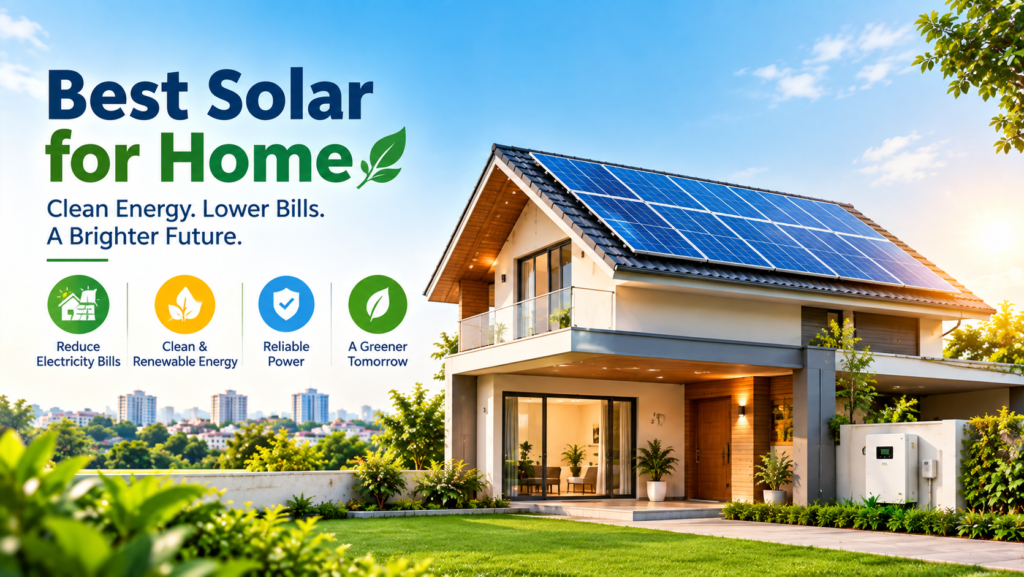
Best Solar for Home: How to Choose the Right Solar System
Choosing the best solar for home depends on more than simply buying the highest-wattage solar panels. The right residential solar system should match your electricity consumption, available roof space, sunlight conditions, budget and backup requirements.
For most homeowners, the first step is to understand the different types of home solar systems and determine which configuration is suitable for their electricity needs.
A properly designed rooftop solar system can help reduce electricity bills, make better use of your rooftop and provide clean renewable energy for years.
What Is the Best Solar System for a Home?
The best solar system for your home depends on how you use electricity and whether you need battery backup.
The three main options are:
- On-grid solar system – connected to the electricity grid and generally designed to reduce electricity bills.
- Off-grid solar system – works independently of the grid and uses batteries for energy storage.
- Hybrid solar system – combines solar generation, grid connectivity and battery backup.
For homes with a reliable electricity connection and a primary goal of reducing electricity bills, an on-grid rooftop solar system is often a practical choice.
If frequent power cuts are a concern, a hybrid system may be more suitable.
What is the Best Solar for Home?
The answer depends on several factors, such as:
- Your average monthly electricity bill
- Roof space and direction
- Budget and payback goals
- Need for power backup (yes/no)
- Access to the electricity grid
Let’s break down the available options.
How to Choose the Best Solar for Your Home
Consider these factors before choosing a system:
1. Your Monthly Electricity Consumption
Check your electricity bills for the previous 6–12 months. Your average monthly consumption is one of the most important factors when determining solar capacity.
2. Available Roof Space
Your roof should have sufficient usable and relatively shadow-free space for the required solar panels.
3. Solar Panel Technology
Monocrystalline and newer high-efficiency technologies such as N-type panels and TOPCon are popular choices, especially where rooftop space is limited.
4. Solar Inverter
The inverter converts electricity generated by the panels into usable AC electricity. Its capacity and compatibility should match the overall system design.
5. Backup Requirement
If you want electricity during power cuts, consider whether you need a hybrid system with batteries.
6. Government Subsidy
Eligible residential consumers may be able to receive financial assistance under applicable government rooftop-solar schemes, including PM Surya Ghar.
How Much Solar Capacity Does a Home Need?
There is no single capacity that works for every house.
As a general starting point:
Monthly Consumption Possible Solar Capacity Up to 150 units 1–2 kW 150–300 units 2–3 kW Above 300 units 3 kW or more These are only indicative figures. Actual capacity should be determined from electricity consumption, roof conditions, sunlight, system design and applicable regulations.
Which Solar System Is Best for Different Homes?
Best for reducing electricity bills
Best for homes with frequent power cuts
Best for locations without reliable grid electricity
There is no universal “best” system. The right choice depends on your home’s electricity requirements and priorities.
What Are the Benefits of Home Solar?
Installing solar panels at home can help:
- Reduce electricity expenses
- Generate clean renewable energy
- Reduce dependence on conventional electricity
- Make use of unused rooftop space
- Potentially improve long-term energy savings
- Take advantage of eligible government incentives
- Support a cleaner environment
Best Solar for Home: Final Recommendation
The best solar system is not necessarily the largest or most expensive system. It is the system correctly sized for your electricity consumption, roof space and future requirements.
Before installation, compare the solar panel technology, inverter, warranties, installation quality, expected generation and after-sales support.
Ready to find the right solar system for your home? Contact Natural Power for a residential solar assessment.
1. On-Grid Solar System (Best for Most Homes)
✅ Key Features:
- Connected to the electricity grid
- Powers your home during the day
- Sends extra energy to the grid (net metering)
- No batteries required
- Cost-effective and low maintenance
 Best for:
 Best for:
- Urban or semi-urban homes
- Areas with stable grid supply
- Households looking to reduce bills, not necessarily for backup
Why it’s the best solar for home:
 Why it’s the best solar for home:
- Lowest installation cost
- Net metering allows you to earn from excess solar
- Government subsidies available
2. Hybrid Solar System (Best for Backup + Savings)
✅ Key Features:
- Combines on-grid + battery backup
- Stores power for use during blackouts
- Still allows net metering
- Slightly higher cost due to batteries
📊 Best for:
- Homes in areas with frequent power cuts
- Families wanting both savings and 24/7 power reliability
🔑 Why it’s the best solar for home:
- Peace of mind during power failures
- You still save on your electricity bill
- You become energy independent
3. Off-Grid Solar System (Best for Remote Homes)
✅ Key Features:
- Not connected to grid
- 100% reliant on solar and battery
- Ideal for rural or remote homes
📊 Best for:
- Farmhouses, mountain cabins, villages
- Homes with no access to grid power
🔑 Why it’s the best solar for home (in remote areas):
- Complete freedom from the grid
- Works even in load-shedding-prone zones
- Essential for energy access in rural India
How Much Solar Do You Need?
Here’s a quick chart to help you estimate the system size based on your electricity bill:
| Monthly Bill | Suggested System Size | Rooftop Space Needed |
|---|---|---|
| ₹1,000 – ₹2,000 | 1 kW – 2 kW | 100 – 200 sq ft |
| ₹2,000 – ₹4,000 | 3 kW – 5 kW | 300 – 500 sq ft |
| ₹5,000+ | 6 kW – 10 kW | 600 – 1,000 sq ft |
The best solar for home is the one that offsets your maximum day-time load, without overproducing.
Key Components of the Best Solar for Home
To build an efficient, long-lasting system, ensure the following:
1. High-Quality Solar Panels
- Prefer Tier-1 monocrystalline panels
- 25–30 years performance warranty
- Efficient even in low light
2. Inverter
- Converts DC to AC
- Choose between string inverter, microinverter, or hybrid inverter
3. Mounting Structure
- Corrosion-resistant
- Proper tilt for maximum sun exposure
4. Battery (Optional)
- Lithium-ion or lead-acid
- Used in hybrid or off-grid systems
5. Net Meter (for On-grid/Hybrid)
- Records power imported and exported
- Enables billing based on actual usage
Cost of Installing the Best Solar for Home (India – 2026)
| System Size | Type | Approx. Cost (INR) |
|---|---|---|
| 1 kW | On-grid | ₹57,000 – ₹70,000 |
| 3 kW | On-grid | ₹1.4 – ₹1.8 Lakhs |
| 5 kW | On-grid | ₹2.5 – ₹2.7 Lakhs |
| 5 kW | Hybrid | ₹3.2 – ₹4.0 Lakhs |
| 5 kW | Off-grid | ₹3.5 – ₹4.5 Lakhs |
Prices vary by state, structure type, wiring needs, and subsidy eligibility. The best solar for home combines cost, efficiency, and service.
Government Subsidy for Residential Solar (India)
Under the PM Surya Ghar Muft Bijli Yojana, homeowners can receive:
- ✅ ₹30,000 subsidy for 1 kW
- ✅ ₹60,000 subsidy for 2 kW
- ✅ ₹78,000 subsidy for 3 kW and above
This brings down the upfront cost significantly. The best solar for home provider will assist you in applying for these subsidies.
Net Metering: Save and Earn from Solar
Net metering allows you to:
- Export unused solar electricity to the grid
- Get credits on your electricity bill
- Enjoy ₹0 or even negative bills
The best solar for home always includes this feature (for on-grid or hybrid setups).