
Solar Subsidy in India
Solar Subsidy in India: Eligibility, Benefits & How to Apply in 2026
In this guide, we explain the latest information about rooftop solar subsidy in India in 2026, including the PM Surya Ghar subsidy, eligibility, application process and important points to check before installing a solar system.
Installing a rooftop solar system can significantly reduce your electricity bills and help you generate clean, renewable energy for your home. To make residential solar more affordable, the Government of India provides financial assistance under the PM Surya Ghar: Muft Bijli Yojana.
If you are planning to install solar panels for your home, understanding the current solar subsidy in India, eligibility requirements, subsidy amount, application process and other benefits can help you make a better decision.
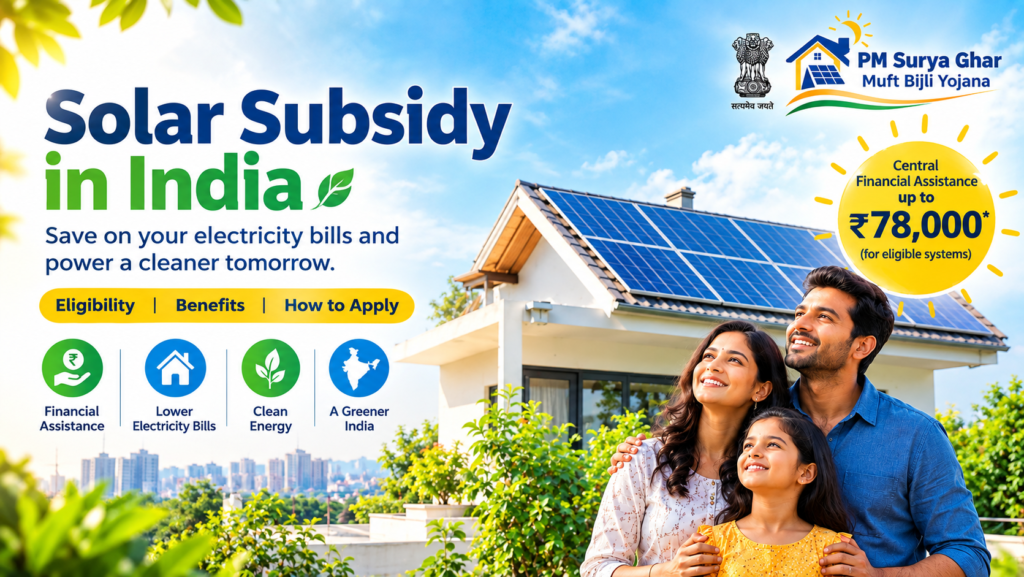
What Is Solar Subsidy in India?
A solar subsidy is financial assistance provided by the government to reduce the upfront cost of installing an eligible solar energy system.
For residential rooftop solar consumers, the main Central Government scheme is PM Surya Ghar: Muft Bijli Yojana.
The scheme is designed to encourage households to install grid-connected rooftop solar systems and reduce their dependence on electricity purchased from the grid.
The benefit is primarily intended for eligible residential electricity consumers. Commercial and industrial consumers should not assume that the residential Central Financial Assistance applies to their projects.
What Is PM Surya Ghar: Muft Bijli Yojana?
PM Surya Ghar: Muft Bijli Yojana is the Government of India’s major residential rooftop solar programme.
The scheme was launched to encourage rooftop solar adoption among households across India. Its objective includes helping households reduce their electricity bills through solar generation.
The programme has a target of supporting rooftop solar installations for one crore households.
The scheme is demand-driven, meaning eligible residential consumers can apply through the official National Portal and proceed with an eligible rooftop solar installation.
Key benefits include:
- Central Financial Assistance for eligible residential rooftop solar systems
- Lower upfront cost of installing solar
- Potential reduction in monthly electricity bills
- Access to eligible financing options
- Online application and tracking through the National Portal
- Ability to select an eligible/empanelled solar vendor
- Support for rooftop solar installation through the DISCOM process
How Much Solar Subsidy Can You Get in 2026?
Under the current PM Surya Ghar framework, the Central Financial Assistance for eligible residential rooftop solar systems is structured around the first 3 kW of capacity.
| Solar System Capacity | Central Financial Assistance |
|---|---|
| 1 kW | ₹30,000 |
| 2 kW | ₹60,000 |
| 3 kW | ₹78,000 |
| Above 3 kW | Maximum CFA remains capped at ₹78,000 |
The subsidy is therefore not simply a 40% subsidy for every system up to 3 kW, as older solar subsidy articles may suggest.
The applicable amount depends on the current government guidelines, benchmark costs, system capacity, consumer category and other scheme conditions.
Example
Suppose you install a qualifying 3 kW residential rooftop solar system.
The maximum Central Financial Assistance under the current structure can be up to:
₹78,000
If your system capacity is higher than 3 kW, increasing the system size does not automatically increase the Central subsidy beyond the applicable cap.
Therefore, it is important to calculate your solar requirement separately from the subsidy amount.
Who Is Eligible for Solar Subsidy?
PM Surya Ghar benefits are intended for eligible residential electricity consumers.
Generally, you should have:
- A residential electricity connection with the local DISCOM
- A suitable location for installing rooftop solar
- An eligible rooftop solar system
- Installation through the applicable government/DISCOM process
- An eligible vendor where required under the scheme
- Required consumer and banking information for the subsidy process
The scheme is available to residential consumers across India, including eligible rural households.
However, eligibility and installation requirements can vary depending on the applicable DISCOM procedures and government guidelines.
Before purchasing a solar system, it is advisable to check the current requirements on the official PM Surya Ghar portal and with your local DISCOM.
Is Solar Subsidy Available for Commercial Buildings?
The residential Central Financial Assistance under PM Surya Ghar should not be confused with incentives or other programmes for commercial, industrial or institutional solar installations.
Businesses can still install rooftop solar and benefit from electricity-bill savings, but the residential PM Surya Ghar subsidy should not automatically be assumed to apply.
If you are installing solar for:
- A house
- Apartment
- Residential property
- Commercial building
- Factory
- Office
- School
- Hospital
- Industrial facility
the applicable financial benefits and regulations may be different.
For a business installation, it is important to evaluate the project based on electricity consumption, tariff, rooftop area, system size, net metering regulations and applicable state policies.
Which Solar System Is Eligible for the Residential Subsidy?
For the PM Surya Ghar residential subsidy, the focus is on eligible grid-connected rooftop solar systems.
A typical on-grid rooftop solar system includes:
- Solar panels
- Grid-connected solar inverter
- Mounting structure
- DC and AC protection equipment
- Wiring and electrical components
- Monitoring system
- Required metering/interconnection equipment
The exact technical configuration depends on the property, electricity connection, sanctioned load, rooftop conditions and DISCOM requirements.
What about an off-grid solar system?
An off-grid solar system works independently from the electricity grid and generally uses batteries to provide backup power.
The residential PM Surya Ghar Central Financial Assistance should not be treated as a general subsidy for any type of off-grid solar installation.
If you specifically need battery backup, discuss your requirements with a qualified solar installer before deciding between an on-grid, hybrid or off-grid system.
How Does the Solar Subsidy Process Work?
The PM Surya Ghar process is designed to be completed through the official National Portal and the relevant DISCOM process.
A simplified overview is:
Step 1: Register on the PM Surya Ghar Portal
Visit the official PM Surya Ghar National Portal and register using the details associated with your electricity connection.
Step 2: Submit Your Rooftop Solar Application
Enter the required consumer and electricity connection details and submit the application.
Step 3: Follow the DISCOM Process
The application is processed according to the applicable electricity distribution company procedures.
Depending on the location and current rules, technical and regulatory processes may be handled through the portal/DISCOM system.
Step 4: Select an Eligible Solar Vendor
Consumers can select an appropriate vendor from the available vendor network on the portal.
Before selecting a company, compare:
- Solar panel quality
- Inverter brand
- Warranty
- Installation experience
- After-sales service
- Project cost
- System design
- Expected generation
- Vendor ratings/reviews where available
Step 5: Solar Installation
After the required approvals/processes, the selected vendor installs the rooftop solar system according to the applicable technical requirements.
Step 6: Inspection and Metering
After installation, the required inspection, documentation and metering/interconnection process is completed through the applicable DISCOM procedure.
Step 7: Subsidy/CFA Processing
Once the installation and verification requirements are successfully completed, the eligible Central Financial Assistance is processed through the scheme’s system.
The current process provides for subsidy disbursal directly to the residential consumer’s bank account after the required verification.
How Long Does It Take to Receive the Solar Subsidy?
The time required can vary depending on:
- Application processing
- DISCOM procedures
- Vendor installation
- Inspection
- Metering
- Documentation
- Bank details
- Verification
- Portal processing
Therefore, homeowners should avoid relying on a fixed number of days unless the current portal/DISCOM provides a specific timeline for their application.
If there is a delay, check the application status on the official portal and contact the appropriate DISCOM or scheme support channel.
What Documents May Be Required?
The exact documents can vary depending on the application and local DISCOM requirements.
Common information/documents may include:
- Electricity bill
- Electricity consumer/account number
- Applicant details
- Mobile number
- Bank account details
- Identity/address information where required
- Property/rooftop information where applicable
- Installation-related documents
- Required declarations or certificates
Make sure that the name and other details provided during the application match the relevant electricity and banking records wherever required.
Can You Get a Solar Subsidy for an Apartment or Housing Society?
Residential rooftop solar arrangements can also involve apartments, group housing and residential societies, but the applicable process and eligibility can depend on the project structure and electricity connection.
For common-area solar systems, the treatment may differ from an individual residential consumer installing solar against their own electricity connection.
Before proceeding, housing societies and apartment associations should check the current PM Surya Ghar guidelines and their DISCOM’s requirements.
Can Farmers Get Solar Subsidy?
Yes, farmers may be eligible for benefits under separate government programmes such as PM-KUSUM, depending on the type of solar project.
PM-KUSUM is different from PM Surya Ghar.
For example, solarisation of agricultural pumps and other agriculture-related solar projects may fall under PM-KUSUM or state-level programmes.
Therefore, farmers should not assume that the residential rooftop subsidy automatically applies to an agricultural solar project.
The applicable scheme should be checked based on:
- Type of agricultural connection
- Solar pump/system
- State
- DISCOM
- Project capacity
- Current government guidelines
Is There a State Solar Subsidy in Addition to the Central Subsidy?
Solar incentives and regulations can vary between states.
Depending on the state and project type, consumers may encounter different provisions relating to:
- Net metering
- Electricity connection
- Metering charges
- Local incentives
- DISCOM procedures
- State-level programmes
- Agricultural solar schemes
The availability of an additional state subsidy should therefore be confirmed with the relevant state government or DISCOM before assuming that it will be available.
What Is Net Metering?
Net metering allows an eligible grid-connected rooftop solar consumer to export surplus electricity to the grid according to the applicable regulatory framework.
For example, during sunny hours, your solar panels may generate more electricity than your home is consuming.
The surplus electricity can be exported to the grid, subject to the applicable metering arrangement and regulations.
At other times, such as during the evening, your home can draw electricity from the grid.
The exact billing and settlement mechanism depends on the applicable state/DISCOM regulations.
Does Solar Subsidy Mean Your Electricity Bill Will Become Zero?
Not necessarily.
The PM Surya Ghar scheme is designed to help households reduce their electricity expenses through rooftop solar.
Some households may achieve very low or even zero electricity bills for certain billing periods, depending on factors such as:
- Solar system capacity
- Electricity consumption
- Solar generation
- Weather
- Self-consumption
- Net-metering arrangement
- Applicable electricity tariff
- Fixed charges
- DISCOM billing rules
Therefore, homeowners should not assume that installing solar automatically means every monthly bill will be ₹0.
A properly sized solar system can, however, significantly reduce electricity purchased from the grid.
How Much Solar Capacity Do You Need?
The right solar system size depends on your electricity consumption rather than simply choosing the maximum subsidy.
For example:
- Low electricity consumption → a smaller system may be sufficient
- Medium consumption → a 2–3 kW system may be appropriate
- Higher consumption → a larger system may be required
Your installer should evaluate your previous electricity bills, available rooftop space, roof orientation, shading and electricity connection before recommending the system size.
A simple approach
Look at your electricity consumption for the previous 6–12 months.
Then discuss the required solar capacity with a qualified installer.
Do not choose a system only because it qualifies for the maximum subsidy.
The objective should be to install a system that provides the best combination of:
Solar generation + electricity savings + system cost + available roof space + long-term performance.
Benefits of Installing Rooftop Solar
Apart from government financial assistance, rooftop solar can provide several long-term benefits.
1. Lower Electricity Bills
Solar electricity can reduce the amount of power you need to purchase from the grid.
2. Long-Term Savings
A quality solar system can continue generating electricity for many years with appropriate maintenance.
3. Renewable Energy
Solar power produces electricity without the direct combustion of fossil fuels during generation.
4. Reduced Dependence on Grid Electricity
Generating part of your electricity at home can reduce your dependence on grid-supplied power.
5. Increased Energy Awareness
Solar monitoring systems allow homeowners to track generation and understand their electricity consumption.
How to Choose the Right Solar Company
Choosing the right installer is just as important as choosing the solar panels.
Before finalising your solar installation company, check:
Solar Panel Quality
Ask about the manufacturer, model, warranty and applicable certification/eligibility requirements.
Inverter
The inverter is one of the most important components of an on-grid solar system. Compare efficiency, warranty, monitoring features and service support.
Installation Quality
Ask about mounting structures, wiring, earthing, lightning protection and safety practices.
Warranty
Understand both product warranties and installation/workmanship warranties.
After-Sales Support
Solar is a long-term investment. Choose a company that can provide service and maintenance after installation.
Government Process Support
If you are applying under PM Surya Ghar, confirm that the vendor can guide you through the applicable portal, DISCOM, installation and documentation process.
At Natural Power, we help customers understand their solar requirements and choose suitable rooftop solar solutions for their homes and businesses.
Our support can include:
- Solar system consultation
- Rooftop assessment
- System design
- Solar panel selection
- Inverter selection
- Installation
- Electrical integration
- Documentation guidance
- Solar subsidy process guidance where applicable
- After-sales support
Our goal is to make the transition to solar simpler, more transparent and more practical for our customers.
If you are planning to install rooftop solar, speak with our team to understand the suitable system size, expected savings, installation requirements and applicable government benefits.
Frequently Asked Questions About Solar Subsidy in India
What is the solar subsidy in India in 2026?
Who can apply for PM Surya Ghar subsidy?
Is PM Surya Ghar subsidy available for commercial solar systems?
What is the maximum solar subsidy available?
Can I install a 5 kW solar system and get a subsidy?
Is solar subsidy available for off-grid systems?
Is solar subsidy available for solar water pumps?
How is the solar subsidy paid?
Can I apply for solar subsidy myself?
How can I check the latest solar subsidy rules?
How To Maintain Solar Panels
- April 15, 2025
All you need to know about Solar Energy benefits
- April 15, 2025