

Solar Energy for Home in India: Complete Guide to Home Solar Systems
Solar energy for home use allows households to generate electricity from sunlight using rooftop solar panels. A well-designed residential solar system can help reduce electricity bills, make better use of available roof space and, depending on the system and local regulations, provide energy backup or enable excess electricity to be exported to the grid.
Choosing the right solar system for your home depends on several factors, including your monthly electricity consumption, roof area, shading, budget, electricity tariff, backup requirements and local DISCOM requirements.
This guide explains how home solar systems work, the different types available, how to estimate the required capacity, solar system costs, government subsidy, potential savings, installation and maintenance.
- MNRE approved
- Quality products and warranty
- Expert installation team
- After sales support
Solar Energy for Home: Quick Overview
| What you want to know | Quick answer |
|---|---|
| What is home solar? | A rooftop solar system that generates electricity for household use |
| Main system types | On-grid, off-grid and hybrid |
| Main benefit | Reducing dependence on grid electricity and lowering electricity costs |
| Battery required? | Not always; it depends on the system type and backup requirements |
| How much solar do I need? | It depends mainly on electricity consumption, roof space and site conditions |
| Is subsidy available? | Eligible residential consumers may receive government support under applicable rooftop-solar schemes |
| How long does solar last? | Quality solar components are designed for long-term operation, subject to maintenance and manufacturer warranties |
| Best first step | Review your electricity consumption and arrange a professional site assessment |
What Is Solar Energy for a Home?
Solar energy for a home is electricity generated from sunlight using a rooftop solar photovoltaic (PV) system.
A typical residential solar installation includes:
- Solar panels
- Solar inverter
- Mounting structure
- DC and AC protection equipment
- Electrical cabling
- Earthing and safety components
- Net meter or other applicable metering arrangement
- Battery storage, when required
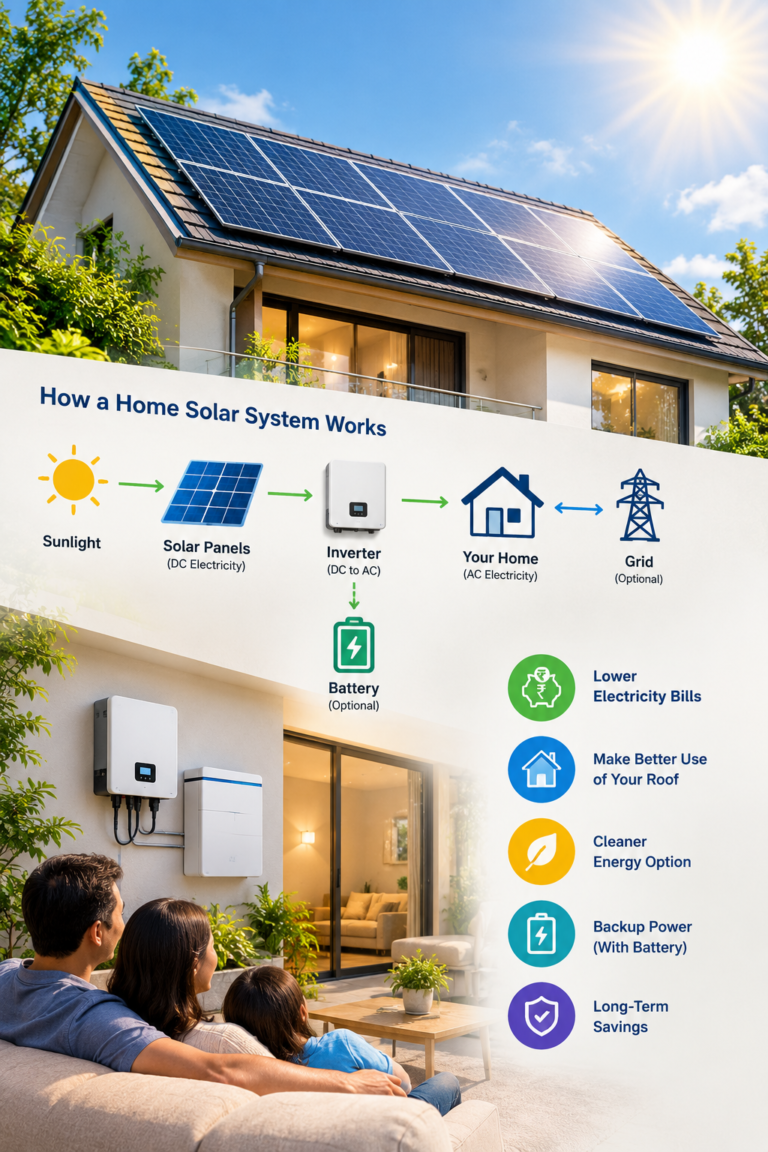
The solar panels convert sunlight into DC electricity. The inverter converts that electricity into AC electricity that can be used by household appliances.
Depending on the system design, electricity can be used directly by the home, stored in batteries or exported to the electricity grid.
How Does a Home Solar System Work?
A typical rooftop solar system works through the following process:
Sunlight → Solar panels → Inverter → Home appliances
For an on-grid system, surplus electricity may be exported to the grid according to the applicable metering arrangement.
For a battery-based system, excess electricity can also be stored for later use, depending on the system design.
The actual generation of a solar system depends on factors such as:
- Location
- Solar irradiation
- Roof orientation and tilt
- Shading
- Panel technology
- System capacity
- Inverter efficiency
- Temperature
- Cable and other system losses
- Maintenance
This is why a professional site assessment is important before deciding the capacity of a home solar system.
Installing solar panels at home can provide several benefits.
Reduce Electricity Bills
Make Use of Your Rooftop
Reduce Dependence on Grid Electricity
Potential Long-Term Savings
Support Cleaner Energy
Possible Backup During Power Cuts
The three main residential solar system configurations are on-grid, off-grid and hybrid.
| Feature | On-Grid Solar | Off-Grid Solar | Hybrid Solar |
|---|---|---|---|
| Connected to electricity grid | Yes | No | Yes |
| Battery | Usually not required | Required | Usually included |
| Backup during power cuts | Generally unavailable | Yes | Yes |
| Main purpose | Reduce electricity costs | Energy independence | Savings + backup |
| Suitable for | Homes with reliable grid supply | Locations with limited/no grid access | Homes requiring backup and grid connection |
On-Grid Solar System
An on-grid solar system is connected to the electricity grid. Solar electricity is used by the home, while surplus generation may be exported to the grid under the applicable metering arrangement.It is generally suitable for homes with a reliable grid connection where reducing electricity purchases is the primary objective.
Off-Grid Solar System
An off-grid solar system operates independently of the electricity grid and normally uses battery storage to supply electricity when solar generation is unavailable.It can be considered for locations where grid electricity is unavailable, unreliable or unsuitable.
Hybrid Solar System
A hybrid solar system combines solar generation, grid connectivity and battery storage.It can be suitable for homeowners who want to reduce electricity consumption from the grid while also having backup power for selected loads or essential appliances.
The number of solar panels required depends on the total system capacity and the wattage of the selected panels.
For example, a system using higher-wattage panels will require fewer panels than a system of the same capacity using lower-wattage panels.
The correct solar capacity should not be selected from your monthly bill alone. A professional assessment should also consider:
- Electricity consumption
- Seasonal consumption patterns
- Daytime electricity usage
- Roof size
- Roof orientation
- Shading
- Available installation area
- Desired savings
- Backup requirements
- Local grid and DISCOM requirements
Example Residential System Sizes
| Solar capacity | Typical consideration |
|---|---|
| 1 kW | Lower household electricity consumption |
| 2 kW | Small to moderate household consumption |
| 3 kW | Moderate residential electricity consumption |
| 5 kW | Higher household consumption |
| 10 kW | Large homes or higher electricity requirements |
These are general planning categories, not a recommendation for every household.
How Much Does Solar for a Home Cost in India?
The cost of a home solar system depends on several factors, including:
- System capacity
- Solar panel technology
- Inverter type and capacity
- Mounting structure
- Roof type
- Electrical work
- Installation conditions
- Battery capacity, if required
- Metering requirements
- Location
- Applicable taxes and other project costs
Home Solar System Price and Subsidy
| Solar System Capacity | Total Project Cost | Government Subsidy* | Effective Cost After Subsidy* |
|---|---|---|---|
| 1 kW | ₹83,000 | ₹30,000 | ₹57,720 |
| 2 kW | ₹1,44,000 | ₹60,000 | ₹88,720 |
| 3 kW | ₹2,05,400 | ₹78,000 | ₹1,32,120 |
| 5 kW | ₹3,24,500 | ₹78,000 | ₹2,51,220 |
| 10 kW | ₹6,49,000 | ₹78,000 | ₹5,72,720 |
Subsidy eligibility and amounts depend on current government scheme rules and approved system capacity. Prices are indicative and should be confirmed before purchase.
Eligible residential electricity consumers may receive central financial assistance under the PM Surya Ghar: Muft Bijli Yojana, subject to the scheme’s eligibility requirements and applicable government guidelines.
The central financial assistance announced for residential rooftop solar is:
- ₹30,000 per kW for the first 2 kW
- ₹18,000 per additional kW from 2 kW to 3 kW
- Maximum central financial assistance of ₹78,000 for systems above 3 kW
The applicable scheme rules, eligibility, application process and implementation arrangements should always be checked against the latest official government information.
⏳ Subsidy scheme period ends 31 March 2027
How Much Can You Save With Solar Energy at Home?
Solar savings depend on your electricity consumption, tariff, solar capacity, system generation, self-consumption, export arrangements and system performance.
A simple way to understand the potential benefit is:
Solar generation × value of electricity offset = potential electricity-cost savings
However, actual savings can differ significantly between households.
For example, a home with high daytime electricity consumption may use more solar generation directly, while a home with mostly nighttime consumption may have different requirements depending on its metering arrangement and whether battery storage is installed.
Factors That Affect Solar Savings
- Monthly electricity consumption
- Electricity tariff
- Solar-system size
- Solar irradiation
- Roof shading
- Household usage pattern
- Net-metering/export rules
- System efficiency
- Maintenance
- Future electricity-price changes
Natural Power can assess your electricity consumption and site conditions to estimate an appropriate system size and potential savings.
The roof area required depends on the number, dimensions and layout of the selected solar panels as well as the required system capacity.
A professional site survey should consider:
- Usable roof area
- Panel orientation
- Roof structure
- Shading
- Access pathways
- Equipment location
- Maintenance access
- Safety clearances
Not every part of a rooftop is suitable for solar-panel installation.
Trees, neighbouring buildings, water tanks, parapet walls and other structures can cause shading and reduce generation.
How Much Can You Save With Solar Energy at Home?
A typical residential solar project follows several stages.
1. Electricity-Bill Assessment
2. Site Survey
3. System Design
4. Proposal and Quotation
5. Approvals and Documentation
6. Installation
7. Testing and Commissioning
8. Monitoring and After-Sales Support
How Long Do Solar Panels Last?
Solar panels are designed for long-term operation, but their performance gradually changes over time.
Actual system life depends on:
- Panel quality
- Installation quality
- Environmental conditions
- Maintenance
- Inverter and component replacement
- Operating conditions
When evaluating a solar system, don’t look only at the initial price. Compare component warranties, expected performance, installation quality, service support and the overall value of the system.
Solar systems generally require limited routine maintenance, but regular inspection helps maintain performance and identify potential problems.
Maintenance may include:
- Cleaning panels when required
- Inspecting cables and electrical connections
- Checking inverter operation
- Monitoring system generation
- Inspecting mounting structures
- Checking for shading changes
- Addressing faults or alarms
The appropriate cleaning and maintenance schedule depends on the local environment and site conditions.
Solar may be worth considering if:
- You have a suitable rooftop
- Your home has regular electricity consumption
- Your roof receives adequate sunlight
- You expect to occupy the property for several years
- You want to reduce electricity purchases from the grid
A solar assessment is particularly important if your roof has significant shading, limited space, structural concerns or unusual electrical requirements.
- System Capacity:Choose capacity based on actual electricity consumption and site conditions.
- Solar Panel Quality:Compare panel technology, manufacturer warranty, performance characteristics and suitability for your location.
- Inverter:The inverter is a critical component of the system. Compare efficiency, warranty, monitoring capabilities and compatibility with the planned system.
- Installation Quality:A well-designed installation should consider structural safety, electrical protection, cable routing, waterproofing and maintenance access.
- Battery Requirement:If backup power is important, determine which appliances need backup and for how long before choosing battery capacity.
- After-Sales Support:Ask about warranty support, maintenance, monitoring and service response.
- Total Project Value:The cheapest quotation is not necessarily the best solar system. Compare equipment, installation, warranties, expected performance and service support.
Natural Power brings experience in solar project development and installation to residential solar requirements.
Instead of choosing a system based only on a standard package, homeowners should receive a solution based on their actual electricity consumption, roof conditions, system requirements and budget.
Our residential solar process can include:
- Electricity-consumption assessment
- Rooftop/site assessment
- System design
- Equipment selection
- Installation
- Commissioning
- Documentation support
- After-sales service
READY TO GO SOLAR?
Frequently Asked Questions About Solar for Home
Is solar energy suitable for every home?
How many solar panels does a home need?
What is the best solar system for a home?
Do solar panels work during a power cut?
Is a battery necessary for home solar?
How much does a home solar system cost?
Is solar subsidy available for homeowners?
How long does solar installation take?
How much can solar reduce my electricity bill?
How should I start if I want solar for my home?
Get a Solar Assessment for Your Home
Thinking about installing solar panels at your home?
Natural Power can help assess your electricity consumption and rooftop conditions and recommend a suitable residential solar solution.
Request Your Home Solar Assessment
Share:
- Monthly electricity bill
- Location
- Roof type
- Approximate roof area
- Backup requirement
- Preferred system size, if known